Three Years Is the Validity. Here’s What the Research Says About Month Three.
Written by Stephanie Austin — Owner & Lead Trainer, Prima Cura Training | Last reviewed: June 2026 | Next review: June 2027
Three Years Is the Validity. Here’s What the Research Says About Month Three
There’s a pattern I see in almost every refresher session I deliver. The learners arrive. I ask them to walk me through the primary survey. And the room goes quiet in a very specific way, not the blank silence of people who never knew it, but the searching silence of people who know they know it, but can’t quite find it.
Most get there eventually. They can name the steps. But when I ask them to explain how those steps form a logical sequence, why each one leads to the next, and what it tells you about the casualty, far fewer can do it. The steps have stayed. The reasoning that gives them structure hasn’t.
That’s not a failure on their part. It’s exactly what the research predicts. And it’s exactly what regular refresher training is designed to address.
What the Research Actually Shows
The evidence on CPR and first aid skill retention is consistent, and it makes uncomfortable reading if your organisation treats a three-year certificate as proof of ongoing competence.
The evidence on CPR and first aid skill retention is consistent, and it makes uncomfortable reading if an organisation treats a three-year certificate as proof of ongoing practical competence.
In the UK, the Health and Safety Executive states that workplace first aid certificates last for three years, but it also strongly recommends that first-aiders complete annual refresher training to help keep their basic skills up to date. That distinction matters. A valid certificate shows that someone has completed the required training and assessment, but it does not mean their practical skills remain sharp for the full three-year period.
UK-focused evidence reviews support this concern. A GMC literature review on skills fade found that life support knowledge and skills decline over time, with evidence of decay at six and twelve months, and practical skills often fade faster than knowledge. The same review also references UK research by Woollard and colleagues, which found that refresher training improved AED and CPR skills and confidence at six and twelve months, while skills declined over time without interval refreshers.
International workplace research points in the same direction. A study of 257 workplace first responders found deterioration in some first aid and CPR skills much earlier, with compression performance showing decline from as early as 30 days after training. While this study was not UK-based, it adds weight to the wider concern: first aid is a practical skill, and practical skills fade when they are not refreshed.
So, the issue is not whether a three-year certificate is valid. It is. The issue is whether employers should rely on certificate validity alone as proof that first aiders remain confident, current and practically ready to respond.

First Aid Skill Decay: What the research shows. Physical skills decline significantly faster than theoretical knowledge, the most dangerous gap is confidence to act.
The Two Types of Forgetting
There’s an important distinction here, because forgetting your first aid training isn’t one thing. It’s at least two.
The first is physical skill decay. Compression depth, rate, hand placement, and airway positioning. These are psychomotor skills that depend on muscle memory. They are built through repetition. Without it, they degrade. The rate at which they degrade is faster than most people assume, and significantly faster than a three-year certificate cycle would suggest.
The second is structural knowledge loss. This is the one I observe most directly. The individual steps of the primary survey are often retained at a surface level. What goes is the understanding of why the steps are ordered the way they are, the flow chart logic that turns a list of actions into a decision-making process.
The primary survey is not a checklist to be ticked. It is a sequence of assessments, each of which informs the next. Danger before response (because you cannot help someone if you become a second casualty), etc.
When the logic is understood, the steps are robust under pressure. When the steps exist without the logic, they collapse the moment something in front of you doesn’t match the training scenario.
| From the training room – Carl Goulding, First Aid Trainer, Prima Cura Training: “A high proportion of learners who come back for refresher training can’t recall the primary survey accurately. And of those who can recall the steps, far fewer can explain why the sequence works the way it does. The steps have survived. The reasoning behind them hasn’t. That gap is exactly what we close in a refresher, not by re-lecturing, but by running scenarios that force the learner to work out the logic for themselves.” |
The Problem That Wasn’t There Fifteen Years Ago
There is a third kind of forgetting that sits alongside the other two, and it’s grown substantially in recent years. It’s not exactly forgetting. It’s the active replacement of correct knowledge with something that feels more authoritative in the moment.
Social media has changed the information environment that first aiders operate in between courses. A viral video claiming certain CPR techniques are harmful. A forum post insisting you check for a pulse before starting compressions. A reel demonstrating a technique that looks confident and is wrong. Some of this content is well-intentioned and inaccurate. Some of it is straightforwardly dangerous.
What I see in the training room is that these fragments stick. Not because people are gullible, but because information encountered casually, scrolling on a phone or half-watching a video, gets processed differently from formal training. It doesn’t feel like it’s overriding anything. It just gradually occupies the same space.
The result: learners arrive for refresher training holding a mixture of correct knowledge from their course, partially remembered knowledge from the years between, and confident misinformation they haven’t had reason to question.
| Common myths I encounter in the training room in 2026: “You need to check for a pulse before starting CPR.” Not current guidance. Pulse checks are unreliable under stress. Unresponsive and not breathing normally: start CPR. “You can make it worse by doing it wrong.” The RCUK 2025 guidelines are explicit: the risk of harm from attempting CPR on someone not in cardiac arrest is low. Inaction is the greater risk. “Good CPR looks smooth and controlled.” Effective CPR is hard physical work. Adequate compression depth requires real force. Many people hold back, unaware that their compressions aren’t deep enough. |
“What If I Get It Wrong?”
This question comes up more often than it did five years ago. Not from indifferent people but from people who genuinely want to help but have absorbed, from the same misinformation environment, a fear that trying and getting something wrong will result in personal consequences.
The legal position is worth stating directly. The Social Action, Responsibility and Heroism Act 2015 provides that courts must have regard to the fact that a person was acting for the benefit of others when considering any claim against them. It doesn’t create blanket immunity. But it establishes clearly that the law recognises and protects people who respond in good faith.
There is no documented case in England and Wales of a lay first aider being successfully sued for causing harm while acting in good faith to assist someone in a genuine emergency. The fear is understandable. It is not evidence-based.
In training, I give learners the space to ask this question directly, then work through the logic with them. Because fear of consequences is often the specific thing sitting between a person and the moment they step forward. Address it clearly, and the training is more likely to activate when it actually counts.
What a Good Refresher Session Actually Does
A refresher is not a repetition of the original course. Or it shouldn’t be. The people in the room have encountered the material before. Some of it has held, some has faded, some has been quietly overwritten. The job is different from the job of initial training.
At Prima Cura, every refresher session is scenario-led. Learners are given situations and prompts and asked to reason their way to the right response. When a myth surfaces, we work through why it doesn’t apply – the physiology, the guideline, the logic. Not just the correction.
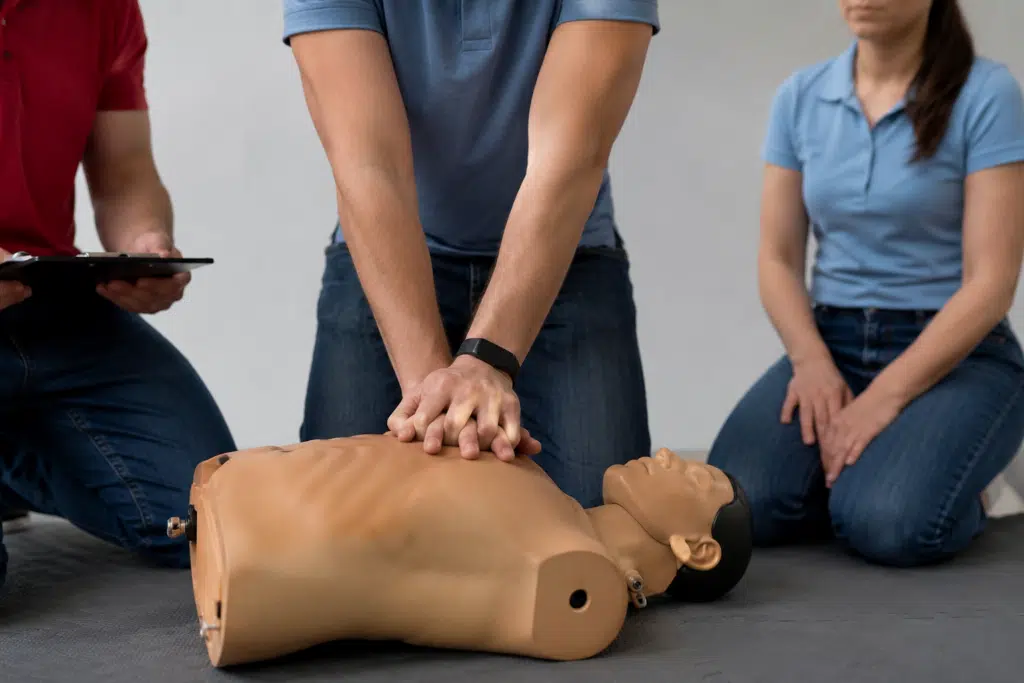
Hands-on manikin time matters. The physical confidence that comes from correct compression, knowing what adequate depth actually feels like, cannot be maintained through theory alone.
| What’s covered in our Basic Life Support and AED annual refresher: Primary survey: sequence and flow logic, not just step recall. Hands-on CPR practice with direct feedback on depth, rate, and recoil. AED practice using a training device: pads on, prompts followed. Common myths addressed directly, with reasoning: not just correction. RCUK 2025 guideline changes explained and applied. Scenario-based learning is built around your specific workplace context. Three hours. At your venue. Up to 12 learners. Aligned with the RCUK 2025 Guidelines. |
When Did Your Team Last Put Their Hands on a Manikin?
If the answer is “when they did the course”, and the course was more than a year ago, it’s time for a refresher. Not because the certificate has lapsed. Because the skill and the confidence that make a certificate meaningful need to be maintained.
CPR & AED Awareness Week runs until 7 June 2026. Any training booked with Prima Cura this week comes with 10 per cent off.
| CPR & AED Awareness Week Exclusive Offer 10% off any course booked 1–7 June 2026. Give us a call or send a message. We’ll tell you what we think your team actually needs. 0333 999 8783 info@primacuratraining.co.uk primacuratraining.co.uk Engage. Educate. Empower. |
The information in this blog post is provided for general awareness and educational purposes only and does not constitute medical or legal advice. Research cited is sourced from peer-reviewed publications and the Canadian Standards Association’s 2024 review of CPR skills retention. Skill decay statistics represent general research findings; individual retention varies. Guidance on CPR and first aid is based on the Resuscitation Council UK Adult Basic Life Support Guidelines 2025. Information regarding the Social Action, Responsibility and Heroism Act 2015 is provided as general educational context only and does not constitute legal advice. In a medical emergency, always call 999 immediately. Prima Cura Training strongly recommends attending accredited, face-to-face training to develop and maintain first aid skills.