Children Are Not Small Adults: What the 2025 Guidelines Changed, and What Everyone Needs to Know
Written by Stephanie Austin — Owner & Lead Trainer, Prima Cura Training | Last reviewed: June 2026 | Next review: June 2027
Children Are Not Small Adults: What the 2025 Guidelines Changed, and What Everyone Needs to Know
Paediatric cardiac arrest is rare. That’s not a reason for complacency; it’s a reason to be specific. When something goes wrong with a child, the emotional stakes are immediately different, and the clinical picture is different too. Understanding why helps you respond correctly rather than falling back on half-remembered adult CPR.
The Resuscitation Council UK Paediatric Life Support Guidelines 2025 were published in October 2025 and contain several changes that anyone responsible for children should know about. The age category definitions have changed. The approach for untrained bystanders has been clarified. And the guidance on AED use in children has been updated.
This blog covers the key differences between paediatric and adult CPR, what the 2025 guidelines say, and what schools and early years settings are legally required to have in place. It is not a substitute for hands-on training. But it will give you a clear picture of what to expect and why it matters.
Why Children Are Different: It Usually Starts With Breathing
The most important difference between paediatric and adult cardiac arrest is not the size of the patient. It’s the cause.
In adults, cardiac arrest is most commonly caused by a sudden cardiac event. In children, cardiac arrest is most commonly the endpoint of a deteriorating situation: respiratory failure, airway obstruction, or circulatory collapse that has not been recognised and treated in time.
This changes everything about how you respond. For adults, early defibrillation is a critical priority because the underlying cause is often electrical. For children, oxygenation (getting air into the lungs) is the critical priority. Which is why paediatric CPR starts with rescue breaths before compressions, and why a trained rescuer uses a different ratio.
Recognising a deteriorating child before cardiac arrest happens is, according to the RCUK 2025 guidelines, the best way to prevent paediatric cardiac arrest altogether. The guidelines introduce a quick-look recognition tool called the BBB tool, Behaviour, Breathing, and Body colour, for assessing whether a child needs urgent medical attention.
| The BBB Recognition Tool (RCUK 2025): Behaviour: Is the child difficult to rouse, floppy, rigid, having a seizure, confused, or crying inconsolably? Unable to move a limb, or unable to speak or walk when previously able to do so? Breathing: Is the child breathing too fast or too slowly? Working hard to breathe? Making unusual noises when breathing? Unable to take a deep breath? Body colour: Is the child’s skin pale, mottled, cyanosed (bluish), or greyish? Check palms, soles, and mucous membranes, especially in children with darker skin tones. If yes to any of the above: call 999 immediately. Do not wait to see if the child improves. |
The Age Categories Have Changed in 2025
This is one of the most practically important updates in the RCUK 2025 Paediatric Life Support Guidelines, and one that has not been widely publicised.
Under the 2025 guidelines, the age categories are:
- Infant: birth to 1 year
- Child: 1 to 12 years
- Adolescent: 13 to 18 years
The significance is that the CPR technique and approach vary between these groups. An adolescent of 14 should, by default, receive adult BLS. An 11-year-old is a child by this definition, not an adolescent. If you are unsure whether someone is an adult or a child. In teenagers, this can genuinely be unclear; the guidelines are practical about it: use the adult algorithm. If a person is mistakenly resuscitated using the paediatric algorithm, the guidelines note that little or no harm will result. When in doubt, act. Don’t spend time deciding.
What’s Actually Different: The Key Changes in Technique
1. Five rescue breaths come first.
Before starting chest compressions in a child of any age, a trained rescuer gives five initial rescue breaths. This is because the most likely cause of arrest is respiratory. Getting oxygen into the lungs is the priority before starting compressions. This is a fundamental difference from adult BLS, where compression-only CPR is an acceptable approach for untrained bystanders.
For ambulance call handlers working with untrained bystanders, the 2025 RCUK guidelines specifically state they should encourage both rescue breaths and compressions for children of all ages, using a 30:2 ratio for untrained rescuers.
2. Compression ratio: 15:2 for trained rescuers.
A rescuer specifically trained in paediatric basic life support uses 15 compressions to 2 rescue breaths. This is different from the adult ratio of 30:2. If you are only trained in adult BLS and have not had paediatric-specific training, the guidelines allow for 30:2.
3. Compression depth is proportional, not fixed.
For infants and children, the compression depth should be at least one-third of the anteroposterior depth of the chest. For adolescents (13 to 18 years), the adult depth of 5 to 6 cm applies. The depth should never exceed 6 cm in any age group.
4. Technique varies by age.
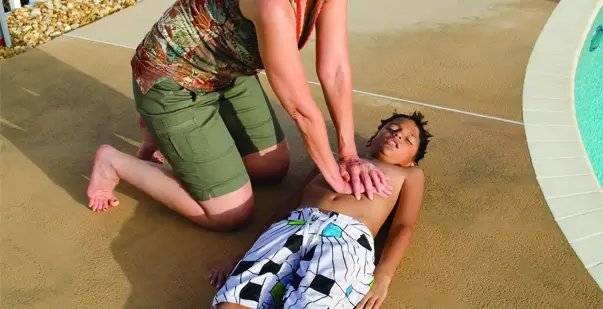
For infants, the recommended technique is the two-thumb encircling method (both thumbs on the lower sternum, fingers wrapped around the chest). For children aged 1 to 12, one or two hands are used depending on the size of the child. For adolescents, the adult two-handed technique applies.
5. Head position matters and changes with age.
Infants need a neutral head position – only a very slight tilt, with two fingers lifting the chin bone without pressing on soft tissues. Older children need more tilt. Adolescents need the same full extension as adults. Over-tilting an infant’s head can actually obstruct the airway rather than open it.

Paediatric CPR: key differences by age group. Based on RCUK Paediatric Life Support Guidelines 2025.
AEDs in Children: Use One
The RCUK 2025 guidelines are clear: use an AED on children of all ages. Follow the voice prompts.
Where available, activate the paediatric mode on the AED for any child weighing less than approximately 25kg (roughly eight years of age and under). Paediatric mode delivers a lower energy dose appropriate for a smaller body. If the AED does not have a paediatric mode, use it in standard adult mode; the alternative is not using it at all, which is always the worst option.
Pad placement varies by size. For smaller children and infants (under 25kg), the anteroposterior position is used. One pad on the front of the chest to the left of the breastbone, the other on the middle of the back between the shoulder blades. For larger children and adolescents, the standard anterolateral position (as in adults) is used, avoiding breast tissue in adolescents.
If only adult-size pads are available and no paediatric pads are present, use the adult pads in the anteroposterior position; one on the front, one on the back, ensuring they do not touch each other.
If You Have No Training: Three Steps
The RCUK 2025 guidelines include clear guidance for untrained bystanders. If you encounter a child who appears to be unresponsive and you have no paediatric first aid training:
- Check: Is the child responding to your voice or touch?
- Call: 999 immediately if they do not respond. Put the phone on speaker. Follow the call handler’s instructions.
- CPR: Start CPR following the dispatcher’s guidance. They will tell you what to do and how to do it.
The call handler will guide you through compressions and rescue breaths. You do not need to know the ratio before you dial. Call first. The ambulance service is trained to support untrained bystanders through the process.
Schools, Nurseries, and Early Years Settings: What the Law Requires
For settings covered by the Early Years Foundation Stage (EYFS) statutory framework, paediatric first aid requirements are set by the Department for Education and have been updated from 1 September 2025.
The updated EYFS statutory framework (September 2025) requires:
- At least one person with a current full Paediatric First Aid (PFA) certificate must be on the premises at all times when children are present
- A PFA-qualified person must accompany children on all outings
- The full PFA qualification must meet EYFS criteria. Typically, a minimum of 12 hours across two days
- PFA certificates must be renewed every three years
- From September 2025, students on long-term placements and volunteers (aged 17 and over) and apprentices in early years settings (aged 16 and over) must also hold a valid PFA certificate if they are to be counted in staff-to-child ratios
An Emergency Paediatric First Aid (EPFA) qualification does not, on its own, satisfy the requirement for the designated first aider on site. It is an appropriate training level for supporting staff and volunteers who do not need to count in ratios.
Ofsted inspections are now expected to look closely at PFA certificate validity and coverage. A lapsed or missing certificate can result in a safeguarding concern being raised, and potentially an inadequate rating for that element of the inspection.
| For schools outside the EYFS framework: Primary and secondary schools are covered by the Health and Safety (First-Aid) Regulations 1981. Paediatric-specific first aid training is strongly recommended and reflects best practice, but the EYFS requirements above apply specifically to early years registered provision. Maintained schools should refer to HSE school first aid guidance and ensure their needs assessment reflects the age group of pupils on site. |
Paediatric First Aid Training With Prima Cura
Prima Cura delivers paediatric first aid training for early years settings, schools, community organisations, sports clubs, and any organisation or individual working with children. All content is aligned with the RCUK 2025 Paediatric Life Support Guidelines and meets EYFS statutory requirements for registered early years providers.
Before every session, we ask about your setting, the ages of the children you work with, your environment, and your specific concerns. The training reflects your actual context, not a generic scenario. And as always, every learner gets hands-on time, not just theory.
| CPR & AED Awareness Week Exclusive Offer 10% off any course booked 1–7 June 2026 Enquiries welcome for all paediatric first aid training, EYFS compliance packages, and school first aid review. Give us a call or drop us a message. 0333 999 8783 info@primacuratraining.co.uk primacuratraining.co.uk Engage. Educate. Empower. |
The information in this blog post is provided for general awareness and educational purposes only. It is based on the Resuscitation Council UK Paediatric Life Support Guidelines 2025, published October 2025, and does not constitute medical advice. It is not a substitute for formal, accredited paediatric first aid training. Paediatric CPR involves physical skills that require hands-on practice and direct feedback from a qualified trainer to develop competence. Age categories, techniques, and guidance referenced in this post are based on RCUK 2025 guidelines current at the time of publication. EYFS statutory framework information is based on the Department for Education’s updated framework, effective 1 September 2025; early years providers should refer to the current statutory framework and DfE guidance for their specific obligations. This post does not constitute legal advice. In a medical emergency involving a child, call 999 immediately and follow the instructions of the ambulance service call handler.