Nobody Jumps Six Feet in the Air: The AED Myths I Hear Every Single Training Day
Written by Stephanie Austin — Owner & Lead Trainer, Prima Cura Training | Last reviewed: June 2026 | Next review: June 2027
Nobody Jumps Six Feet in the Air: The AED Myths I Hear Every Single Training Day
A learner in one of my recent sessions, a care worker with over a decade of experience, told me she’d been informed at a previous workplace that she wasn’t allowed to use the AED without specific training. So she hadn’t. Not once. Not even in practice. She’d walked past that cabinet every day for years, convinced it wasn’t for her.
She’s not alone. It comes up regularly. And it’s wrong.
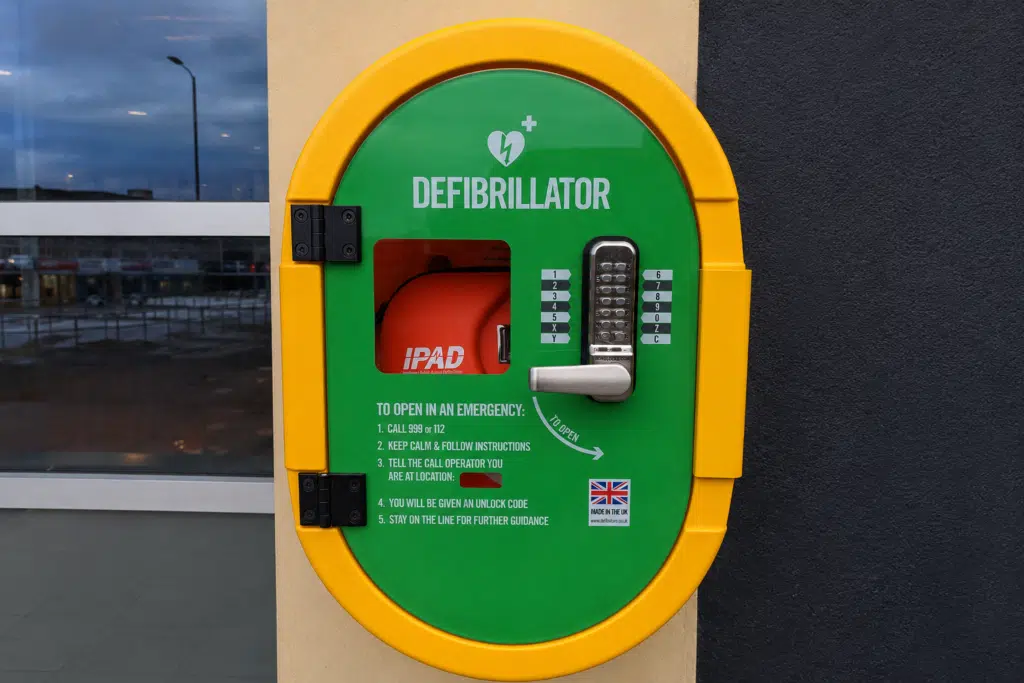
AEDs sit in cabinets in shopping centres, train stations, leisure centres, offices, and community spaces across the UK. Some of those cabinets never get opened in a real emergency — not because there’s no one there, but because the people nearby don’t think they’re the right person to open one.
So here are the myths. And the facts, straight from the Resuscitation Council UK 2025 Adult Basic Life Support Guidelines.
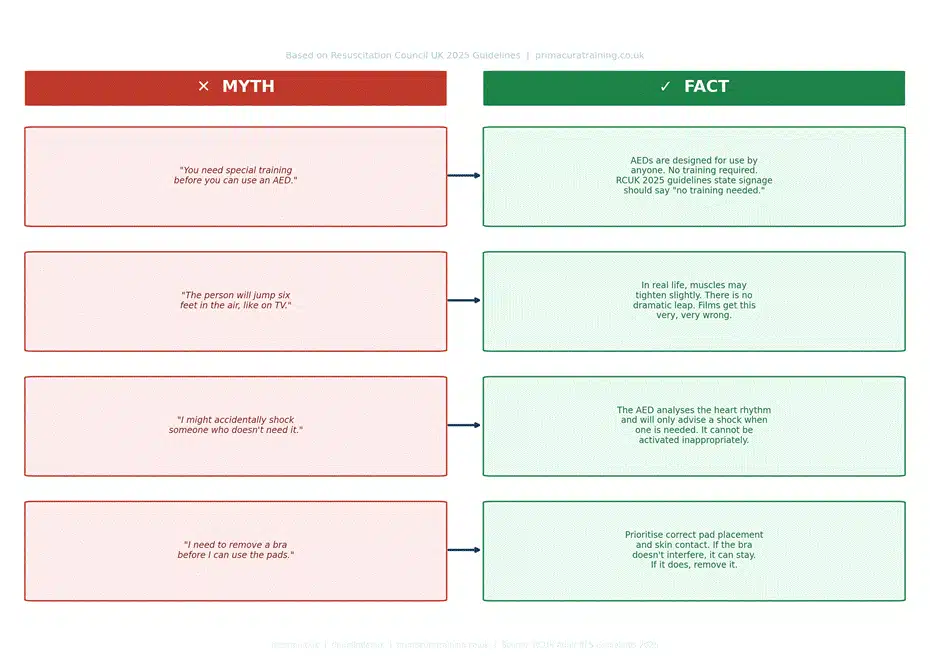
AED myths vs facts — based on Resuscitation Council UK 2025 Guidelines.
Myth 1: “You Need Training to Use an AED”
| ✕ MYTH “I haven’t been trained on the AED, so I can’t use it.” | ✓ FACT: Anyone can use an AED. The 2025 RCUK guidelines explicitly state that AED signage should say “no training needed.” The device talks you through every step. |
This is the one that frustrates me most, because it directly contradicts what the guidelines say, and it’s being passed on in workplaces by people who genuinely think they’re helping.
The 2025 RCUK Adult Basic Life Support Guidelines are unambiguous on this point: anyone can use an AED. The signage on AED cabinets should state that no training is required. The device itself will guide you through every step with clear voice prompts and visual instructions.
Could training make you more confident? Yes. Absolutely. That’s what a Basic Life Support and AED course is for. It gives you hands-on practice so you’re not fumbling with the device for the first time when it counts. But the absence of training is not a reason to leave an AED in its cabinet while someone is dying nearby.
| RCUK 2025 Guidelines state: “AED signage should include a statement that no training is needed to use an AED.” “Anyone can use an Automated External Defibrillator (AED).” Source: Resuscitation Council UK Adult Basic Life Support Guidelines, October 2025 |
Myth 2: “They’ll Jump Six Feet in the Air Like in the Films”
| ✕ MYTH “I’ve seen it on TV. The person flies off the bed. I don’t want to do that to someone.” | ✓ FACT Muscles may tighten slightly when a shock is delivered. The dramatic leap you’ve seen in films and TV dramas is not what happens. Films get this badly, repeatedly wrong. |
I understand exactly where this one comes from. Television has a lot to answer for when it comes to CPR and defibrillation. The dramatic chest-heave, the body lifting off the surface, the person waking up immediately, none of that reflects what actually happens.
When an AED delivers a shock, there may be a visible muscle contraction, and the person may stiffen or twitch slightly. That’s it. There is no dramatic leap. There is no arc of electricity visible to the naked eye. And the person does not immediately open their eyes and say thank you.
What matters is what comes next: you restart chest compressions immediately after the shock, regardless of whether it appeared to work. The AED will tell you when to pause for rhythm analysis. You follow the prompts.
The film version of defibrillation also, incidentally, tends to use it in situations where it wouldn’t be indicated – delivering shocks to flatlining patients, for example. AEDs don’t work that way. They analyse the rhythm. If the rhythm isn’t shockable, no shock is delivered.
Myth 3: “What If I Accidentally Shock Someone Who Doesn’t Need It?”
| ✕ MYTH “What if their heart is fine and I shock them? Could I stop a healthy heart?” | ✓ FACT An AED analyses the heart rhythm before advising a shock. It will only recommend a shock if the rhythm is shockable. It cannot be triggered accidentally. The shock button does nothing unless the AED determines it is appropriate. |
This is a reasonable fear, and I never dismiss it when it comes up in training. The idea that you might accidentally cause harm to someone with a healthy heart is understandable. But it’s also not how AEDs work.
An AED analyses the electrical activity in the heart before it does anything else. If the rhythm it detects is not shockable – for example, if the person has fainted but their heart is functioning normally -the device will tell you no shock is advised and instruct you to continue CPR. Pressing the shock button in that scenario does nothing.
The RCUK 2025 guidelines are direct: the risk of harm from using an AED on someone not in cardiac arrest is low. The risk of not using one when cardiac arrest is present is not low.
| From the RCUK 2025 Adult BLS Guidelines: “Lay people should start CPR for presumed cardiac arrest without concerns about harm to people not in cardiac arrest. The risk of harm from CPR is low.” “The risk of harm to rescuers from accidental shock during AED use is low.” |
Myth 4: “I Have to Fully Remove a Bra Before I Can Use the Pads”
| ✕ MYTH “I wouldn’t know what to do if the person were a woman. Do I have to remove clothing? What if I can’t?” | ✓ FACT Prioritise correct pad placement and skin contact. If pad placement can be achieved without removing the bra, it can stay. If the bra interferes with placing the pads correctly, remove it. Don’t let this question cause you to hesitate. |
This comes up a lot, usually quietly, at the end of a session, or as a private question. People don’t want to say it out loud, but they’re genuinely uncertain, and that uncertainty can translate to hesitation at exactly the wrong moment.
The RCUK 2025 guidance is clear and practical: the priority is correct pad placement with skin contact. If the bra doesn’t physically prevent you from placing the pads in the right position, it can remain in place. If it does interfere — and some bra designs will — then it needs to come off. The guidelines specifically note that rescuers should not be concerned about exposing the chest to apply pads, and should prioritise the life-saving intervention.
What does correct pad placement look like?
| Standard pad placement — male (left) and female (right). Right pad: upper right chest below collarbone. Left pad: lower left side of chest. | Pad placement with bra in situ: acceptable when pads achieve correct position and skin contact without interference. |
The right pad goes on the upper right chest, just below the collarbone. The left pad goes on the lower left side of the chest, roughly where the bottom of the ribs meets the side. The AED pads themselves show diagrams; follow them.
A few practical points on this:
- If there is a second rescuer present, one person continues CPR while the other places the pads. Don’t stop compressions to deal with clothing if you can avoid it.
- Wire underwiring in a bra is not a contraindication to pad placement
- Wet clothing or skin. Dry the chest if possible before placing the pads. Moisture reduces the effectiveness of the shock.
- Body hair. Most modern AEDs include a razor in the kit for exactly this reason. A firm press and quick removal of the pad will take some hair with it if needed.
How to Find Your Nearest AED Right Now
AEDs are registered on The Circuit, the national AED database used by 999 call handlers during emergencies. When you call 999, the ambulance service can direct you to the nearest registered AED.
You can also search for your nearest device directly at Defib Finder, a public-facing map of registered AEDs across the UK. It’s worth doing this for your workplace, your home area, and anywhere you spend significant time.
As of mid-2025, over 108,000 AEDs were registered on The Circuit. Not all AEDs in the country are registered, which is why any business or community organisation that has a device should register it.
| Does your workplace AED need registering? If your organisation has an AED that isn’t on The Circuit, it won’t show up when a 999 call handler is looking for the nearest device. Registration is free and takes minutes. Go to thecircuit.uk to register yours. |
For Businesses and Organisations: What the Guidelines Say About AED Placement
The RCUK 2025 guidelines set clear expectations for how AEDs should be deployed in public and workplace settings:
- AED cabinets should be unlocked and accessible 24 hours a day, seven days a week.
- Locations should be clearly sign-posted, with signage stating that no training is needed to use the device.
- High foot-traffic locations (airports, shopping centres, stations) should have on-site AEDs in accessible positions.
- All devices should be registered with The Circuit.
If your business has an AED, it’s worth checking: is it in a locked cabinet? Is the signage clear? Is it registered? These aren’t bureaucratic questions; they directly determine whether it gets used if it’s ever needed.
Train With an AED, Not Just Near One
Having an AED on your premises is a start. Having staff who have actually held one, applied the pads, and followed the prompts on a training device is the difference between readiness and proximity.
Our Basic Life Support and AED course gives your team hands-on practice with a training AED, CPR manikins, and real scenarios built around your setting. Three hours. Up to 12 learners. Delivered at your venue. Fully aligned with the RCUK 2025 guidelines.
| CPR & AED Awareness Week Exclusive Offer 10% off any course or training booked 1–7 June 2026. Give us a call or drop us a message. 0333 999 8783 info@primacuratraining.co.uk primacuratraining.co.uk Engage. Educate. Empower. |
The information in this blog post is provided for general awareness and educational purposes only. It is based on the Resuscitation Council UK Adult Basic Life Support Guidelines 2025 and does not constitute medical advice. It should not be used as a substitute for formal, accredited first aid training. CPR and AED use are physical skills that require hands-on practice and direct feedback from a qualified trainer to develop competence. The pad placement images included in this post are based on current RCUK guidance and are intended as illustrative references only. Prima Cura Training strongly recommends attending accredited, face-to-face training to develop and maintain these skills. In a medical emergency, always call 999 immediately. If you are unsure whether someone is in cardiac arrest, call 999 and follow the instructions of the ambulance service call handler. Content in this post reflects guidance current as of the time of publication. Always refer to the most current RCUK guidelines for clinical guidance.