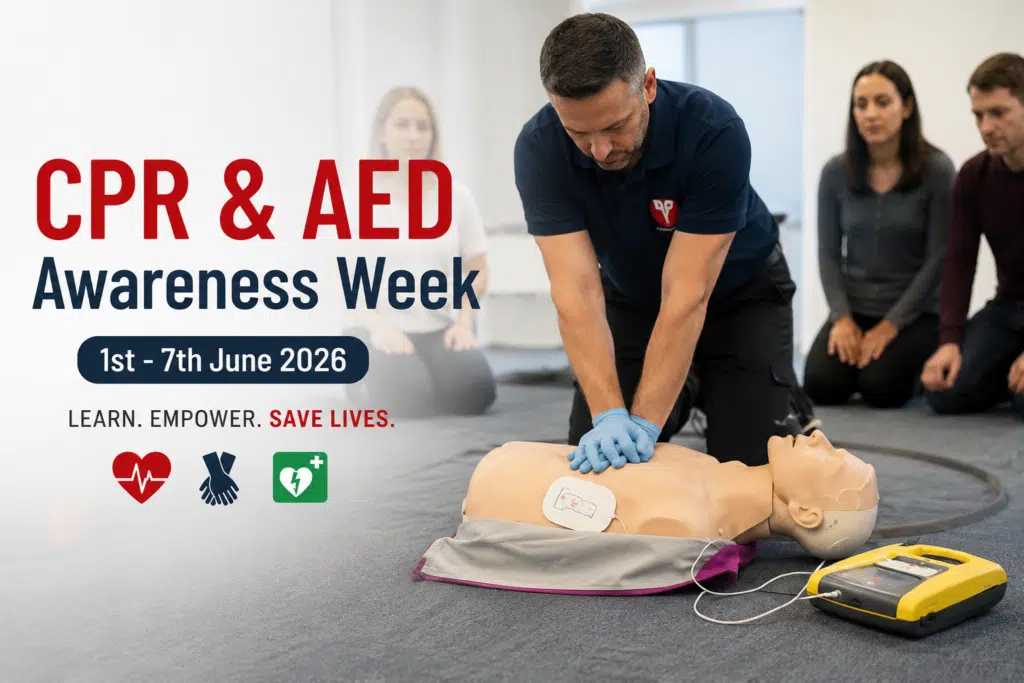
CPR & AED Awareness Week: 1-7 June 2026
Written by Stephanie Austin — Owner & Lead Trainer, Prima Cura Training | Last reviewed: June 2026 | Next review: June 2027
The Training That Saved a Life in a Manchester Car Park
On a Tuesday in November 2023, Kieren Robinson sent a message to his business networking group. Thirteen people hit the heart emoji within minutes.
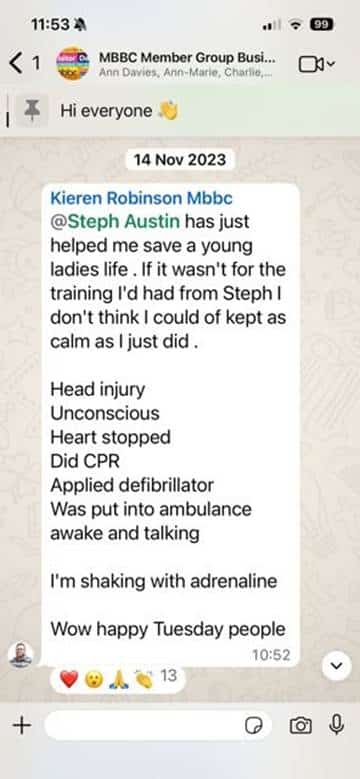
Kieren is a carpenter. He runs BeeSpoke Carpentry here in Manchester. He’s not a paramedic. Not a first responder by trade. Just a tradesman who got his training, remembered it when it counted, and kept a young woman alive in a car park.
That message is the best thing anyone has ever sent me about what I do. And I’ve been delivering first aid training for 15+ years.
CPR & AED Awareness Week: 1-7 June 2026
CPR & AED Awareness Week runs every year at the start of June. The goal is simple: get more people knowing what to do when someone’s heart stops. Because too many people still don’t act when it happens in front of them. They freeze. They’re not sure they’re doing it right. They wait for someone else to step forward.
Kieren didn’t wait. He acted. And she walked out of that ambulance awake and talking.
This week is as good a time as any to ask whether you, your team, or your organisation are genuinely ready to do the same.

What’s Changed: Resuscitation Council UK 2025 Guidelines
The Resuscitation Council UK published updated Adult Basic Life Support guidelines in October 2025. If your training predates them, here’s what you need to know.

Call 999 immediately for any unresponsive person
The guidance has changed on this. Previously, the advice was to confirm abnormal breathing before calling. Not any more. If someone is unresponsive, call 999 without delay. Assess their breathing while you wait for the call to be answered. The ambulance service call handler will assist you if you’re unsure.
Abnormal breathing doesn’t always look the way you’d expect
The 2025 guidelines specifically recognise that in the early stages of cardiac arrest, especially following exercise, a person may display a near-normal or panting breathing pattern rather than the slow, laboured breathing most people associate with the condition. If someone collapses after physical activity and is unresponsive, assume cardiac arrest. Don’t be reassured by breathing that looks almost normal.
The 999 call handler is part of the chain
This has always been true in practice. The 2025 guidelines give it formal weight. Call handlers are trained to recognise cardiac arrest over the phone and will give you CPR instructions while you wait for the ambulance. You don’t need to know everything before you dial. Call first. They’ll guide you through it.
Lay rescuers may need support afterwards
Finding someone in cardiac arrest and attempting resuscitation is, for many people, a traumatic experience. The 2025 guidelines acknowledge this directly and encourage support for bystanders after a cardiac arrest event. If you’ve been through it, that response is completely normal. The Resuscitation Council UK has a dedicated support page for anyone affected.
The core CPR technique hasn’t changed
Compress the centre of the chest at a rate of 100-120 compressions per minute, to a depth of at least 5cm but no more than 6cm. Allow the chest to fully recoil after each compression. If you’ve been trained to give rescue breaths, alternate 30 compressions with 2 breaths. If you haven’t, continuous chest compressions are the right call.

The AED: Anyone Can Use One. Anyone.
One of the things Kieren did, one of the things that almost certainly saved that young woman’s life, was to use the AED.
A lot of people are still nervous about defibrillators. They’ve heard stories about doing it wrong. The Resuscitation Council UK 2025 guidelines are unambiguous: the risk of harm from using an AED on someone not in cardiac arrest is low. The risk of harm from not using one when someone is in cardiac arrest is not low.
Use it. Follow the voice prompts. The machine analyses the heart rhythm and tells you exactly what to do. It won’t shock someone who doesn’t need it.
AEDs across the UK are registered on The Circuit (www.thecircuit.uk), the national AED database maintained in partnership with the British Heart Foundation. You can also use Defib Finder to locate your nearest registered AED. Their locations are available to ambulance dispatchers during a 999 call — they are in shopping centres, train stations, leisure centres, offices, and community spaces.
| CPR & AED Awareness Week Exclusive Offer 10% off any course or training booked 1–7 June 2026 Get in touch to claim your discount: steph@primacuratraining.co.uk | 0333 999 8783 | primacuratraining.co.uk |

CPR Skills Deteriorate. That’s Not an Opinion.
Kieren trained a couple of months before that Tuesday in November. Two months. Not two years. Not “a few years back when I did the course.” Two months.
CPR technique deteriorates without practice. The rate, the depth, the rhythm, the confidence. It fades faster than most people expect, and research consistently backs that up. That’s exactly why the accepted annual refresher exists for Emergency First Aid at Work and First Aid at Work certificate holders. The qualification gets you trained. The refresher keeps you ready.
If your FAW or EFAW certificate is still technically valid but the last time you put your hands on a manikin was the day you sat the course, that gap matters. Not because you’ve forgotten everything, but because the physical confidence that stops you from hesitating in a real emergency needs reinforcing.
Under the Health and Safety (First Aid) Regulations 1981, employers must ensure adequate and appropriate first aid provision, which includes keeping qualified first aiders competent throughout the validity period of their certificate. Annual BLS refresher training is the recognised way to maintain that standard between full requalification cycles.
| Is your team’s BLS competency current? Our Basic Life Support and AED course is the accepted annual refresher for EFAW and FAW certificate holders. Three focused hours. Hands-on CPR and AED practice. All content aligned with the Resuscitation Council UK 2025 guidelines. Delivered at your venue. Maximum 12 learners per trainer. 0333 999 8783 | info@primacuratraining.co.uk |
Training That Sticks, Because It’s Built Around You
What Kieren described in that message, the calm, the sequence, the decision to act without hesitating, that’s what good training produces. Not just knowledge. Readiness.
Before every Prima Cura session, we ask about your setting: your incident reporting procedures, the specific hazards your team faces, and the context they actually work in. On the day, that context shapes the training. If your staff work in a care home, they’re not practising on hypothetical office scenarios. If your team are lone workers, that reality shapes every exercise.
It means the training lands. Because it was built for the people in the room.
A few things that matter to the organisations that book with us:
- 98.9% learner satisfaction across all Prima Cura courses
- All trainers hold Enhanced DBS certificates and maintain ongoing CPD
- We respond to all enquiries within one working day
- We’ll tell you at the enquiry stage if a different course is a better fit, not after you’ve booked
Courses that cover BLS and AED training
| Basic Life Support & AED | Half-day (approx. 3 hours) | Face-to-face | Max 12 learners | CPD accredited. The accepted annual refresher for EFAW and FAW holders. Also right for health and social care staff, education teams, and community organisations. Emergency First Aid at Work (EFAW) | 1-day | Accredited | For lower-risk workplaces. Includes CPR and AED. Valid 3 years with annual BLS refresher recommended. First Aid at Work (FAW) | 3-day | Accredited | For higher-risk workplaces. Includes CPR and AED. Valid 3 years with annual BLS refresher recommended. |
Ready to Book?
CPR & AED Awareness Week runs from 1-7 June 2026. Any training booked with Prima Cura during that window gets 10% off. Not just BLS, any course or training we deliver.
If your team’s BLS skills are overdue for a refresh, give us a call, drop us an email, or fill in the contact form on the website. We’ll sort the rest.
The information in this blog post is provided for general awareness and educational purposes only. It is based on the Resuscitation Council UK Adult Basic Life Support Guidelines 2025 and does not constitute medical advice. It should not be used as a substitute for formal, accredited first aid training. CPR and AED use are physical skills that require hands-on practice and direct feedback from a qualified trainer. Prima Cura Training strongly recommends attending accredited, face-to-face training to develop and maintain these skills. In a medical emergency, always call 999 immediately. If you are unsure whether someone is in cardiac arrest, call 999 and follow the instructions of the ambulance service call handler. If you have been affected by a cardiac arrest event, the Resuscitation Council UK provides dedicated support at resus.org.uk.


