First Aider vs First Responder: What’s the Difference in the UK?
Written by Stephanie Austin – Owner & Lead Trainer, Prima Cura Training
Last reviewed: April 2026 | Next review: April 2027
People use “first aider” and “first responder” as if they mean the same thing. After 15 years of delivering first aid training, I can tell you the confusion comes up in nearly every room I walk into. And it’s worth clearing up, because in the UK, “first responder” actually refers to two completely different things depending on the context.
A first aider: the workplace standard
A first aider is someone who has completed a recognised first aid qualification, typically either a First Aid at Work (FAW) or an Emergency First Aid at Work (EFAW) certificate. These are the qualifications the Health and Safety Executive references under the Health and Safety (First-Aid) Regulations 1981, and they’re what most employers are legally required to have in place.
First aiders are trained to assess a situation, manage a range of injuries and medical emergencies, perform CPR, use an AED, control bleeding, manage an unconscious casualty, and hand over to emergency services when needed. They’re not clinically trained medical professionals. Their job is to provide immediate care until more qualified help arrives.
How many first aiders a business needs, and at what level, depends on a risk assessment of the workplace. A busy construction site has different requirements from a small office. The HSE’s guidance on first aid at work is the starting point for any employer working this out, and the updated L74 guidance (2024) sets out what “adequate and appropriate” provision actually looks like in practice. If you’re unsure which qualification is right for your team, our post on FAW vs EFAW walks through exactly that.
First responder: And here’s where it splits
In the UK, “first responder” isn’t a protected title. Anyone can use it. That matters because it means two very different groups of people operate under that label.
Community First Responders (CFRs)
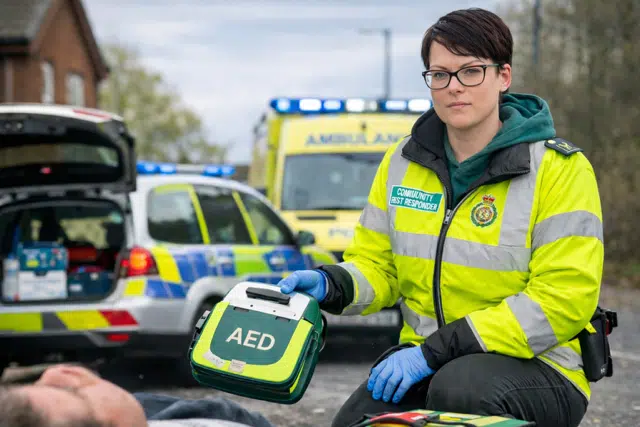
A Community First Responder is a volunteer, dispatched by an NHS ambulance service, trained to attend certain 999 calls in their local area before an ambulance can get there. They’re particularly valuable in rural areas where response times are longer. CFRs are trained in life-saving interventions, including CPR and defibrillation, and they work under the governance of the relevant ambulance trust. They’re not paramedics. But they can make a significant difference in the minutes before one arrives.
CFR schemes are managed by local ambulance services across England. You can see how they operate in practice via services such as Yorkshire Ambulance Service and West Midlands Ambulance Service. Training standards vary between trusts, though many now use the national Level 3 First Responder on Scene (FROS) syllabus.
Pre-hospital / clinical first responders
The second use of “first responder” comes from the event medical and pre-hospital care sector. Here, it describes someone with enhanced clinical training beyond standard first aid, able to deliver interventions such as oxygen therapy, airway management, and trauma care. The Level 3 Award in First Response Emergency Care (FREC 3) is the leading regulated qualification in this space, updated and re-launched in June 2025. It’s endorsed by the Royal College of Surgeons of Edinburgh Faculty of Pre-Hospital Care and sits on the Regulated Qualifications Framework (RQF). But the job title “first responder” still carries no legal protection in the UK. If a provider or contractor is using that title, always ask what qualification sits behind it.
So what does this mean for employers?
For most businesses, the question isn’t whether you need a first responder. It’s whether you have the right first aid provision in place under the Health and Safety (First-Aid) Regulations 1981. That starts with a proper needs assessment and ends with trained, certificated staff and a plan for when something goes wrong.
If you’re overwhelmed and don’t know where to start, we have published a handy guide, ‘Workplace First Aid in the UK: Employer Duties, HSE Requirements and Best Practice‘ for employers.
If your workplace has a higher clinical risk, such as a care setting, a large events venue, or a remote worksite, there may be a case for provision beyond standard first aid. But that’s a conversation worth having with a training provider who actually understands your sector.
We deliver First Aid at Work and Emergency First Aid at Work training across Greater Manchester, London, Surrey and beyond. If you want to talk through what your business actually needs, get in touch.
This article is intended for general guidance and awareness only. It reflects current UK guidance and practice at the time of writing, but does not replace formal training, workplace risk assessment, or professional advice. Employers should refer to the Health and Safety (First-Aid) Regulations 1981 and relevant HSE guidance when determining appropriate first aid provision.


