What Should Be in a Workplace First Aid Kit? HSE Guidance Explained
Written by Stephanie Austin, Founder & Lead Trainer at Prima Cura Training
First aid kits have a funny habit of being ignored until the exact moment they’re needed. Then suddenly everyone wants to know what should be in there, who’s responsible, and whether what’s available actually meets legal requirements.
So let’s clear it up properly.
In the UK, first aid provision at work isn’t optional, and it’s not a “nice to have”. It’s a legal requirement, governed by the Health and Safety Executive (HSE) under the Health and Safety (First-Aid) Regulations 1981.
And yes, that includes having the right first aid kit, not just a first aid kit.
What the Law Says About First Aid at Work
Under UK law, every employer must:
- Provide adequate and appropriate first aid equipment
- Ensure there are suitably trained first aiders or appointed persons
- Assess first aid needs based on workplace risks, size, and activities
This applies to all workplaces, including offices, shops, schools, care settings, construction sites, warehouses & self-employed
The key phrase here is “adequate and appropriate”. There is no one-size-fits-all kit, and the HSE is very clear on this.
What the HSE Recommends in a Basic First Aid Kit
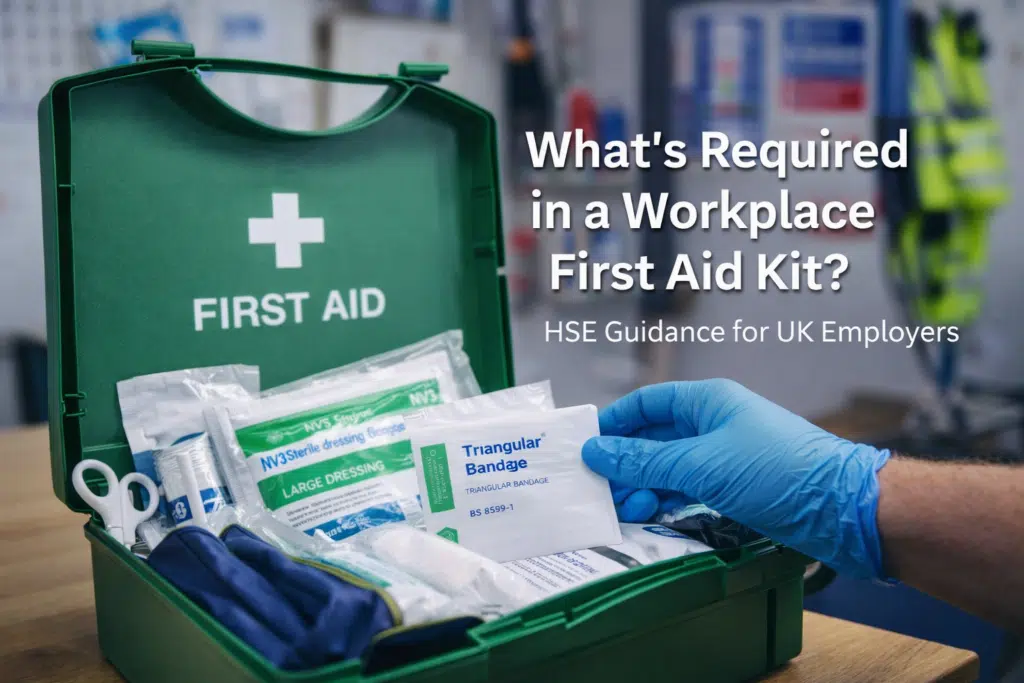
The HSE provides a minimum recommended list for a low-risk workplace. A standard first aid kit should include:
- A leaflet giving general first aid guidance
- Individually wrapped sterile adhesive dressings & plasters
- Sterile eye pads
- Triangular bandages
- Safety pins
- Large sterile wound dressings
- Medium sterile wound dressings
- Disposable gloves
That’s the baseline, not the finish line.
What Should NOT Be in a Workplace First Aid Kit
This is where things often go wrong.
The HSE is clear that first aid kits should not contain:
- Tablets or medicines (including painkillers)
- Creams, lotions, or antiseptic wipes, unless appropriate and suitable
- Anything that staff are not trained to use
Recent Government guidance has also reinforced that some non-sterile alcohol-free wipes should not be used & discarded if you have them in your first aid kits.
Your First Aid Kit Must Match Your Workplace Risks
A small office is very different from a care home, school, or construction site. The HSE expects employers to carry out a first aid needs assessment that considers:
- The nature of work activities
- Workplace hazards and risks
- Number of employees
- Shift patterns and lone working
- History of accidents or incidents
- Presence of vulnerable people (children, service users, the public)
For example:
- Care settings may need additional infection control measures
- Construction sites may need trauma dressings and bleeding control
- Schools and childcare settings may need paediatric considerations
If your kit hasn’t changed in years, there’s a good chance it no longer reflects your actual risks.
Who Is Responsible for First Aid Provision?
The responsibility always sits with the employer, not the first aider.
Employers must ensure:
- First aid kits are accessible, clearly marked, and fully stocked
- Equipment is checked regularly and kept up to date
- Staff know where the kits are and who the first aiders are
- First aiders receive appropriate, accredited training (the minimum for accredited is the EFAW)
Frequently Asked Questions About Workplace First Aid Kits and Legal Requirements
What does the HSE say must be in a workplace first aid kit?
The Health and Safety Executive (HSE) recommends that a basic workplace first aid kit include sterile dressings, plasters, eye pads, triangular bandages, disposable gloves, and a first aid guidance leaflet. The exact contents must be appropriate for the workplace risks, size, and activities, not just a standard list.
Is it a legal requirement for employers to provide a first aid kit?
Yes. Under the Health and Safety (First-Aid) Regulations 1981, employers are legally required to provide adequate and appropriate first aid equipment, facilities, and trained personnel. This applies to all UK workplaces, including offices, shops, care settings, and construction sites.
How many first aid kits does a workplace need?
There is no fixed number. The HSE expects employers to carry out a first aid needs assessment to determine how many kits are required, where they should be located, and what they should contain. Larger sites, higher-risk environments, or multi-floor buildings will usually need more than one kit.
Are non-sterile alcohol-free wipes allowed in first aid kits?
Non-sterile alcohol-free wipes are not suitable for use on open wounds or broken skin. Recent Government guidance has highlighted infection risks linked to their misuse, particularly in care and clinical environments. Only sterile products should be used for wound care.
Can painkillers or medication be kept in a workplace first aid kit?
No. The HSE advises that first aid kits should not contain tablets, medicines, or creams. This includes painkillers such as paracetamol or ibuprofen. Employers may have separate policies for medication, but it should not form part of standard first aid provision.
Who is responsible for checking and restocking first aid kits?
The employer is legally responsible, although this task can be delegated to a trained first aider or appointed person. First aid kits should be checked regularly to ensure contents are complete, in date, and suitable for the workplace.
Do all workplaces need a trained first aider?
Most workplaces must have either a trained first aider or an appointed person, depending on the level of risk. Low-risk environments may only require an appointed person, while higher-risk workplaces will need fully trained first aiders with accredited certification, such as the First Aid at Work.
How often does first aid training need to be refreshed?
HSE guidance recommends that first aid qualifications are refreshed every three years, with annual skills updates encouraged to keep knowledge current and confidence high.
Does first aid provision need to be reviewed regularly?
Yes. Employers should review first aid provision whenever there are changes to staffing levels, work activities, equipment, layout, or risk assessments. Regular reviews help ensure first aid arrangements remain compliant and effective.
How can employers be confident their first aid provision is compliant?
The best approach is to:
- Carry out a documented first aid needs assessment
- Use HSE-aligned first aid kits
- Ensure staff receive appropriate, accredited training
- Keep up to date with Government and HSE guidance
At Prima Cura Training, we help organisations review their first aid provision and deliver training that reflects real workplace risks and current UK guidance.
Training Matters Just as Much as the Kit
A perfectly stocked first aid kit is useless if no one knows how to use it properly.
HSE guidance makes it clear that first aiders must be trained to:
- Assess situations safely
- Provide appropriate first aid
- Know when to escalate and call emergency services
- Record and report incidents correctly
Training should be fit for the workplace, not generic or outdated.
At Prima Cura Training, our first aid courses are tailored to the actual environments people work in, whether that’s care, education, corporate, or high-risk industries. No box-ticking. No irrelevant scenarios. Just real-world first aid that makes sense.
Staying Compliant Is About Readiness.
First aid compliance isn’t about preparing for the worst every day. It’s about being ready when something unexpected happens.
That means:
- Reviewing first aid kits regularly
- Keeping training up to date
- Staying informed when guidance changes
- Making sure the provision still reflects your workplace
At Prima Cura Training, we actively monitor HSE updates, Government guidance, and best practice across health and safety and health and social care. When changes affect workplace compliance, we update our training and keep our clients informed.
Need a First Aid Review or Training Update?
If you’re unsure whether your first aid kit, provision, or training meets current UK requirements, it’s worth checking now rather than after an incident.
We deliver:
- Emergency First Aid at Work
- First Aid at Work
- Paediatric First Aid (OFSTED & EYFA approved)
- Tailored first aid for care, education, and specialist settings
Delivered in-house, UK-wide, by experienced trainers who understand compliance and real life.
This article is intended for general guidance only and reflects current UK first aid recommendations at the time of writing. First aid kit contents should be determined by a suitable risk assessment and may vary depending on your workplace, setting, or specific organisational requirements. Always follow relevant HSE guidance and your organisation’s policies when selecting or maintaining first aid supplies.