We Got Trained Too. Here’s What Happened.
Written by Stephanie Austin — Owner & Lead Trainer, Prima Cura Training
Last reviewed: April 2026 | Next review: April 2027
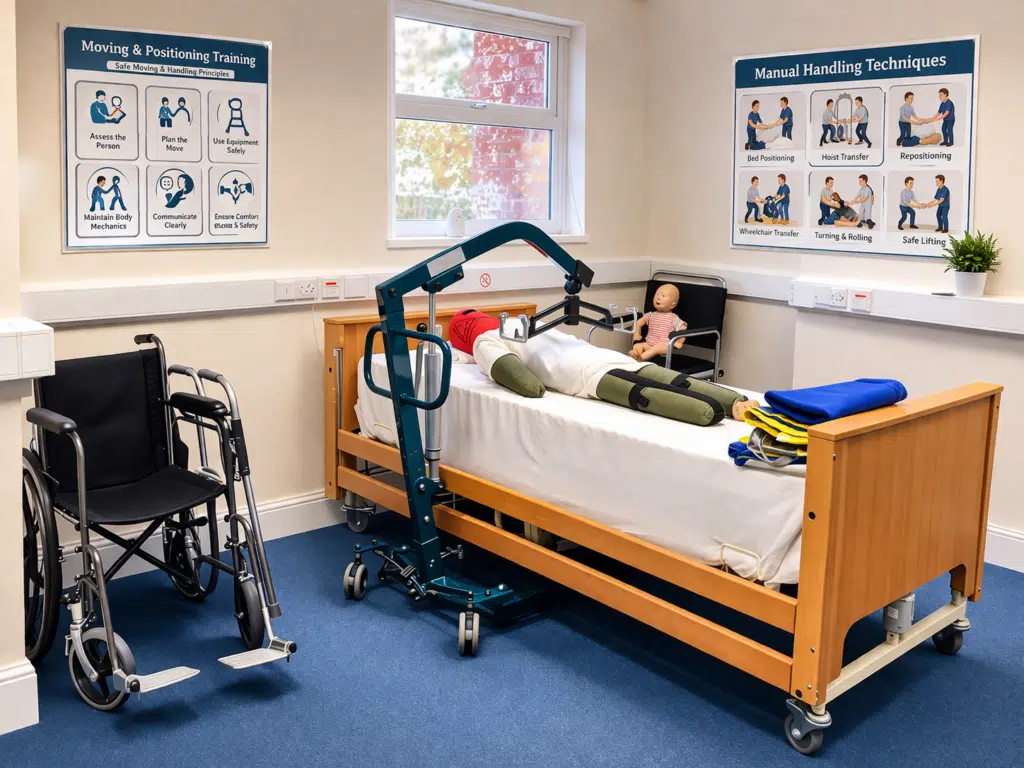
My associate trainer, Joanne, and I recently made the trip to Coventry to update our moving and positioning people trainer qualifications through the Healthcare Trainers Network.
I travelled from Manchester. Joanne from Surrey. Neither of us was exactly local.
Worth it? Absolutely.
We ask care staff to stay current. So do we.
There’s no legal requirement to update a moving and positioning trainer qualification on a set cycle. No regulator is going to write to you asking when you last refreshed yours.
I do it every two years anyway.
Because I think trainers who don’t keep their own knowledge current have no business standing in front of a room telling care staff how to do it safely. That standard applies to everyone at Prima Cura Training, including me.
What the day looked like
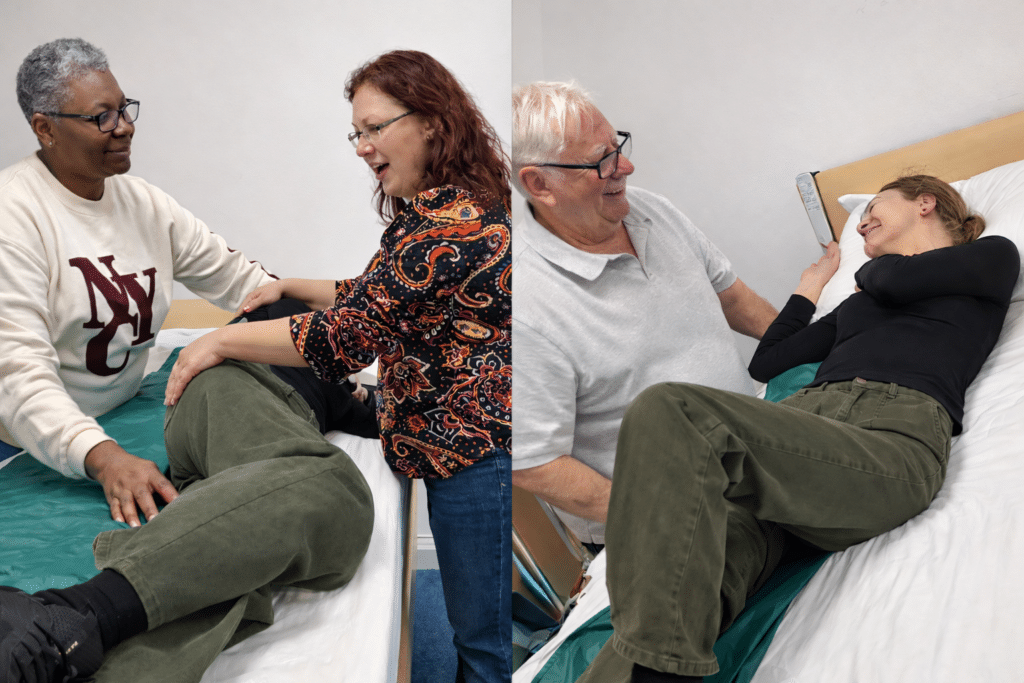
Small group. If you’ve ever sat in a training room with forty delegates and one trainer, you’ll know why that matters. We had proper time. Time to ask questions, work through scenarios, get hands-on with the practical elements, and talk to other moving and positioning trainers from different settings.
Those conversations between practitioners are worth a lot. Comparing notes with people doing the same work in different care environments gives you a perspective that no textbook provides. Someone might be seeing a pattern in their setting that you haven’t encountered yet. Someone else’s approach to a risk assessment challenge might be sharper than yours. That kind of open exchange is genuinely useful, and it doesn’t happen in a webinar.
It was also a bit of a full-circle moment for me personally. David Inglis, who heads up HTN, was the one who put me through my PTLLS qualification years ago. Seeing him again was a reminder of how small health and social care training really is, and how much of it is built on relationships that go back years.
What I took away
A good chunk of the day was refresher and reinforcement. A reminder of why the underpinning principles exist. Updates on risk assessment approaches. The kind of consolidation that stops small habits from quietly drifting over time. You don’t always notice your own technique has shifted until you’re working through it with someone watching.
But I also picked up something new. There’s an updated technique for assisting an individual to transfer using a Sara Steady, Rotunda, or stand aid. The specifics matter with that kind of equipment: the approach, the positioning, and the communication with the person being supported throughout. Getting that updated in a practical session, with real-time feedback, is a completely different experience from reading about it in guidance.
That’s the nature of moving and positioning training. You can know the theory inside out. The practical still has to be practised.
Why is this relevant to you?
If your team books moving and positioning training through Prima Cura, Joanne or I will be delivering it. And we’ll have kept our own skills current before we do.
Not as a selling point. Just as a baseline standard.
If your staff are due a refresher, or you’d like to talk through what moving and positioning training looks like for your setting, get in touch.
This blog is intended for general awareness and professional insight based on real training experience. It does not replace formal training, workplace policies, or a moving and handling risk assessment. Always follow your organisation’s procedures.