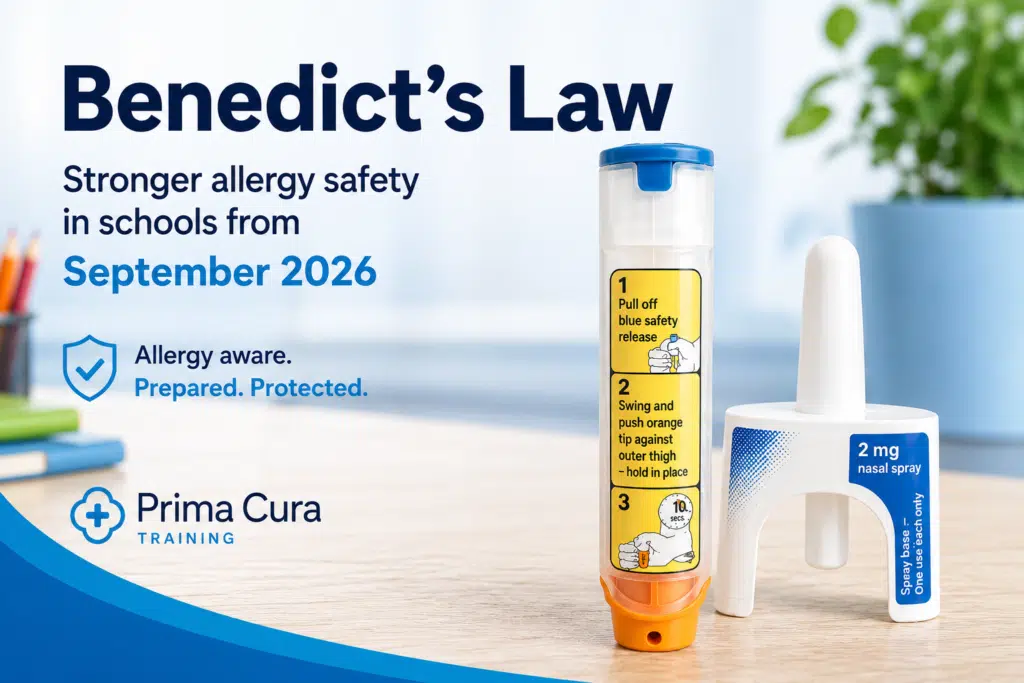
Benedict’s Law: What Schools in England Must Do Before September 2026
Written by Stephanie Austin — Owner & Lead Trainer, Prima Cura Training | Last reviewed: 14th July 2026 | Next review: May 2027
| Updated July 2026 to reflect the DfE’s final statutory guidance, published 6 July 2026. This post previously covered proposed requirements while the consultation was open. Everything below now reflects what’s confirmed. |
Benedict’s Law: What Schools in England Must Do Before September 2026
I’ve been delivering anaphylaxis training to school staff for years. And in that time, I’ve seen knowledge gaps that genuinely pull me up short.
One I won’t forget: a staff member who had no idea what an adrenaline auto-injector was. Not a bit unsure about dosage or timing. They didn’t know what it was. They thought the insulin pen belonging to a diabetic colleague was the same thing.
This wasn’t carelessness. This was someone doing their job every day in a school that had never given them the information they needed. And in a building full of children with life-threatening allergies, that gap is dangerous.
That’s precisely what Benedict’s Law is designed to change.
Who Benedict Blythe was
Benedict Blythe was five years old when he died from anaphylaxis at school in 2021. He was given milk despite having a known allergy. His mother, Helen Blythe, spent the years that followed pushing for the kind of mandatory protections that might have saved him.
The result is Benedict’s Law, formally the Schools Allergy Safety Bill and an amendment to the Children’s Wellbeing and Schools Bill. It passed in February 2026. From September 2026, schools in England will be legally required to meet a clear set of standards around allergy safety.
What the final guidance actually requires
On Monday 6 July 2026, the Department for Education concluded its consultation on supporting pupils with medical conditions at school and published the finished statutory guidance, Allergy Safety in Schools. It comes into effect from 1 September 2026.
In plain English: every school covered by the guidance must now have four things in place: a published allergy safety policy, allergy awareness training for all staff, spare adrenaline auto-injectors on site, and an Individual Healthcare Plan for every pupil with an allergy.
Here’s what each of those actually means in practice.
A dedicated allergy safety policy. Not a paragraph tucked inside a wider medical conditions document. A standalone policy, with a named senior leader responsible for it, reviewed at least annually, and published on the school’s website.
Allergy awareness training for all staff. Not just first aiders or the medical room. Catering staff, lunchtime supervisors, office staff, supply teachers, the lot. A reaction can start anywhere on site, and the person nearest when it happens needs to know what to do.
Spare adrenaline auto-injectors on site. Held by the school itself, not dependent on a pupil’s own device being available or up to date. These are for use in any child or adult showing signs of anaphylaxis, including someone with no known allergy. As many as three in ten severe reactions happen in people with no prior diagnosis, which is exactly why relying only on a named pupil’s own AAI leaves a gap.
Individual Healthcare Plans. A specific, written plan for every pupil with a diagnosed allergy, covering what needs to happen, when, and by whom, including in an emergency. These are built together with the child and their parents.
Before this legislation, guidance on holding spare adrenaline auto-injectors was non-statutory. Schools could choose whether to follow it. Reports suggested that as many as half of all schools had no spare adrenaline pens at all. The new statutory guidance closes that gap.
One thing worth flagging clearly: the duty is currently statutory for maintained schools, academies, and pupil referral units. Independent schools and non-maintained special schools are not yet under the same legal duty, though the government has said it intends to bring in equivalent requirements for these settings through the relevant regulatory standards. If you lead an independent school, this is very much still coming your way, and getting ahead of it now puts you in a stronger position than waiting for the requirement to land.
Ofsted will look at how schools have implemented these changes as part of the inspection, so this isn’t a policy to write and forget.

Why the knowledge gap is bigger than most schools realise
The anecdote I opened with is not a one-off. In my experience delivering anaphylaxis training to school staff, the gaps are significant and consistent. Staff often cannot distinguish a severe allergic reaction from something less urgent. Many have never handled an adrenaline auto-injector, let alone practised using one. Very few have had any formal training on what a school’s actual responsibilities are when a child goes into anaphylactic shock.
The consequences of those gaps can be serious. The statutory guidance itself cites National Child Mortality Database figures showing 19 child deaths from anaphylaxis and 54 from asthma between April 2019 and March 2023. Benedict’s death was preventable. The legislation bearing his name exists because voluntary guidance and good intentions were not enough.
What schools need to do now
The guidance is published. The requirements are confirmed. The only question left is whether your school is ready for September.
Start by checking whether you have a standalone allergy policy, not a paragraph buried inside a broader medical conditions document. If it doesn’t exist yet, or exists but hasn’t been reviewed in the last year, that needs sorting now, along with naming the senior leader who owns it.
Then look at your AAI stock. Do you hold spare adrenaline auto-injectors that belong to the school, not to individual pupils? If not, that needs to change before September.
Then look at your staff. Who in your building would know what to do if a child collapsed from anaphylaxis during lunch? Who would know where the AAIs are kept, how to use them, and when to call 999? If the answer is “one or two people” or “I’m not sure”, that’s the training gap Benedict’s Law is designed to close, and it’s one every member of staff now needs to have covered, not just the designated first aider.
EURneffy (Neffy): A new option worth knowing about
As schools prepare for Benedict’s Law, there is a new development in how anaphylaxis can be treated that is worth understanding: EURneffy, the UK’s first needle-free adrenaline nasal spray.
EURneffy was approved by the MHRA in July 2025 and became available in the UK from October 2025. It delivers adrenaline through the nasal lining rather than by injection, making it a needle-free alternative to traditional adrenaline auto-injectors such as EpiPen and Jext.

For schools, the arrival of EURneffy raises a practical question: if a pupil or staff member carries one, would your team know what it is and how to use it? This is exactly the kind of knowledge gap that good allergy training addresses.
Real-world data from the United States, where Neffy has been available since 2024, shows that around nine in ten patients experiencing anaphylaxis were successfully treated with a single dose, a rate comparable to traditional AAIs. That’s reassuring. But EURneffy is not a straightforward replacement for everyone.
| Important note on EURneffy suitability The British Society for Allergy and Clinical Immunology (BSACI) advises that EURneffy may not be suitable for those who have previously needed more than one dose of adrenaline to control anaphylaxis, or those who have experienced severe anaphylaxis with significant low blood pressure. For those groups, adrenaline auto-injectors remain the recommended treatment. EURneffy is currently available on private prescription. NHS access is expected as it is introduced across allergy services. A 1mg paediatric dose for children weighing 15 to 30kg is under review and expected in 2026. Individuals and schools should seek guidance from a GP or allergy specialist before making any changes to their emergency medication. |
How Prima Cura can help
We deliver anaphylaxis awareness training for school staff across Greater Manchester and England, covering how to recognise a severe allergic reaction, how to use an adrenaline auto-injector correctly, and what to do while waiting for the emergency services.
Anaphylaxis awareness is included within the following Prima Cura Training courses:
- Anaphylaxis Awareness
- Emergency First Aid for Schools
- Emergency Paediatric First Aid
- 2-Day Paediatric First Aid (Ofsted Approved)
If your school needs to get staff trained before September 2026, get in touch. We’ll work around your timetable.
| Get in touch with Prima Cura Training Call: 0333 999 8783 Email: info@primacuratraining.co.uk Website: primacuratraining.co.uk |
This blog post reflects the Department for Education’s final statutory guidance, Allergy Safety in Schools, published 6 July 2026 and correct to the best of our knowledge at the time of writing. Schools should refer to the official DfE guidance for the definitive compliance requirements, particularly around how the duty applies to independent schools and non-maintained special schools, which is still developing. Information on EURneffy (Neffy) is included for general awareness only and does not constitute medical advice. Suitability varies between individuals. Always consult a GP or allergy specialist before making any changes to prescribed emergency medication or allergy action plans. Prima Cura Training is a health, safety, and social care training provider. Nothing in this blog post should be taken as legal or clinical guidance. For legal compliance queries, consult a qualified legal professional. For clinical allergy management, consult an allergy specialist or GP.