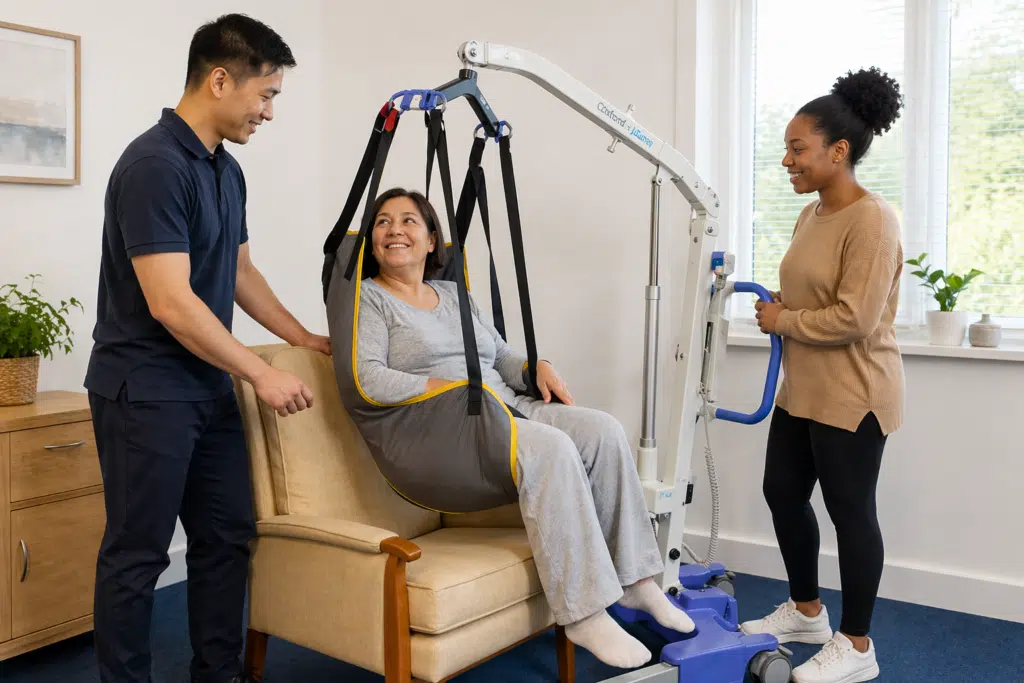
Moving and Positioning People in Care: Why the Small Things Matter Most
Written by Stephanie Austin, Owner and Lead Trainer, Prima Cura Training | Last reviewed: May 2026 | Next review: May 2027
Moving and Positioning People in Care: Why the Small Things Matter Most
Moving and positioning people is one of the most physically demanding and technically precise tasks in care. It happens across every shift, in care homes, domiciliary settings, supported living, and NHS facilities alike. And because it’s so routine, it’s also the area where small things quietly drift.
Not through carelessness. Not through not caring. Usually, through a combination of busy shifts, understaffing, and simply not having been taught the right way in the first place.
That last point matters more than the sector likes to acknowledge.
You’re Only as Good as the Information You’re Given
A few years ago, I was running a moving and positioning training session when a care worker came to me afterwards, visibly upset. She’d just realised that a technique she’d been using since she started her first job in care was a condemned practice. The drag lift. Her in-house trainer at her previous organisation had taught it to her as standard. She genuinely didn’t know it was wrong. She was mortified.
I said to her what I say to anyone in that situation: you’re only as good as the information you’re given.
The drag lift was formally condemned decades ago. It places severe strain on the shoulders, neck and spine of the person being moved, and causes significant musculoskeletal risk to the carer. No reputable training programme teaches it. But poor or outdated in-house training still exists in pockets of the sector, and care workers on the receiving end of it have no reason to question what they’ve been taught.
This is why the quality of training matters. Not just whether a certificate exists, but what was actually taught.
The Gold Standard: HOP7
The Handling of People, 7th edition, known as HOP7, is the recognised gold standard for moving and positioning practice in the UK. Published by BackCare in 2023, it underpins quality trainer programmes across the country and is endorsed by organisations including the HSE, the Royal College of Nursing, the Chartered Society of Physiotherapy, and the College of Occupational Therapists.
Every edition reflects changes in legislation, case law, equipment developments, and technique. If the moving and positioning training your staff receive isn’t grounded in HOP7, it’s worth asking what it is grounded in.
| Is Your Moving and Positioning Training Up to Standard? Use this checklist to sense-check your current provision: |
| ✓ | Training is delivered by someone working to HOP7 (7th edition, 2023) standards, not an outdated edition. |
| ✓ | Individual moving and positioning care plans exist for every person and are reviewed whenever their needs or condition change. |
| ✓ | Risk assessments are person-specific, not a generic template applied to everyone. |
| ✓ | All hoisting equipment has been examined by a competent person within the last six months (LOLER). |
| ✓ | Slings are inspected before every single use and removed from service if damaged. |
| ✓ | Staff refresher training is regular — not just on induction and never again. |
| ✓ | No condemned practices (including the drag lift) are being used or taught informally on the floor. |
| ✓ | Equipment is maintained, fit for purpose, and there is a clear process for reporting faults. |
What the Law Requires
Employers in care have clear legal obligations across three pieces of legislation. Together, they set out a framework that goes well beyond simply buying a hoist and hoping for the best.
| Legislation | What It Requires | Who It Applies To |
| Manual Handling Operations Regulations 1992 | Requires employers to avoid hazardous manual handling where reasonably practicable. Where it cannot be avoided, they must assess the risk and reduce it as far as possible. In care, the ‘load’ is a person, which changes the nature of the task entirely. | All employers where manual handling takes place |
| Health and Safety at Work etc. Act 1974 | Places a broader duty on employers to protect the health, safety and welfare of their staff. Covers training, supervision, safe systems of work, and safe equipment. | All employers |
| Lifting Operations and Lifting Equipment Regulations 1998 (LOLER) | Applies to all hoisting equipment used in care: overhead hoists, mobile hoists, stand aids, Sara Steadys, Rotundas. All lifting equipment must be thoroughly examined every six months by a competent person. Slings must be inspected before every single use. | Care providers using any lifting equipment |
The HSE’s guidance on moving and handling in health and social care brings this together in a care-specific context and is worth bookmarking for any care manager responsible for moving and positioning policy.
The Small Things That Make the Biggest Difference
Good technique isn’t just about avoiding serious injury. It’s about the experience of the person being moved in every single interaction. The table below shows where practice most commonly goes wrong, and what it should look like instead.
| Technique | What Goes Wrong | What Good Looks Like |
| Supporting a limb during repositioning | Grabbing the wrist to move the arm: quick, but it can cause pain, feel undignified, and cause real harm to anyone with fragile skin or joint problems. | Support the whole limb with a flat, open hand placed beneath it. Takes no longer. Requires correct training. |
| Hand position when repositioning | Not used. Ever. If your team has been taught this, the training needs reviewing urgently. | Hands flat and open, spread across the body to distribute contact. Paws, not claws. |
| Fitting a slide sheet | Folding the sheet and jabbing fingers repeatedly into the person’s back to push it underneath. Uncomfortable for anyone. Potentially distressing for someone with pressure injuries or sensory sensitivities. | Sheet prepared and positioned properly before the person is moved onto it. No fingers in anyone’s back. |
| Using a hoist | Using a sling that hasn’t been inspected, or equipment that hasn’t been LOLER-examined in the last six months. | Slings inspected before every use. Hoist examined every six months by a competent person. Records kept. |
| The drag lift | Still being taught by some in-house trainers as standard practice. Condemned decades ago. Places severe strain on the person’s shoulders, neck and spine, and causes significant musculoskeletal risk to the carer. | Not used. Ever. If your team has been taught this, training needs reviewing urgently. |
None of this is about blame. The difference between wrong and right in every row above isn’t effort or intent. It’s training. Specifically, whether someone was taught correctly and whether that training has been reinforced since.
Why This Keeps Happening
Technique drifts over time. Particularly when:
- Refresher training isn’t regular
- Staffing pressures push shortcuts
- A care worker has been shown an easier-looking method by a more experienced colleague who picked up their own habits somewhere along the line
Good moving and positioning practice needs reinforcing. Not as a tick-box exercise, but as a genuine quality check on what is actually happening in practice — on every shift, not just during an inspection.
For Care Managers
Individual moving and positioning care plans need to reflect the actual person in front of you, reviewed whenever their condition or needs change. A generic risk assessment applied to every resident isn’t a risk assessment. It’s an unfilled template. The Manual Handling Operations Regulations 1992 are explicit that assessments must be suitable and sufficient for the specific task and individual.
Equipment needs to be maintained, inspected, and fit for purpose. LOLER isn’t a bureaucratic formality. It exists because hoisting equipment that fails puts lives at risk.
And training needs to be delivered by someone working to current best practice standards, HOP7 included — not just someone who holds an old certificate from a course that last ran when a different edition of the guidance was current.
For Care Workers
If something doesn’t feel right in how you’re working, say so. If a technique feels awkward or if you’re not confident with a particular piece of equipment, ask. There is no version of this work where guessing is safer than asking.
And if you’ve ever been taught something that later turned out to be wrong, that isn’t on you. Training quality varies. The responsibility for giving staff accurate, current, safe practice guidance sits with the employer and the trainer — not the person on the receiving end of it.
| Moving and Positioning Training from Prima Cura. We deliver moving and positioning training across care settings, working to HOP7 standards. Our training is built around your team, your environment, and the people you support. |
To find out more about our Moving and Positioning Training, or call us to talk through what your team needs.
This article is intended for general guidance and awareness around moving and positioning practices in health and social care settings. It does not replace formal training, organisational policies, or professional clinical judgement. Moving and positioning tasks must always be carried out in line with your organisation’s risk assessments, individual care plans, and current legislation, including the Manual Handling Operations Regulations 1992, Health and Safety at Work etc. Act 1974, and LOLER 1998. Improper techniques can result in serious injury to both the person being moved and the staff member. Always follow your training, use appropriate equipment, and seek guidance from a qualified trainer or competent professional if you are unsure.