The Weakest Link: Why Bystander Action Is the Variable That Changes Everything
Written by Stephanie Austin — Owner & Lead Trainer, Prima Cura Training | Last reviewed: June 2026 | Next review: June 2027
The Weakest Link: Why Bystander Action Is the Variable That Changes Everything
I trained over a thousand people to do CPR during the pandemic. Not in a conference centre. Not in a nice warm training room with freshly cleaned manikins on a mat. Outside. In car parks. In high-vis jackets and face masks, kneeling on paving slabs, compressing chest mannequins while working out how to teach effectively when you couldn’t get closer than two metres to anyone.
They were NHS Test and Trace staff. People who were already turning up every day to a job that was hard, uncertain, and not without risk. What they needed, what they deserved, was training that worked. Training that stuck. So that’s what we delivered.
I think about those sessions every time someone says, “somebody else will sort it.”
This follows on from our previous blog for CPR & AED Awareness Week, where we looked at why awareness matters and why more people need the confidence to act before an ambulance arrives.

The Chain of Survival: Four Links, and One That Almost Always Breaks
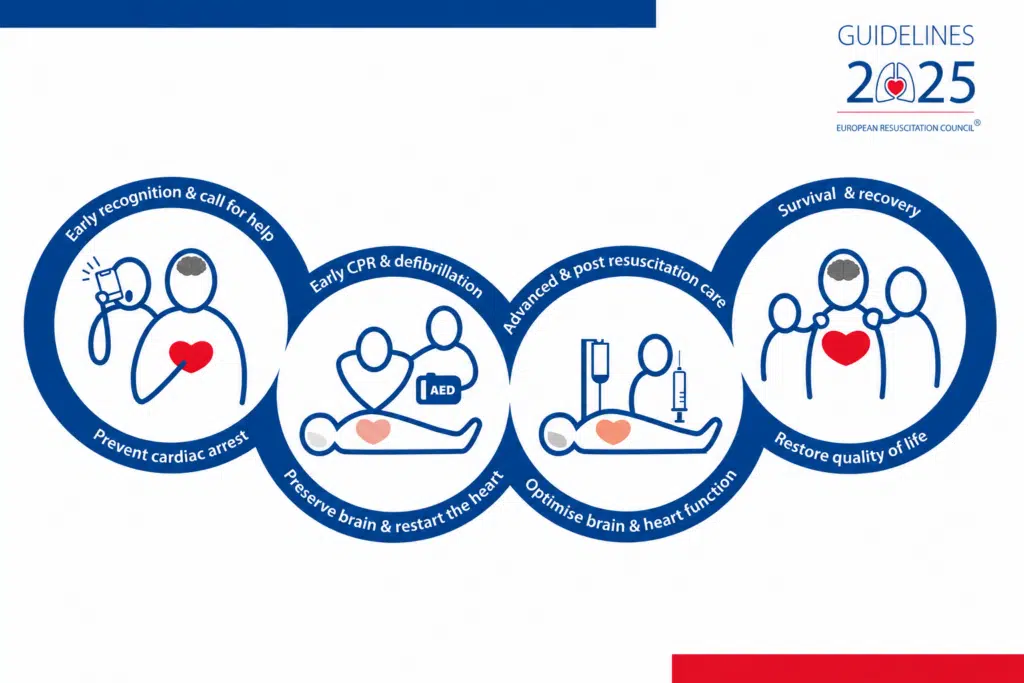
The Resuscitation Council UK describes cardiac arrest outcomes in terms of a chain of survival. Four links. Each one matters. And the chain is only as strong as its weakest.
Link one: Early recognition and calling 999
Someone has to recognise that the person on the floor is in cardiac arrest. Not just unwell, not just having a funny turn, but call for help immediately. The 2025 RCUK guidelines updated the advice here: call 999 for any unresponsive person, before assessing breathing. Get the ambulance coming. Then assess. The call handler will walk you through it.
Link two: Bystander CPR
The ambulance is on its way. The average response time in England is around 8 minutes. Eight minutes is a long time when a brain is being starved of oxygen. The person closest to the incident, the bystander, is the only person who can bridge that gap. Every compression matters.
Link three: Early defibrillation
Most survivable cardiac arrests involve a shockable heart rhythm. CPR keeps blood circulating. The AED resets the rhythm. Without defibrillation, CPR alone rarely gets someone to the other side of a cardiac arrest. With it, early defibrillation within three to five minutes can produce survival rates of up to 50 to 70 per cent.
Link four: Advanced life support and post-resuscitation care
This is the paramedics, the hospital team, the ICU. This link gets the most attention. It also gets the least benefit from improvement, because by the time it kicks in, the first three links have already determined the outcome.

The Chain of Survival; Resuscitation Council UK 2025 Guidelines. Every link matters. The weakest two are the ones bystanders control.
What the Numbers Actually Tell Us
According to the Resuscitation Council UK 2025 guidelines, around 115,000 out-of-hospital cardiac arrests are reported to ambulance services in England each year. Of those, resuscitation is attempted in approximately 43,000 cases. And according to the British Heart Foundation, fewer than one in ten people survive.
Not because the ambulance was too slow. Not because hospitals aren’t ready. Because links one and two break far too often.
Bystander CPR is provided in 60 to 73 per cent of cases in England. That sounds reasonable until you compare it to Norway, where rates are consistently above 73 per cent, and where survival outcomes regularly outperform ours. And AED use by bystanders? Under 10 per cent of cases nationally.
Here’s what changes when those two numbers improve. Research cited in the RCUK 2025 guidelines found that where a trained bystander acted promptly and correctly, return of spontaneous circulation occurred in 50 to 57 per cent of cases, and 30-day survival reached 30 per cent. The national average sits at 9 to 10 per cent.
| That gap is not a gap in paramedic quality. It’s a gap in who’s standing next to someone when their heart stops. |
Training 1,000 People to Be That Person
During the height of the pandemic, Prima Cura delivered Emergency First Aid at Work training to over a thousand NHS Test and Trace staff across sites. In car parks, loading bays, and outdoor spaces. Whatever was available.
The conditions were difficult. The training wasn’t. Because the content doesn’t change based on the setting. What you need to know, you need to know.
What those staff needed was the confidence that if someone collapsed in front of them, they wouldn’t freeze. That they’d be link 2 in the chain. And that they could use an AED without second-guessing themselves.
Some of those thousand people have probably been that link since. I’ll never know for certain. But I know they were trained, which puts them ahead of the majority of bystanders who stood next to a cardiac arrest last year and couldn’t help.
Why People Don’t Act, and What Good Training Does About It
When someone collapses in front of you, several things happen at once. Your brain tries to categorise what it’s seeing. It looks for reasons not to act: they might just be asleep, someone else will step forward, you might do it wrong, you might make it worse.
Good training doesn’t just teach technique. It teaches recognition, the moment when waiting is no longer an option.
And it teaches this: you cannot make it worse. Cardiac arrest is already the worst. CPR, even imperfect CPR, is better than no CPR. The Resuscitation Council UK is clear on this: the risk of harm from attempting CPR on someone not in cardiac arrest is low. The risk of not acting when someone is in cardiac arrest is not.
The people who step forward when something goes wrong are not, as a rule, braver than anyone else. They’re just better prepared.
The Practical Question for Any Business
The 2025 RCUK guidelines recommend strengthening the chain of survival through advocacy, education, and community action. They call for mandatory CPR training for schoolchildren, students, and drivers. These are long-term ambitions. The practical action is available right now.
If you manage a team of people:
- Do your staff know how to recognise cardiac arrest?
- Do they know where the nearest AED is?
- Is your first aid training current, or something that got done once and hasn’t been revisited since?
| Is your team’s BLS competency current? Our Basic Life Support and AED course is the accepted annual refresher for EFAW and FAW certificate holders. Three focused hours. Hands-on CPR and AED practice. All content aligned with the Resuscitation Council UK 2025 guidelines. Delivered at your venue. Maximum 12 learners per trainer. CPR & AED Awareness Week Exclusive Offer 10% off any course booked 1–7 June 2026 0333 999 8783 | info@primacuratraining.co.uk | primacuratraining.co.uk |
Ready to Train Your Team?
CPR & AED Awareness Week runs from 1 to 7 June 2026. Any training booked with Prima Cura during that window gets 10 per cent off, not just BLS, any course we deliver.
If you want to talk through what your team needs, give us a call or drop us a message. We’ll be straight with you about what’s right for your organisation, including if something else is a better fit than what you first had in mind.
The information in this blog post is provided for general awareness and educational purposes only. It is based on the Resuscitation Council UK Adult Basic Life Support Guidelines 2025 and does not constitute medical advice. Statistics cited are sourced from the Resuscitation Council UK, the British Heart Foundation, and the Out-of-Hospital Cardiac Arrest Outcomes (OHCAO) Registry and are correct at the time of publication. They should not be used as a substitute for formal, accredited first aid training. CPR and AED use are physical skills requiring hands-on practice and direct feedback from a qualified trainer. Prima Cura Training strongly recommends attending accredited face-to-face training to develop and maintain these skills. In a medical emergency, always call 999 immediately. If you are unsure whether someone is in cardiac arrest, call 999 and follow the instructions of the ambulance service call handler. For professional medical advice, speak to a qualified healthcare professional.