How Many Types of Diabetes Are There? A Lot More Than Two
Written by Stephanie Austin, Owner & Lead Trainer, Prima Cura Training | Last reviewed: November 2026 | Next review: November 2027
There are more than two types of diabetes. Most people have heard of type 1 and type 2, but Diabetes UK also lists gestational diabetes, LADA, MODY, neonatal diabetes, type 3c, cystic fibrosis-related diabetes, steroid-induced diabetes and diabetes caused by rare genetic syndromes such as Wolfram syndrome. And in April 2025, the International Diabetes Federation formally recognised type 5 diabetes, a form linked to long-term malnutrition. The type matters because it decides how someone’s diabetes is treated, and the treatment is a big part of what decides their risk of a hypo.
“That’s the first time a trainer has ever bled for me in the name of education.” A learner said that to me after I’d pricked my own finger and tested my blood glucose, live, in the middle of a Diabetes Awareness course. It got a laugh. It also opened up the conversation this whole post is about.
The Short Version
| Type | What’s going on | Usually treated with |
| Type 1 | The immune system destroys the cells in the pancreas that make insulin | Insulin, every day, for life |
| Type 2 | The body doesn’t make enough insulin, or the insulin doesn’t work properly | Healthy eating and activity, tablets, and sometimes insulin |
| Gestational | High blood sugar that develops in pregnancy and usually goes after the birth | Diet and activity, sometimes tablets or insulin |
| LADA (sometimes called type 1.5) | A slow-developing autoimmune diabetes, usually diagnosed at 30 to 50 | Often tablets at first, then insulin sooner than in type 2 |
| MODY | A change in a single gene that runs strongly in families, usually diagnosed before 25 | Depends on the gene: tablets, insulin or no treatment at all |
| Neonatal | A genetic diabetes diagnosed before six months of age | Insulin, or tablets for around half of those affected |
| Type 3c | Another condition damages the pancreas, such as pancreatitis, pancreatic cancer or surgery | Usually metformin at first, then insulin if needed |
| Cystic fibrosis-related | Thick mucus damages the pancreas | Insulin, alongside a high-calorie diet |
| Steroid-induced | Corticosteroid medicines push blood sugar up | Sometimes nothing short term, tablets or insulin if longer |
| Wolfram syndrome | A very rare genetic syndrome that includes diabetes | Treated like type 1, with insulin |
| Type 5 | Linked to long-term malnutrition, mainly in low and middle-income countries | Guidance still being developed by the IDF |
What Can a Blood Glucose Meter Tell You, and What Can’t It?
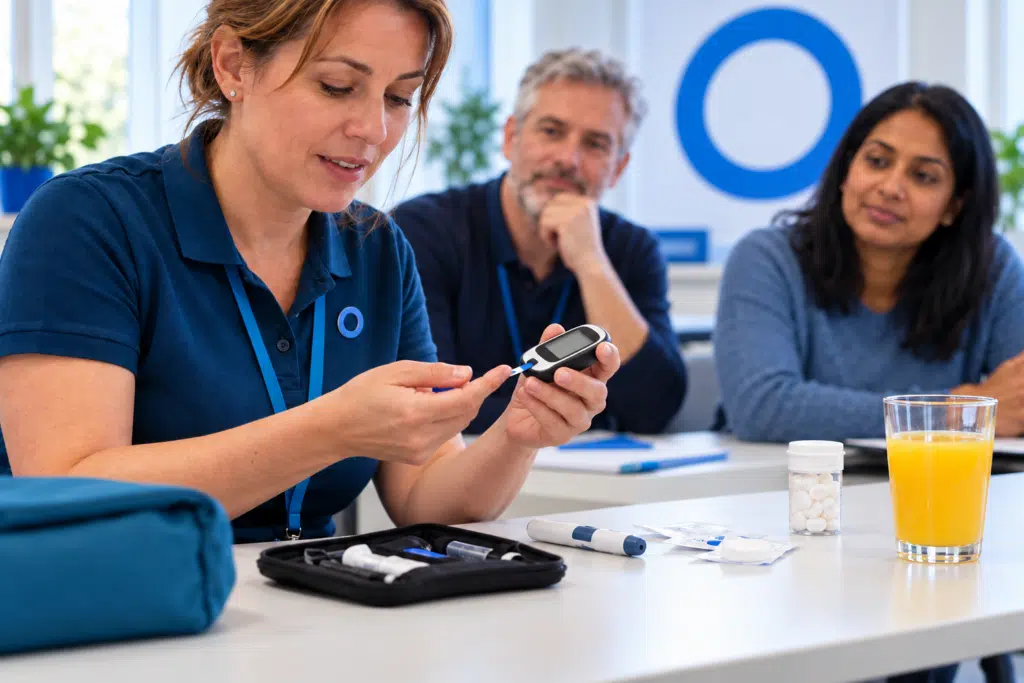
On face-to-face Diabetes Awareness courses, there’s a point where I stop talking about blood glucose and show it.
I set it up properly first. All the infection control is done and it’s a controlled environment, because demonstrating a finger-prick test while ignoring infection prevention would teach exactly the wrong lesson. Then I test myself and read out the result, and we talk it through. Did I have breakfast? Did I have a biscuit with my coffee? Have I been rushing about setting up the room? Learners start to see a reading as a snapshot of someone’s morning, not a mark out of ten.
But here’s the bit I want people to take away this World Diabetes Day. That meter gives you a number. It doesn’t tell you what type of diabetes someone has, or whether they have diabetes at all. Two people could get exactly the same reading on the same morning and be living with completely different conditions, on completely different treatment, with completely different risks.
That conversation is usually where the assumptions come out. Most people arrive knowing about type 1 and type 2, and not much else. So when we start talking about diabetes that develops in pregnancy, diabetes caused by steroids, or diabetes that runs through a family because of a single gene, the room tends to go quiet in a thinking sort of way.
One thing I’m always clear about, in that room and here: watching me do a test doesn’t make anyone competent to do one on someone else. In a care setting, blood glucose monitoring is a delegated healthcare activity, and it needs proper delegation, training and a competency assessment.
Why Does Everyone Think There Are Only Two Types of Diabetes?
Because two types account for almost everyone. According to Diabetes UK’s 2024 to 2025 figures, around 90 per cent of people with a diabetes diagnosis have type 2 and around 8 per cent have type 1. The other forms make up the remaining 2 per cent.
Two per cent sounds small. It isn’t. Over 4.7 million people in the UK have a diabetes diagnosis, so 2 per cent is more than 90,000 people. If you work in care, or you employ a decent-sized team, there’s a real chance you’ll support or work alongside someone whose diabetes isn’t type 1 or type 2.
There’s a second reason, and it matters more. Several of the less common types are regularly mistaken for type 1 or type 2 at first. Diabetes UK says that about 90 per cent of people with MODY are first diagnosed with the wrong type. LADA and type 3c are both often diagnosed as type 2 by mistake. So some people who are counted as type 1 or type 2 today will turn out to have something else.
Type 1 and Type 2: What Do People Get Wrong About the Two Everyone Knows?
Type 1 isn’t only a children’s condition
Type 1 diabetes is an autoimmune condition. The body attacks the cells in the pancreas that make insulin, so it can’t make any at all. Diabetes UK is clear that although it’s often diagnosed in childhood, people can develop type 1 diabetes at any age. Nothing a person did caused it and nothing could have prevented it. People with type 1 can’t live without insulin, whether by injection or a pump.
Type 2 isn’t only about weight
Type 2 diabetes happens when the body doesn’t make enough insulin, or the insulin it makes doesn’t work properly. Weight is one risk factor. It isn’t the only one. Diabetes UK lists age (over 40 for people of white heritage, and from 25 for people of African Caribbean, Black African or South Asian heritage), family history and ethnicity alongside it, and states plainly that type 2 doesn’t just affect people living with overweight or obesity.
I spend time on this in training because the “lifestyle disease” label sticks, and it gets in the way. A person who feels judged for their diagnosis is less likely to tell you when something’s wrong.
Type 2 can also go unnoticed for years. Diabetes UK estimates that almost 1.3 million people in the UK could be living with type 2 diabetes and not know it yet.
What Are the Other Types of Diabetes?
Here’s each one in plain English, with the detail that matters if you support someone who has it or work alongside them.
Gestational diabetes
Gestational diabetes is high blood sugar that develops during pregnancy, when the body can’t make enough extra insulin to meet the demands of pregnancy. The NHS offers testing between 24 and 28 weeks to those at higher risk. It usually goes away after the birth, but it raises the chance of developing type 2 diabetes later, which is why the NHS recommends a check 6 to 13 weeks after birth and then every year.
LADA (latent autoimmune diabetes in adults)
LADA sits somewhere between type 1 and type 2, which is why you’ll sometimes hear it called type 1.5. It’s autoimmune, like type 1, but it develops much more slowly, over months rather than weeks. It’s usually diagnosed between 30 and 50. People often start on tablets and move on to insulin sooner than someone with type 2 would.
In plain English: someone told they have type 2 in their 40s may later be told it’s LADA, and their treatment may change. If you support them, their care plan needs to change with it.
MODY and neonatal diabetes (monogenic diabetes)
Monogenic diabetes is caused by a change in a single gene. There are two main forms.
MODY (maturity onset diabetes of the young) runs strongly in families. A parent with the gene change has a 50 per cent chance of passing it on to each child, and those who inherit it generally develop MODY before 25. Treatment depends entirely on which gene is involved. Some people take small doses of tablets instead of insulin, some need insulin, and one form, glucokinase MODY, usually needs no treatment at all.
Neonatal diabetes is diagnosed before a baby is six months old. It’s very rare, with fewer than 100 people diagnosed in the UK, according to Diabetes UK. Around half of those affected can be treated with a tablet instead of insulin.
Type 3c diabetes
Type 3c diabetes develops when another condition damages the pancreas. Causes include acute and chronic pancreatitis, pancreatic cancer, cystic fibrosis, haemochromatosis and having part or all of the pancreas removed. Because the pancreas also makes digestive enzymes, people with type 3c can have stomach pain, diarrhoea and oily stools as well as diabetes, and Diabetes UK lists low blood sugar among its symptoms. It’s often diagnosed as type 2 by mistake.
Cystic fibrosis-related diabetes
Cystic fibrosis-related diabetes is the most common type of diabetes in people with cystic fibrosis. Thick mucus damages the pancreas so it can’t make enough insulin. It’s usually treated with insulin.
Here’s the part that catches people out: the eating advice is different. People with cystic fibrosis usually need a high-calorie, high-protein and high-fat diet to keep weight on and fight infection. The “cut the sugar and fat” messages people associate with diabetes can do real harm here. Follow the person’s own plan, set by their cystic fibrosis team.
Steroid-induced diabetes
Corticosteroids are prescribed for things like severe asthma, arthritis, inflammatory bowel disease and some cancers, and they can push blood sugar up. Diabetes UK explains that higher doses taken by mouth or by injection carry more risk, and that people already at higher risk of type 2 are more likely to be affected. For many people blood sugar goes back to normal when the steroids stop. For some it doesn’t.
This one is worth knowing in care settings, because a course of steroids is common. If someone on steroids starts weeing more, is unusually thirsty or tired, or is losing weight without trying, report it.
Wolfram syndrome
Wolfram syndrome is a rare genetic condition, also known as DIDMOAD after its four main features: diabetes insipidus, diabetes mellitus, optic atrophy (a problem with the nerve to the eye) and deafness. Diabetes UK puts it at around 1 in 770,000 people in the UK. The diabetes is treated like type 1.
Type 5 diabetes
Type 5 is the newest name on the list. The International Diabetes Federation formally recognised it at its World Diabetes Congress in Bangkok in April 2025. It was previously called malnutrition-related diabetes and is linked to long-term undernutrition, mostly in low and middle-income countries in South-East Asia and sub-Saharan Africa. The IDF says refugees and migrants from resource-poor settings can also be affected. It’s rarely seen in the UK, but it shows how the picture is still changing.
What Are the Biggest Myths About Diabetes?
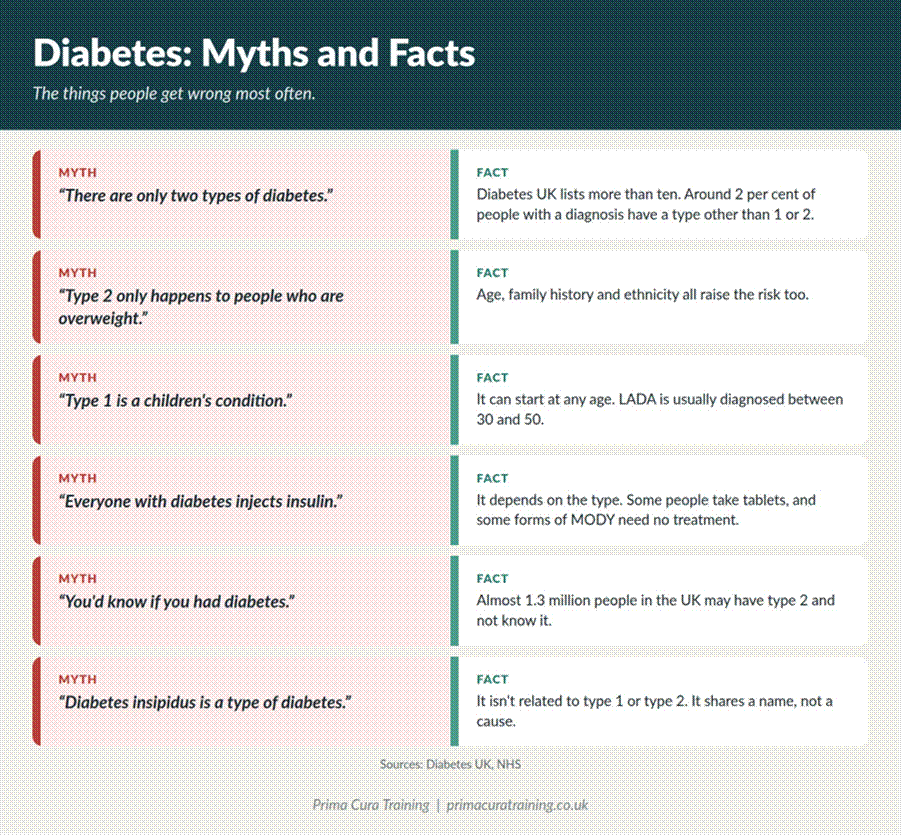
These are the ones I hear most often, and what the evidence says instead.
- “There are only two types.” Diabetes UK lists more than ten, and around 2 per cent of people with a diagnosis have a type other than 1 or 2.
- “Type 2 only happens to people who are overweight.” Age, family history and ethnicity all raise the risk too. Diabetes UK says type 2 doesn’t just affect people living with overweight or obesity.
- “Type 1 is a children’s condition.” It can start at any age, and LADA, its slower cousin, is usually diagnosed between 30 and 50.
- “Everyone with diabetes injects insulin.” Treatment depends on the type. Some people with MODY take tablets, and some need no treatment at all.
- “You’d know if you had it.” Almost 1.3 million people in the UK may have type 2 diabetes and not know.
- “Diabetes insipidus is a type of diabetes.” It isn’t. The NHS states that diabetes insipidus is not related to type 1 or type 2 diabetes. It shares a name, not a cause.
Does the Type of Diabetes Change What a Care Worker Should Do?
Yes and no. The care worker’s line doesn’t move: recognise, escalate, follow the care plan, and never diagnose or change a dose. What changes is what you’re watching for.
Hypo risk follows the medication, not the label. The NHS explains that hypos are common in people who take insulin, and can also happen with some other diabetes medicines such as gliclazide and glimepiride. So someone with type 2 on gliclazide can have a hypo, and someone with glucokinase MODY on no treatment at all is very unlikely to. Know what the person takes. That’s the job of the care plan and the medication record, and our Medication Awareness course covers how to read them.
Know what “normal” looks like for them. Someone with type 3c may have digestive symptoms every day. Someone with cystic fibrosis-related diabetes may be on a high-calorie diet that looks nothing like what you’d expect. Neither is a problem to “fix”. Our Nutrition and Hydration in Care Settings course goes into how individual eating plans work in practice.
Watch people on steroids. Thirst, weeing more, tiredness and weight loss in someone on a course of steroids should be reported, even if they’ve never had diabetes.
Report when a diagnosis changes. LADA, MODY and type 3c are all regularly diagnosed as something else first. When the diagnosis changes, the treatment often changes, and the care plan, the risk assessment and the hypo plan need updating with it. Good recording and reporting is what makes sure that happens.
Insulin administration and blood glucose monitoring are named as examples of delegated healthcare activities in the Skills for Care, DHSC and NHS England guiding principles. Awareness training alone doesn’t make anyone competent to carry them out, whatever type of diabetes the person has. For registered managers, this sits under Regulation 12 (safe care and treatment) and Regulation 18 (staffing), and our blog on Regulation 18 and CQC inspection covers the training side in more detail.

What Should Employers Know About the Less Common Types?
Most people with diabetes manage it themselves, every day, without anyone at work noticing. The type doesn’t change that. What helps is not assuming.
Under the Equality Act 2010, the government’s guidance on the definition of disability (paragraph B14) says diabetes that is controlled by medication or diet should be judged as it would be without that treatment. In practice, many people with diabetes, of any type, will be covered.
A few things I’d want any employer to know:
- Ask, don’t guess. Someone with MODY might be on tablets or on nothing. Someone with LADA might be moving onto insulin this year. The person knows what helps them. Ask what they need, whether that’s breaks to test and eat, a private space, or time off for appointments.
- Gestational diabetes happens during pregnancy. Once an employee tells you in writing that she’s pregnant, the HSE says you must complete an individual risk assessment and make any changes needed. Extra antenatal appointments, regular meals and somewhere to test fit naturally into that.
- Steroid courses are often short. A colleague on steroids for a flare-up of asthma or arthritis may need some temporary flexibility while their blood sugar is being checked.
- Make sure your first aiders know what to do. Diabetic emergencies are part of the First Aid at Work syllabus. Our Workplace First Aid in the UK guide covers how to work out what your workplace needs.
Whatever the Type, What Should You Do If Someone Becomes Unwell?
If someone with diabetes suddenly becomes shaky, sweaty, pale, confused or starts behaving out of character, treat it as a hypo (low blood sugar), whatever type of diabetes they have. The Resuscitation Council UK 2025 First Aid Guidelines say to give 15 to 20g of glucose if they’re awake and can swallow, check again after 15 minutes and repeat if they’re no better, then give a light snack once they’ve recovered. Never give food or drink to someone who is unresponsive. Call 999 if they become unresponsive or aren’t improving.
I’ve written a full walk-through of this in what to do if someone’s blood sugar suddenly drops, so I won’t repeat it all here.
High blood sugar is the other direction. Being very thirsty, weeing a lot, being sick, breathing fast or having fruity-smelling breath can be signs of diabetic ketoacidosis, which needs urgent medical help. The NHS page on high blood sugar explains when to call 111 and when to call 999.

World Diabetes Day 2026: Why Does Early Action Start With Knowing the Signs?
World Diabetes Day is held every year on 14 November, and the International Diabetes Federation’s theme for 2026 and 2027 is Early Action on Diabetes. The IDF’s point is that spotting diabetes early can prevent serious complications such as diabetic ketoacidosis.
Early action works best when people know there’s more than one way diabetes can turn up. A new mum, a 45-year-old who doesn’t fit the type 2 picture, someone who’s just finished a course of steroids, someone recovering from pancreatitis. The NHS lists the main symptoms as feeling thirsty all the time, weeing more than usual, feeling very tired and losing weight without trying, and advises asking for an urgent GP appointment or contacting NHS 111 if you or your child has any of them.
Diabetes Awareness Training That Goes Beyond Type 1 and Type 2
Our half-day Diabetes Awareness course is built for care teams and workplaces. It covers what diabetes is, the different types, hypos and hypers, and the care worker’s line: recognise and escalate, never diagnose or adjust. On face-to-face courses, that includes the live blood glucose demonstration, with all the infection control that goes with it. Remote learners see it on video instead.
For workplaces, diabetic emergencies are covered on First Aid at Work (3-Day).
If you’d like to talk through what fits your team, call us on 0333 999 8783 or email info@primacuratraining.co.uk. You can also see our full course list.
Frequently Asked Questions
How many types of diabetes are there?
There are more than two. Diabetes UK lists type 1, type 2, gestational diabetes, LADA, MODY, neonatal diabetes, type 3c, cystic fibrosis-related diabetes, steroid-induced diabetes and diabetes caused by rare syndromes such as Wolfram syndrome. The International Diabetes Federation also formally recognised type 5 diabetes, linked to malnutrition, in April 2025.
Can steroids cause diabetes?
Yes. Corticosteroids can raise blood sugar and cause steroid-induced diabetes, especially at higher doses taken by mouth or by injection. For many people blood sugar returns to normal once the steroids stop, but people already at higher risk of type 2 diabetes may develop longer-lasting diabetes.
Does the type of diabetes change first aid for a hypo?
No. If someone with diabetes becomes shaky, sweaty, confused or behaves out of character, treat it as a hypo whatever their type: give 15 to 20g of fast-acting sugar if they’re awake and can swallow, and call 999 if they become unresponsive or don’t improve. The type does affect how likely a hypo is, because hypos are most common in people who take insulin or certain tablets.
This article is general information about the different types of diabetes and what they can mean for care teams and employers. It reflects UK guidance from Diabetes UK, the NHS, the International Diabetes Federation, the Resuscitation Council UK 2025 First Aid Guidelines and the Skills for Care delegated healthcare activities guiding principles at the time of writing. It isn’t medical advice and it doesn’t replace a person’s own care plan, the advice of their diabetes team or first aid training. If you’re worried about someone, call 999 or NHS 111. Guidance can change, so check the linked sources for the current position.