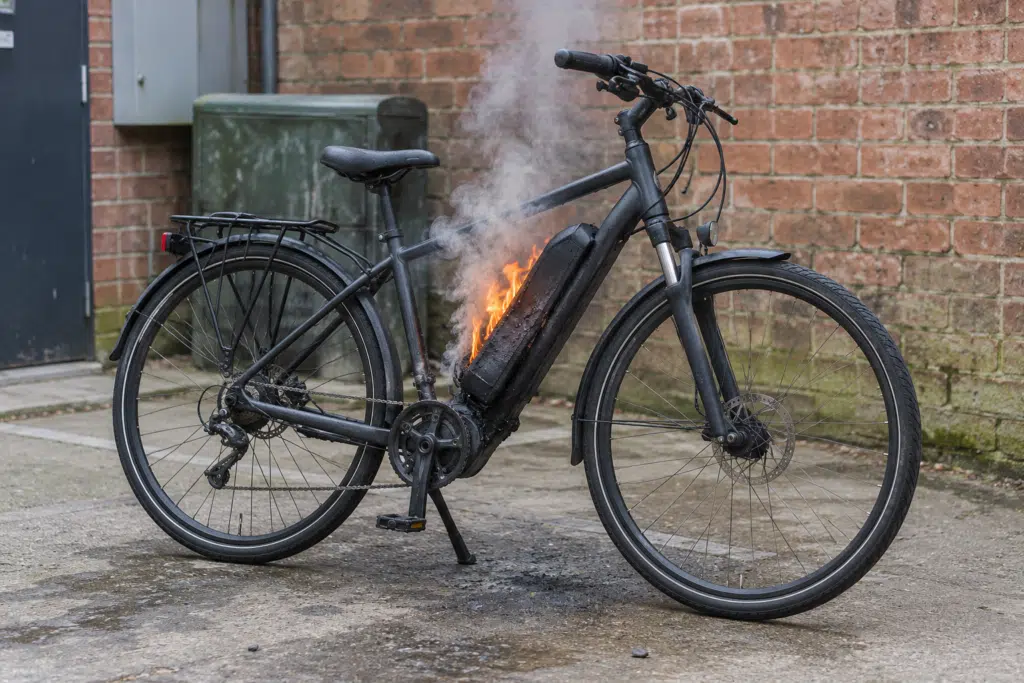
What Is a Class L Fire, and Should You Ever Use an Extinguisher on a Lithium-Ion Battery?
Written by Stephanie Austin, Owner & Lead Trainer, Prima Cura Training | Last reviewed: November 2026 | Next review: May 2027
Lithium-ion battery fires got their own fire class in January 2026. Here’s what that changes, what it doesn’t, and why a new letter on an extinguisher isn’t permission to fight one.
Recently I was working in a residential care home when I walked along a hallway and found a mobility scooter plugged in and charging, parked right across the fire escape door. It belonged to one of the residents, but the home was responsible for maintaining it. If that battery had failed, the fire would have started in the one place people needed to get out through.
A Class L fire is a fire involving lithium-ion cells and batteries, the rechargeable kind in e-bikes, e-scooters, mobility scooters, laptops, phones, vapes and power tools. Class L was added to the international standard for classifying fires, published in the UK as BS ISO 3941:2026, in January 2026. It’s a new name for a risk we already had, not a new way of putting it out. For an e-bike, e-scooter or mobility scooter battery fire, UK fire and rescue services are clear: don’t try to tackle it. Get out, stay out and call 999.
In more than 15 years as a trainer, I’ve learned to spot the question that’s about to land on every course. This one is “so do we need Class L extinguishers now?” The honest answer is more useful than a yes or a no, and it starts with what the new class actually is.
The Short Version
| The question | The answer |
| What is Class L? | Fires involving lithium-ion cells and batteries where no metallic lithium is present. Added in BS ISO 3941:2026. |
| Is it a new law? | No. It’s a classification. Your duties under the Regulatory Reform (Fire Safety) Order 2005 haven’t changed, but your fire risk assessment should cover battery risks. |
| Do I need new extinguishers? | Not automatically. Your fire risk assessment decides. The test standard for lithium-ion extinguishers was still being finalised in 2026. |
| An e-bike, e-scooter or mobility scooter is on fire | Don’t tackle it. Get everyone out, close doors behind you, call 999 and stay out. |
| A phone, laptop or vape is smoking, off charge | If you’re trained and it’s safe, a water or water-based extinguisher can cool it. If in doubt, get out. |
| A battery is hot, swelling, hissing or smells | Stop using it, unplug it if it’s safe to, keep people back and don’t charge it again. |
What Is a Class L Fire?
Fires are classed by what’s burning, because the fuel decides how a fire behaves and what will, or won’t, put it out. Until this year the international standard had five classes: A for solids, B for flammable liquids, C for flammable gases, D for metals and F for cooking oils and fats. The third edition of the standard, ISO 3941:2026, was published in January 2026 and added a sixth.
Class L covers fires involving lithium-ion cells and batteries “where no metallic lithium is present”. That’s the wording the National Fire Chiefs Council uses, and it has since added Class L to its national firefighting guidance. That one phrase, no metallic lithium, is what separates Class L from Class D.

Is a Class L fire the same as a Class D fire?
No, and this is where a lot of the confusion online comes from. Class D is for burning metals, and that includes disposable lithium metal batteries, the non-rechargeable kind. The rechargeable lithium-ion batteries in your phone, your laptop and your e-bike don’t contain metallic lithium. The British Standard for choosing and positioning extinguishers, BS 5306-8:2023, already made that distinction: rechargeable lithium-ion batteries are not Class D hazards. A Class D powder extinguisher is not the answer to a lithium-ion battery fire.
Why isn’t there an electrical fire class?
Because electricity isn’t a fuel, it’s a source of ignition. That’s true in the old standard and the new one. Once the power is off, a fire that started at a plug socket is usually a Class A fire. What makes lithium-ion batteries different is that switching off the power doesn’t switch off the battery. The energy is stored inside it, and it stays there.
Why Did Lithium-Ion Batteries Need Their Own Fire Class?
Because they don’t behave like anything else on the list. When the revised standard was published, the Fire Protection Association set out the hazards that justified a class of their own:
- Thermal runaway. Once a cell overheats, it sets off a chemical reaction that keeps producing its own heat.
- Cell-to-cell spread. One failing cell heats the next, so a battery pack can fail in stages.
- Toxic and flammable gases. Batteries vent gas as they fail, and that gas can build up and ignite.
- Explosion and projectiles. Cells can burst and throw debris.
- Stranded energy. A damaged battery can hold on to energy and re-ignite long after the flames seem to be out.
Put simply, you can knock the flames down and still have a battery that’s cooking itself from the inside. That’s why the fire service advice on these fires is so blunt.
The numbers explain why the industry wanted a name for it. London Fire Brigade attended 206 e-bike and e-scooter fires in 2025, a record for the capital and roughly one every other day. Closer to home, Greater Manchester Fire and Rescue Service attended 120 incidents involving e-bikes, e-scooters and mobility scooters between October 2020 and September 2025, with 34 of them in the last of those twelve-month periods, the highest of the five.
What Does Class L Change for Your Workplace?
Less than some of what you’ll read online would suggest. Class L is a classification. It isn’t a new law, and it doesn’t mean you have to replace the extinguishers you already have.
Your legal duties are exactly where they were, under the Regulatory Reform (Fire Safety) Order 2005. If you’re the responsible person for a workplace, or for the communal areas of a building, you already have to carry out a fire risk assessment, keep it under review, keep escape routes clear and give staff adequate fire safety training.
In plain English: if lithium-ion batteries are charged, stored or used in your building, and they almost certainly are, your fire risk assessment should say so and say how you’re managing them. The Fire Protection Association’s guidance after the new class was published says the same: assessments should establish whether lithium-ion batteries are present, what type and how many, and how they’re stored and charged.
The government has also published guidance for premises such as schools and workplaces on managing the fire risk from e-bike and e-scooter batteries, and London Fire Brigade has a page of guidance for responsible persons. Its reminder is a useful one to pin to the staff room wall: most fires involving e-bikes and e-scooters happen while the battery is charging.
Can You Put Out a Lithium-Ion Battery Fire With an Extinguisher?
Sometimes, if it’s a single small device and you’re trained. For anything bigger, no. The size of the battery changes everything.
A single small device, such as a phone, laptop or vape
BS 5306-8:2023 was the first edition of the British Standard on choosing and positioning extinguishers to deal with lithium-ion batteries. As BAFE explains, it says water or water-based extinguishers should be provided to cool individual small rechargeable devices, such as laptops, phones, e-cigarettes and portable power tools, that are no longer on charge. A device that is on charge has to be disconnected first. The same clause makes clear that it doesn’t cover multiple devices or the batteries in larger equipment.
So picture a laptop starting to smoke on a desk. It’s already unplugged, you’ve been trained, and you have a clear way out behind you. That’s the situation the British Standard has in mind. The aim is cooling: you’re not smothering the battery, you’re taking the heat out of it. If any part of that picture isn’t true, get out and call 999.
E-bikes, e-scooters and mobility scooters
This is where the advice changes completely. Greater Manchester Fire and Rescue Service puts it in one line: “Do not attempt to extinguish the fire. Get out, stay out, call 999.” London Fire Brigade says the same: get out immediately, raise the alarm, call 999 and don’t try to tackle the fire yourself.
An e-bike or mobility scooter battery holds far more energy than a phone. The fire can take hold in seconds and the smoke is toxic. A portable extinguisher isn’t built for that, and neither is the person holding it.
What about “lithium-ion” or “Class L” extinguishers?
You’ll see extinguishers sold as lithium-ion or Class L extinguishers. Most use AVD, aqueous vermiculite dispersion: a water-based agent carrying fine mineral particles, designed to cool the battery and coat it in a crust that helps stop the fire spreading between cells. Before you buy one, these are worth knowing:
- There isn’t a finished British test standard for them yet. The European standard that will set out how these extinguishers are tested and marked, EN 3-11, was still going through its final drafting and approval stages in 2026, and the drafts deal with small batteries, not large ones.
- The marking proposed in those drafts is a battery symbol with “Li”, not a letter L. So “Class L” on a label today is the manufacturer describing its own testing, not a certified rating.
- Class L describes the fire. It doesn’t promise that any extinguisher can put one out.
None of that makes them useless. For a site that charges a lot of small devices, a water-based extinguisher designed with lithium-ion batteries in mind may well be the right choice, and your fire risk assessment is where that decision belongs. It just doesn’t change the e-bike advice. A Class L sticker on an extinguisher isn’t permission to stand in a corridor and fight a mobility scooter fire.
Can a P50 extinguisher be used on a Class L fire?
I get asked this, and the honest answer is: which P50? P50 is a brand of service-free extinguishers made by Britannia Fire, and the range includes powder, water mist and a lithium-ion AVD model, among others. The name tells you who made it, not what’s inside it.
- A P50 powder extinguisher isn’t designed for lithium-ion batteries. Powder doesn’t give you the cooling the British Standard calls for.
- A P50 water mist or the P50 lithium-ion AVD model is water-based, so it fits the BS 5306-8 advice for a single small device that’s off charge, if you’re trained.
- No P50, and no other portable extinguisher, changes the advice for an e-bike, e-scooter or mobility scooter fire. Get out, stay out, call 999.
Read the label on the extinguisher, not the brand name on the side. That goes for every brand, not just this one.
What Should You Do If a Battery Is Overheating or on Fire?
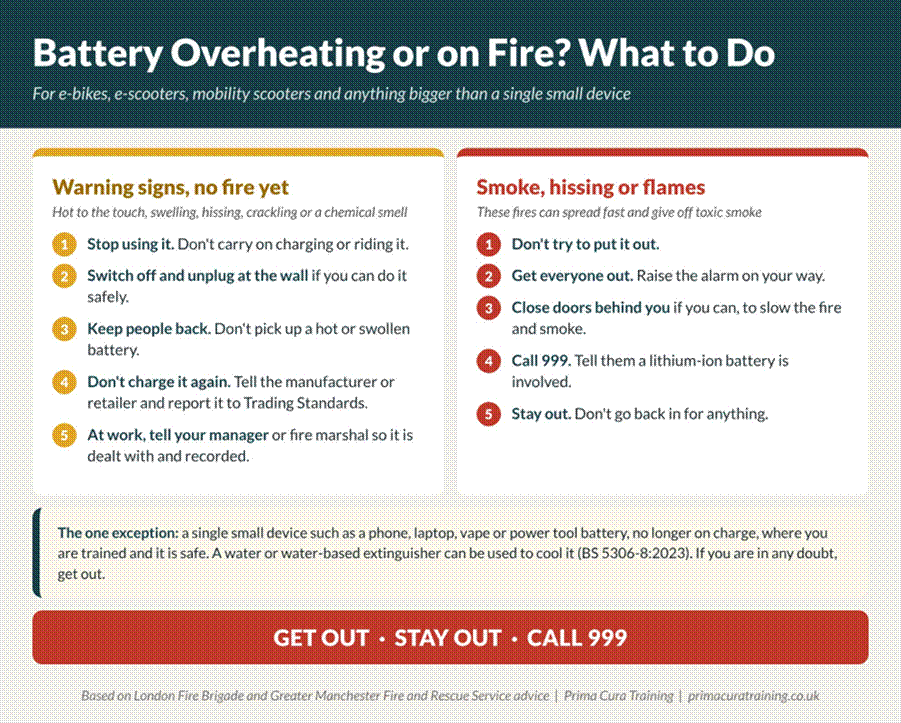
If you notice warning signs and there’s no fire yet:
- Stop using it. Don’t carry on charging it or riding it.
- Switch it off and unplug it at the wall, if you can do that safely.
- Keep people back, and don’t pick up a battery that’s hot or swollen.
- Don’t charge it again. Contact the manufacturer or retailer, and report a faulty battery to Trading Standards.
- At work, tell your manager or fire marshal so it’s dealt with and recorded.
If it’s smoking, hissing or on fire:
- Don’t try to put it out, unless it’s a single small device, off charge, and you’re trained.
- Get everyone out and raise the alarm on your way.
- Close doors behind you if you can, to slow the fire and smoke.
- Call 999 and tell them a lithium-ion battery is involved.
- Stay out. Don’t go back in for the battery, your bag or anything else.
Once the fire service has dealt with it, don’t be tempted to move, keep or reuse the battery. Damaged cells can hold stranded energy and re-ignite later.
How Can You Tell a Lithium-Ion Battery Is Failing?
Batteries rarely go from fine to fire with no warning at all. London Fire Brigade’s warning signs are worth teaching to everyone who charges anything at work:
- The battery is extremely hot to the touch, beyond the normal warmth of charging or use.
- It looks swollen, bulging or misshapen.
- There are lumps, leaks or cracks in the casing.
- You can hear hissing or cracking.
- There’s a strong chemical smell.
Some things make failure more likely. Fire services link many battery fires to chargers that don’t match the battery, batteries and chargers bought from unknown sellers or second-hand, batteries that have been dropped or damaged, and e-bike conversion kits. London Fire Brigade’s charging advice adds two habits that matter: let a battery cool down after use before you charge it, and never leave it charging unattended, overnight or while you’re asleep.

The Scooter by the Fire Escape: What Should Care Homes Do About Mobility Scooters?
Back to that hallway. The scooter mattered to the resident who owned it, because it was how they got about. But the home was responsible for its maintenance, which made it the home’s risk to manage, and it was charging right across the fire escape door.
I reported it to the manager and talked through why it couldn’t stay there, and what safer charging would look like. This kind of thing usually isn’t carelessness. A scooter needs charging, there’s a socket in the hallway, nothing goes wrong the first time, and after a while it stops looking like a risk at all.
The National Fire Chiefs Council’s mobility scooter guidance doesn’t leave much room for interpretation: “no storage or charging of mobility scooters on any escape route is allowed.” The same guidance warns that a scooter fire in a corridor or stairwell can make conditions untenable in under three minutes. In a care home, where some residents need staff to help them out of the building, three minutes is not long.
What good looks like in a care home:
- Scooters and powered wheelchairs are charged and stored in a designated area away from escape routes, ideally a fire-resisting room or a suitable outbuilding, with smoke or heat detection.
- Charging happens in the day, when staff are awake and around. The NFCC guidance suggests restricting overnight charging, and in staffed settings a managed approach decided by the fire risk assessment.
- Someone is named as responsible for checking the scooter, its charger and its battery, and those checks are written down.
- The fire risk assessment names the scooters, where they’re charged and how that’s controlled.
- The resident keeps their scooter. The scooter moves. This is about where and when it charges, not about taking anyone’s independence away.
And it isn’t only scooters. Think about powered wheelchairs, battery-powered equipment, staff phones and vapes charging in the staff room, and the e-bike someone rides to work. If you’re reviewing this as part of your wider risk assessments, our Risk Assessing in Health and Social Care course covers how to do it properly.
Supported Living: How Do You Manage Chargers When Support Is Meant to Be Hands-Off?
This question came straight from a group of my learners working in supported living for people with mental health needs. They weren’t worried about the big kit. They were worried about the small stuff: vapes, phone chargers and power banks bought cheaply from online marketplaces, often with no UKCA or CE mark, coming into the building without staff knowing what they were or where they came from.
Their question was a fair one. Supported living is designed to be less hands-on than residential care. People hold their own tenancies and run their own lives. So how much can staff actually do?
More than you’d think, and none of it involves confiscating anyone’s charger.
- Start with a conversation, not a rule. Most people have no idea that a cheap charger can be a fire risk. Explaining why, and showing the warning signs, does more than a ban ever will.
- Respect choice, and record it. Under the Mental Capacity Act 2005, a person with capacity can make decisions that others think are unwise. Your job is to make sure the choice is an informed one, and that the conversation is written down.
- Make the safe option the easy one. A sensible place to charge that isn’t a bed or a hallway, a working smoke alarm where people charge, and an agreement not to charge overnight or while asleep.
- Know what you’re looking at. UKCA or CE markings are a starting point, but London Fire Brigade warns that counterfeit markings exist. Poor packaging, missing instructions and no manufacturer details are warning signs too.
- Put it in the support plan and risk assessment, so it’s agreed, reviewed and not left to whoever happens to be on shift. Our Positive Risk Taking in the Care Sector course is built for exactly this kind of balance.
- Check the communal areas. Shared hallways and lounges fall under the Fire Safety Order, and the responsible person for the building should be looking at battery charging there.
- Use the free help. In Greater Manchester, the fire service offers a free Home Fire Safety Assessment for people whose health or circumstances raise their fire risk, and carers and professionals can refer someone with their permission. Many other fire and rescue services offer similar home safety visits.
One more thing for supported living teams: worn-out batteries and vapes don’t belong in household bins. GMFRS advises taking damaged or end-of-life batteries to your local household waste recycling centre.
What Happens When the Fire Risk Assessment Spots It and Nothing Changes?
My partner works in a university building where people were plugging e-scooters in to charge along a corridor and in an open-plan office, right where a battery failure would cause the most harm. He raised it and wasn’t taken seriously. Then the building had its fire risk assessment, and the assessor picked up exactly the same thing. And people are still doing it.
That’s the part that bothers me. The risk has been spotted twice, once by someone who works there and once by a professional, and it’s still happening. A fire risk assessment is only as good as what happens after it’s written.
It usually comes down to a few things. There’s nowhere else to charge. Nobody has explained why it matters. And nobody follows it up. So what actually changes behaviour?
- A written charging rule in plain English that says where e-bikes and e-scooters can and can’t be charged and stored.
- Somewhere safe to do it instead. London Fire Brigade has called on universities and colleges, along with landlords and local authorities, to help by providing safe storage or charging facilities where possible.
- Telling people why. The warning signs graphic above takes two minutes to go through in a team meeting.
- Fire marshals who know they can say “not there” and know what to do next.
- Managers who follow it up, and an action that isn’t closed until the behaviour has changed, not when the email has gone out.
Keeping escape routes clear isn’t optional. Article 14 of the Fire Safety Order requires the responsible person, where it’s needed to keep people safe, to make sure routes to emergency exits and the exits themselves are kept clear at all times. A charging e-scooter in a corridor isn’t clear.
At Home, and a Word Before Black Friday
Black Friday falls on 27 November this year, four days after this post goes out, and plenty of e-bikes, e-scooters, power banks and replacement chargers will be heading into baskets before Christmas. Greater Manchester Fire and Rescue Service’s festive advice is simple: buy from reputable sellers and manufacturers, check for UKCA or CE safety markings, and only use the correct charger for your battery.
At home, the same rules that protect a workplace apply:
- Charge on a hard, flat surface where heat can escape, away from exits and never anywhere that would block your way out.
- Fit a smoke alarm in the room where you charge.
- Let the battery cool after use before charging, and unplug the charger when it’s done.
- Don’t charge while you’re out, overnight or while you’re asleep.
- Register new products with the manufacturer so you hear about recalls.
- Never put batteries in the household bin. Take them to the recycling centre.
Stronger rules for online sellers are on their way. The Product Regulation and Metrology Act 2025 gives the government powers to place new duties on online marketplaces, and in June 2026 the government consulted on proposals that include requiring marketplaces to take due care to prevent, identify and remove dangerous products. Until those rules are in force, the checking is down to you.
Fire Safety Training That Keeps Up With Battery Fires
I’m adding Class L and lithium-ion battery risks to both of our fire safety courses, because the question is already coming up in the room. When I train on site, we talk about your scooters, your charging points and your corridors, not a generic floor plan.
- Fire Safety Awareness: for all staff. How fires start and spread, what the fire classes mean, spotting a battery that’s about to fail, raising the alarm and getting out.
- Fire Marshal: for the people with a fire safety role. Checks, keeping escape routes clear, managing an evacuation and the practical side of extinguishers. Hands-on extinguisher training with live fire is available on request.
- For care providers reviewing their battery risks, Risk Assessing in Health and Social Care pairs well with either course.
If you’d like to talk it through, give us a call on 0333 999 8783 or email info@primacuratraining.co.uk. You can also browse all of our courses.
Frequently Asked Questions
What is a Class L fire?
A Class L fire is a fire involving lithium-ion cells and batteries where no metallic lithium is present, such as the batteries in e-bikes, e-scooters, mobility scooters, laptops, phones and vapes. Class L was added to the international fire classification standard, BS ISO 3941:2026, in January 2026. It recognises that lithium-ion batteries can go into thermal runaway, release toxic gas and re-ignite, which sets them apart from other fires.
When was Class L introduced?
Class L was introduced in the third edition of ISO 3941, Classification of fires, published in January 2026 and adopted in the UK as BS ISO 3941:2026. It replaced the 2007 edition. The National Fire Chiefs Council has since added Class L to its national firefighting guidance.
What is the difference between a Class D and a Class L fire?
Class D fires involve burning metals, including disposable lithium metal batteries. Class L fires involve rechargeable lithium-ion batteries, which contain lithium salts rather than metallic lithium. A Class D powder extinguisher is not designed for lithium-ion battery fires.
Do I need a Class L fire extinguisher by law?
No. Class L is a fire classification, not a new legal requirement, and there was no finished British test standard for lithium-ion extinguishers in 2026. Under the Regulatory Reform (Fire Safety) Order 2005, your fire risk assessment decides what firefighting equipment you need, and it should now consider the lithium-ion batteries charged, stored and used on your premises.
This article is general information about fire safety and lithium-ion batteries in England, based on the standards, legislation and fire and rescue service guidance available at the time of writing. It isn’t legal advice and it doesn’t replace a suitable and sufficient fire risk assessment for your premises. Standards in this area are still developing, so check for updates before relying on anything here. If a battery is smoking or on fire, get out, stay out and call 999.