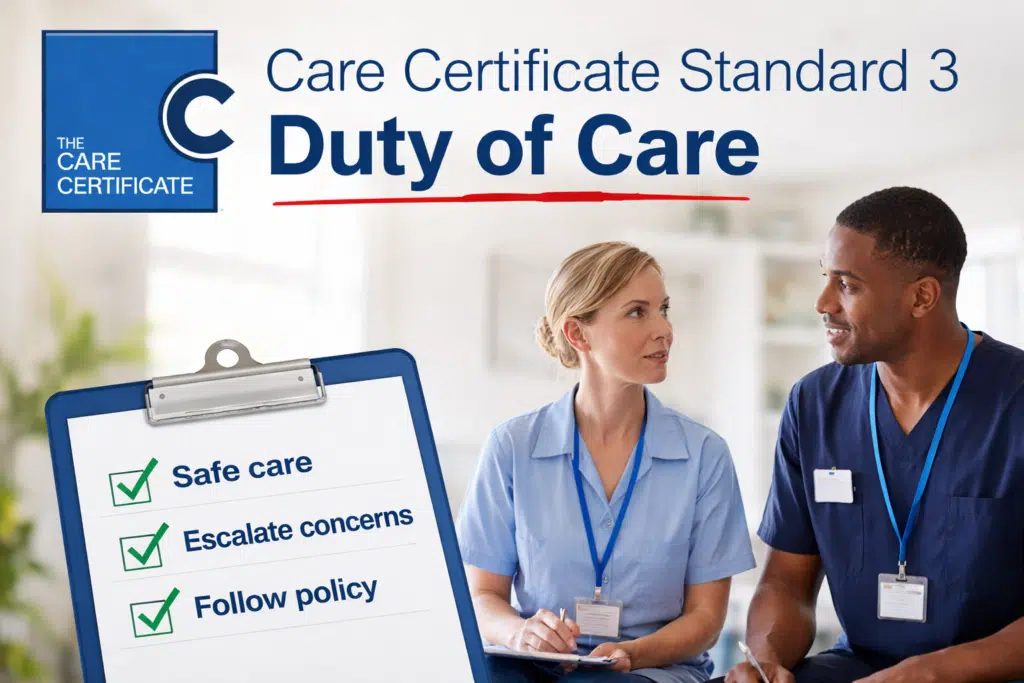
Care Certificate Standard 3: Duty of Care
Written by Stephanie Austin, Owner & Lead Trainer, Prima Cura Training
Last reviewed: April 2026 | Next review: April 2027
“Duty of care” is one of those phrases that everyone in health and social care recognises. It appears in policies, induction packs and inspection reports so often that it can start to feel automatic.
Ask a new starter what it means, and you will usually hear something like, “It means looking after people properly.” That instinct is right. But Care Certificate Standard 3 asks for something deeper than instinct.
It asks workers to understand what duty of care really means when situations are uncomfortable, awkward or emotionally difficult. Because in reality, Duty of Care is not tested when everything is running smoothly. It is tested when something feels wrong, and someone has to decide what to do next.
What Duty of Care Means in Everyday Practice
At its simplest, ‘duty of care’ means having a legal and professional responsibility to act in the best interests of the people you support and to avoid foreseeable harm, whether through action or inaction. In practice, that includes:
- Providing safe and competent care
- Following agreed ways of working
- Staying within your level of competence
- Escalating concerns appropriately
- Challenging unsafe or poor practice
This is not about being dramatic or confrontational, but understanding that professional responsibility does not pause when something feels uncomfortable.
Duty of care shows up in small, everyday decisions just as much as it does in safeguarding situations.
Where Duty of Care Sits Legally
Care workers are not expected to quote legislation, but they should understand that duty of care is grounded in a wider legal and regulatory framework.
In regulated adult social care services, expectations around safe care and safeguarding are overseen by the Care Quality Commission (CQC).
Duty of care links directly to:
- The Health and Social Care Act 2008 (Regulated Activities) Regulations 2014
- The Care Act 2014 and safeguarding responsibilities
- Regulation 12 (Safe Care and Treatment)
- Regulation 13 (Safeguarding service users from abuse and improper treatment)
- Regulation 18 (Staffing – competence and support)
That does not mean staff need to memorise regulation numbers. It means they need to understand that if harm is foreseeable and no action is taken, accountability can follow.
Framed properly, this is not about fear, it is about protection, for the person supported, for the worker and for the organisation.
When Loyalty and Professional Responsibility Collide
This is where Standard 3 becomes real. Most new staff want to fit in. They want to be seen as helpful and supportive. They do not want to cause tension. Now imagine noticing:
- A colleague is rushing the delivery of personal care
- Language that feels dismissive
- A medication shortcut
- Documentation was completed later without clarity
These are not dramatic scandals. They are the everyday moments where culture quietly reveals itself.
Duty of care requires action, not public confrontation, nor accusation, but appropriate reporting through agreed organisational pathways.
Emotionally, that can feel difficult. Standard 3 exists to help staff understand that raising a concern is not a betrayal of a colleague. It is a commitment to safe practice.
Raising Concerns and Whistleblowing
A meaningful Standard 3 discussion should ensure that workers understand:
- How to raise concerns within their organisation
- Who to report to
- What whistleblowing actually means
- How safeguarding pathways operate
- Why documentation matters
In a healthy service, staff know who the safeguarding lead is. They know how to record concerns factually. They trust that concerns will be taken seriously and handled fairly.
If someone says, “I wouldn’t want to get anyone in trouble,” that is not something to criticise. It is a starting point for a conversation about accountability and culture. Workers need reassurance that raising concerns in good faith is protected, not punished.
Doing Nothing Is Still a Decision
One of the most important elements of Standard 3 is understanding that failing to act can carry the same weight as acting incorrectly.
If unsafe practice is observed and not reported, harm can build gradually. Documentation gaps widen. Safeguarding risks grow quietly.
Record-keeping is often misunderstood as bureaucracy. In reality, it provides:
- Evidence of action
- Clarity for managers
- Continuity of care
- Protection for the person supported
- Protection for the worker
When staff understand that early on, documentation becomes purposeful rather than procedural.
Balancing Safety, Rights and Independence
Duty of care does not mean removing all risk. Good care balances safety with dignity, autonomy and personal choice. Supporting someone to make an unwise decision can still be appropriate, provided risk is assessed and managed proportionately. Which connects back to understanding your role under Standard 1.
The question often becomes: are we protecting the person, or are we protecting ourselves from scrutiny?
That reflection is not always simple. It often belongs in supervision discussions as much as it does in induction training. This is where ‘duty of care’ overlaps with person-centred care and safeguarding principles. It requires thoughtful judgment rather than defensive practice.
What a Meaningful Standard 3 Assessment Should Explore
A robust Care Certificate Standard 3 assessment should go beyond a written definition.
It should involve:
- Discussion of realistic scenarios
- Exploration of reporting and escalation pathways
- Understanding of safeguarding responsibilities
- Awareness of whistleblowing procedures
- Reflection on personal and professional accountability
Ask a worker, “What would you do if you saw a colleague acting unsafely?”
The quality and balance of their response will tell you far more than a worksheet ever could.
Where Services Sometimes Drift
Standard 3 weakens when:
- Reporting pathways are unclear
- Policies are lengthy but not explained
- Managers respond inconsistently
- Staff fear repercussions
- Concerns are dismissed
If someone raises a concern once and feels unsupported, that experience shapes future behaviour.
Duty of care only works when leadership behaviour reinforces it. Culture is not created by policy. It is created in response. These patterns often become more visible during inspection, particularly when assessed against the expectations set out in the CQC Quality Statements, where culture, leadership response and safeguarding confidence are explored in practice rather than on paper.
How We Approach Standard 3 in Practice
When supporting organisations implementing the Care Certificate framework, much of our work around Standard 3 focuses on strengthening confidence, particularly at the management level.
That might include:
- Clarifying escalation pathways
- Reviewing whistleblowing procedures
- Strengthening safeguarding documentation standards
- Encouraging reflective supervision conversations
- Supporting managers to respond proportionately and consistently
Duty of care cannot live only in a workbook. It must be visible in everyday decisions and leadership responses. When staff feel safe to raise concerns and managers respond constructively, safeguarding improves without creating a culture of fear.
Frequently Asked Questions
Is Duty of Care the same as safeguarding?
No. Safeguarding focuses specifically on protecting people from abuse and neglect. Duty of care is broader and applies to all aspects of safe, competent and accountable practice.
Can a care worker be personally accountable?
Yes. Care workers hold professional responsibilities and may be accountable for negligent actions or failure to act where harm was foreseeable. Understanding this strengthens professional awareness rather than creating anxiety.
Does raising a concern automatically mean making a complaint?
Not necessarily. It means following the correct reporting pathway when something unsafe or inappropriate is identified.
Why Standard 3 Deserves Careful Attention
Care Certificate Standard 3 is not about frightening staff with liability, but rather, building confidence to act appropriately when something does not feel right. When Duty of Care is genuinely understood:
- Concerns are raised earlier
- Safeguarding improves
- Documentation becomes clearer
- Accountability strengthens
- Risk reduces
Serious problems rarely appear without warning. They develop quietly when small concerns are ignored.
Standard 3 helps prevent that quiet build-up.
If you are reviewing your Care Certificate framework, this is the point at which you assess whether staff truly feel safe, supported and confident enough to speak up when it matters.
Policies are necessary; however, culture is decisive.
This article is provided for guidance and educational purposes only. It does not replace organisational policy, professional supervision or legal advice. Providers should ensure alignment with current legislation and regulatory expectations, including duties under the Health and Social Care Act 2008, the Care Act 2014 and oversight by the Care Quality Commission. Where uncertainty exists, appropriate senior management or legal advice should be sought.


