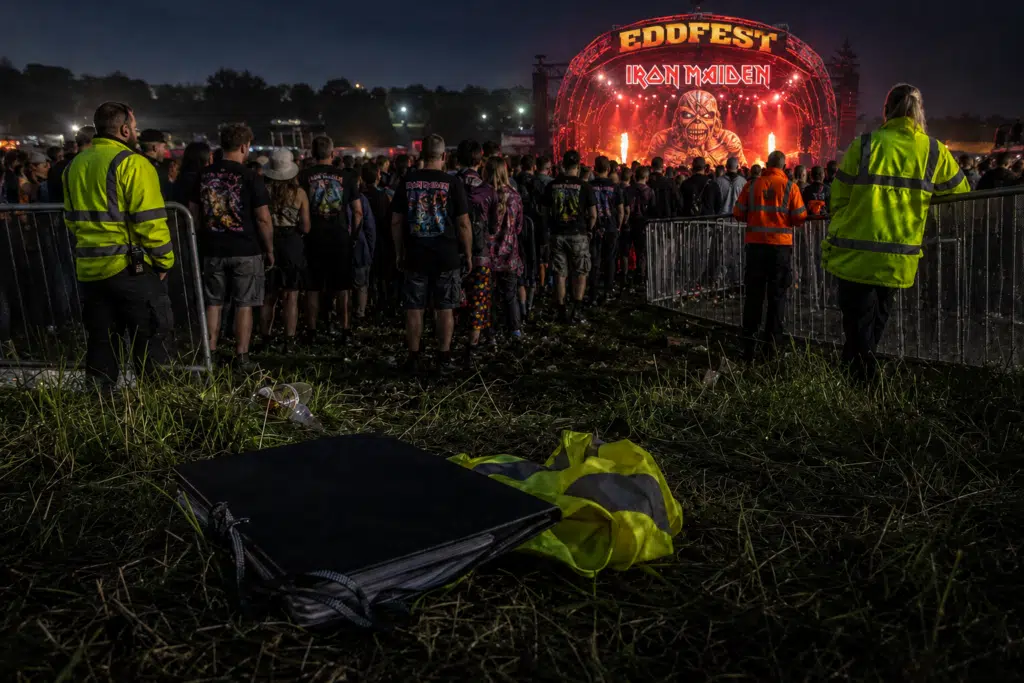
Iron Maiden Were Phenomenal. EddFest’s Safety Plan Never Left the Handbook.
Written by Stephanie Austin, Founder & Lead Trainer, Prima Cura Training | Last reviewed: August 2026 | Next review: August 2027

Iron Maiden at Knebworth on 11 July 2026 gave me exactly what I paid for.
Eddie loomed over the stage, 55 thousand people bellowed along to every chorus, and I came away buzzing in the way only a gig you’ve waited years for can leave you. That’s not what I’ve spent the weeks since thinking about, though.
15 years of delivering health and safety training does something to how you watch a crowd. I wasn’t just a fan. I was clocking queue lengths, watching how security handled bag checks, and noticing who was actually in charge when things started to go wrong. And a lot went wrong.
The policies were there. I know that for a fact, because copies of the EddFest staff handbook ended up littered across the site by the end of the night, dropped by the people who were supposed to be using them. What wasn’t there, consistently, was anyone applying them.

The Queue Nobody Was Watching
On the walk up to the gates, one toilet block was serving thousands of people arriving for a show of over fifty thousand. Four portaloos in that block had a queue of around seventy people when I walked past. While people stood waiting, I watched someone collapse from the heat. No security. No medical staff. It was the people standing near them, total strangers, who stepped in.
It didn’t stop there. Later on, I was refused access to the accessible toilets, despite showing a RADAR key, the standard national scheme for exactly that purpose, because I was told it “only applied to people with a physical disability.”
That’s not what the scheme is for, and it left me queuing for the regular toilets for another fifteen minutes on top of everything else. Reasonable adjustments for disabled visitors aren’t a nice-to-have. They’re a duty under the Equality Act 2010, and misapplying a scheme built to help people is its own training failure, not a paperwork one.
Welfare planning for an event this size is basic risk assessment: how many toilets a crowd needs, and who’s watching the queues that inevitably form. Neither had been thought through properly, and the gap got filled by members of the public doing a job event staff should have been doing.
Why Did Security Depend on Which Gate You Walked Through?
Good security screening is consistent, or it isn’t really security; it’s theatre.
At EddFest it was neither. Ticket scanners were failing for a lot of attendees, and staff waved people through without checking anything. When I went through myself, nobody looked in my bag despite it being visible on my shoulder, and I walked through with both hands in my pockets. The only question I got asked was whether my dress had pockets. I said no, as a joke, assuming it was obvious I was joking. I was waved through anyway.
A few feet away, other attendees were being made to tip out water bottles the event’s own pre-event guidance said were allowed in. Inconsistent screening like that isn’t a minor inconvenience. At an event of this scale, it’s a genuine gap, and it shouldn’t happen.
This is precisely the gap our WAVE (Welfare and Vulnerability Engagement) training is built to close for security and licensed premises staff: spotting risk consistently, not just when someone’s watching.
It matters more than it might have a year ago, too. The Terrorism (Protection of Premises) Act 2025, known as Martyn’s Law, received Royal Assent in April 2025 and introduces a statutory duty on qualifying premises and events to plan and prepare for a terrorist attack.
It isn’t in force yet. Government guidance sets an implementation period of at least 24 months from Royal Assent, so there’s no suggestion EddFest broke the law that night. But it’s exactly the kind of preparedness gap the legislation exists to close, and screening this inconsistency, happening now, is worth organisers paying attention to well before that duty lands.
The Handbook Was on the Ground. The Training Wasn’t in the Room.
Here’s the part that stuck with me most. Copies of the staff handbook, the internal document telling event staff exactly what they were supposed to do, were scattered around the arena by the end of the night. Someone even filmed themselves flicking through a discarded copy, and that footage did the rounds in an attendee Facebook group afterwards.
So the problem was never a lack of paperwork. The procedures existed, in enough detail that a stranger could pick one up off the ground and read it cover to cover. What was missing was anyone applying it under pressure. A handbook nobody’s trained on is just paper. It doesn’t stop a crush, it doesn’t calm a queue, and it definitely doesn’t stay in a member of staff’s hands instead of on the floor.
It wasn’t just the handbooks that told me oversight was thin on the ground that night. Bar staff, a few people ahead of me in the queue, were quietly offering ten drinks for £50 cash, bypassing the official cashless system entirely. Small detail, maybe, but it says something about how closely anyone was actually supervising staff conduct once the doors opened.

Twenty-Five Minutes in a Crowd That Shouldn’t Have Existed
The exit is where this stopped being merely disappointing and started being genuinely dangerous.
There was no signage directing people to different exits, so the entire crowd funnelled toward one gate near the welfare and first aid tent.
It took around twenty-five minutes to get through. The crowd compressed to the point where people were being pushed, and some were running through gaps in a fully enclosed space. Crowd barriers that should have been removed for the exit were still in place, and people fell over them.
One security guard was trying to manage that bottleneck. One. No megaphone, no colleagues nearby to help him.
HSE’s own guidance on crowd safety at events sets out exactly this scenario: monitor crowd density, plan egress routes properly, and make sure barriers are configured for getting out, not just getting in. None of that showed up on the night, and dangerous crowd compression at an exit is one of the most well-documented ways serious injuries happen at large events.
The Walk Nobody Marshalled
Getting back to the car meant a walk of over a kilometre with no lighting, no marshals and no signage. Attendees simply followed each other in the dark, and plenty of people, myself included, ended up in the wrong area as a result.
In the space of that one walk, I watched a wheelchair user tip into a ditch after being funnelled into a fenced area with no safe route through, only for other attendees to get them out. I watched a woman fall, and later learned she’d broken her wrist. I watched someone on crutches become physically trapped in loose safety netting that should never have been left across a walking route. When a staff member eventually turned up to deal with the netting, they laughed and told people to move along.
Further on, near the cattle grids, where the crowd had become so lost that people were effectively walking in circles, I found two marshals and asked for help. They told us their shift had ended and they weren’t prepared to assist, laughing as they said it. A member of the public who’d taken it on herself to direct traffic was asked by marshals if she wanted a hi-vis vest, since they’d already clocked off.
Families with young children were still searching for their cars at one in the morning, in the cold, with no lighting and nobody to ask.

Three Hours Going Nowhere
Finding the car didn’t end it. What followed was close to three hours stuck in the dark, barely moving, because there was no organised traffic management across the five car park zones, all of them barriered off from each other and poorly signed. In the end it was other attendees, not staff, who started shifting barriers themselves just to let cars through.
I’d gone to the show with my friend Pete, who has type 1 diabetes and is open about it because he’d rather people understood what that actually looks like day to day, not just the textbook version. Sitting in a stationary car for hours with no idea when we’d move, his blood sugar dropped fast, quickly enough that it got uncomfortably close to becoming a real emergency.
We managed it between us, but it’s exactly the kind of situation event planning is supposed to anticipate. Thousands of people held in gridlocked car parks for hours isn’t just a bad end to a good night. For someone managing a health condition, it’s a genuine risk, and it’s precisely why welfare provision has to cover getting people out safely, not just letting them in.
What a Thousand Other People Saw Too
I know this wasn’t just my night going wrong, because a dedicated Facebook group set up for EddFest attendees has hundreds, by some counts over a thousand, people describing versions of the same evening. Poor signage. Inadequate welfare facilities. Inconsistent security. Injuries and serious delays on exit. When that many strangers independently describe the same failures, it stops looking like one attendee’s bad night and starts looking like a systemic planning problem.
I raised all of this formally, in writing, including from my professional standpoint as someone who has delivered Welfare and Vulnerability Engagement (WAVE) training to security and licensed premises staff for years. Months on, I still haven’t had a reply.
So What Would Actually Have Fixed This?
Not more paperwork. EddFest almost certainly had risk assessments, an event safety plan and a staff handbook covering most of what went wrong that night. I know the handbook existed. I watched people wading through it on their phones.
What was missing was people who’d actually been trained to apply it: staff confident enough to check a bag properly instead of waving people through, marshals who knew what to do with a crowd that had lost momentum instead of laughing and walking away, and someone briefed to notice a seventy-person queue outside four portaloos before someone collapsed in it.
I’ve seen the same gap at gigs for fifty thousand people and in warehouses with twenty staff on the floor. Good documents don’t train anyone. People do, and only once they’ve actually been given the training and the confidence to use it under pressure.

If your team is responsible for security, welfare or crowd safety, whether that’s at events or on your own site, our WAVE training builds exactly this kind of confidence under pressure. It sits alongside our First Aid and Health & Safety Awareness courses for teams who want their people, not just their paperwork, ready for the moment something goes wrong. Get in touch if you’d like to talk through what would actually make a difference for your team.
This article reflects Stephanie Austin’s personal, first-hand account and professional opinion of the event she attended on 11 July 2026, and is not an investigative report, legal finding, or official statement on behalf of any regulatory body. It describes what Steph and her friend Pete personally witnessed and experienced that night; references to a wider pattern of complaints from other attendees are included to show that similar experiences were widely reported, not because Prima Cura has independently verified each of those accounts. A formal written complaint covering these concerns was submitted to the event’s organisers and, as of publication, has not received a response. Where staff conduct is described in this article, it reflects Steph’s own observations and interpretation of events on the night, not a finding of misconduct against any individual or organisation. Legislative references, including to Martyn’s Law, the Equality Act 2010 and HSE guidance, are correct to the best of our knowledge at the time of writing but do not constitute legal advice; readers should refer to gov.uk, legislation.gov.uk and hse.gov.uk directly for current guidance, and Martyn’s Law in particular is not yet in force. Details relating to Pete, including his health condition, are included with his full knowledge and consent.