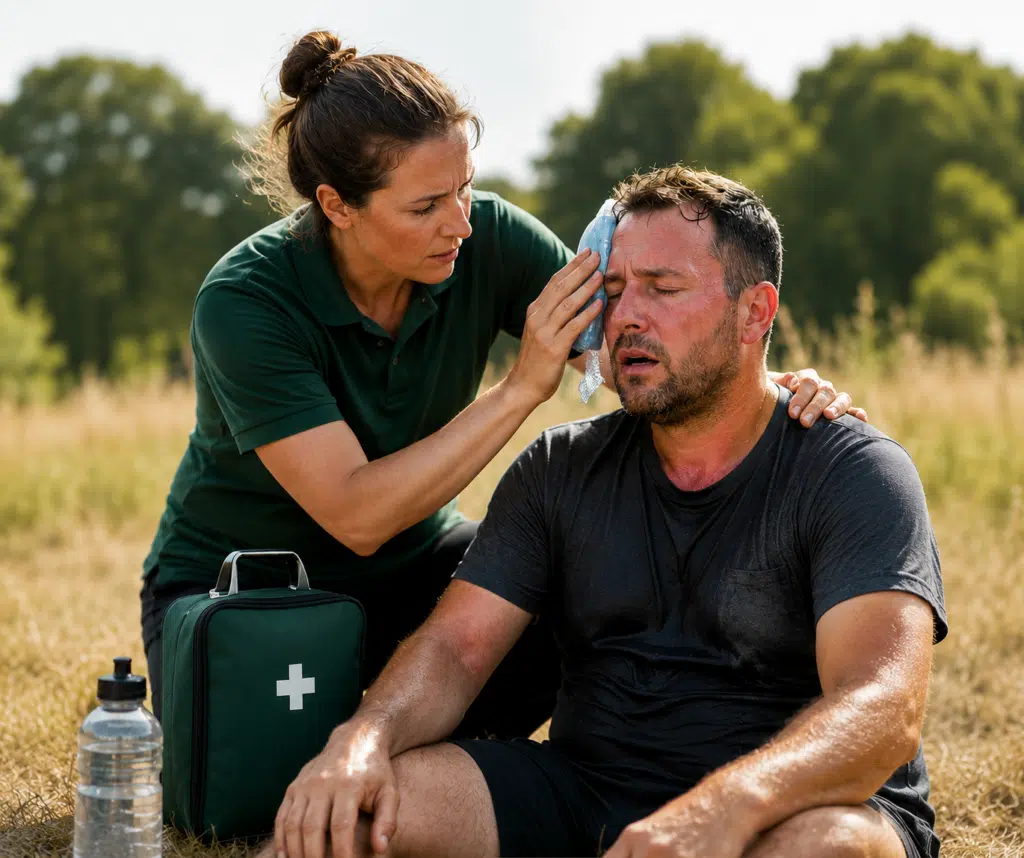
Do You Know the Difference Between Heat Exhaustion Vs Heat Stroke?
Written by Stephanie Austin — Owner & Lead Trainer, Prima Cura Training | Last reviewed: May 2026 | Next review: May 2027
One Needs Water and a Sit-Down. The Other Needs 999. Do You Know the Difference Between Heat Exhaustion and Heat Stroke?
Every summer, I pull on a wool doublet, strap on leather and steel, and spend a day marching across a field dressed as a 17th-century soldier. I do historical battle re-enactment, which is every bit as brilliant as it sounds and considerably hotter than it should be. The kit we wear, wool, linen, armour in some cases, was designed for a climate historians will tell you was noticeably cooler than what we now experience. The people who originally wore this stuff were not doing it in late July heat. We are.
In that world, heat-related illness is a regular and serious topic. We look out for each other. And the thing that comes up again and again, both at events and in my first aid training sessions, is the confusion between heat exhaustion and heat stroke. People use the terms as though they mean the same thing. They don’t. One is your body struggling but still coping. The other is your body in crisis. Knowing the difference could genuinely change what you do next, and that matters.
The Short Version
| Heat Exhaustion | Heat Stroke | |
| Body temperature | Raised, usually below 40°C | 40°C or above |
| Skin | Pale, cool, clammy | Hot, flushed (may be dry or still sweating) |
| Mental state | Alert, may feel dizzy or distressed | Confused, disoriented, or unconscious |
| Sweating | Heavy sweating | May have stopped (or ongoing if exercise-related) |
| Action | Cool, rest, rehydrate, monitor | Call 999 immediately |
What Is Heat Exhaustion?
Heat exhaustion occurs when the body overheats but hasn’t yet lost control of its ability to regulate temperature. It’s serious and needs attention, but it isn’t immediately life-threatening if you respond quickly.
The body is still doing its job (sweating, trying to cool down), but it’s running low on water and salts to work with. The result is someone who feels genuinely awful: heavy sweating, pale and clammy skin, weakness, dizziness, a fast but weak pulse, headache, nausea, and sometimes muscle cramps. They may feel faint. But the key point is that they should still be conscious and able to hold a conversation. That distinction matters more than almost anything else.
What to do for heat exhaustion:
- Move the person somewhere cool: shade, air conditioning, anywhere out of direct heat
- Loosen or remove excess clothing
- Cool them down: cool water on the skin, a fan if available, cool damp cloths to the neck and forehead
- Give cool water to drink in small sips, if they’re conscious and not vomiting
- Have them lie down with legs raised if they feel faint
- Monitor closely
If they don’t show genuine improvement within 30 minutes, or if their condition gets worse, call 999. Heat exhaustion that goes untreated can become heat stroke. That’s not scare-mongering; it’s just how the physiology works.
What Is Heat Stroke?
Heat stroke is a medical emergency. The body’s temperature regulation has broken down entirely. Core temperature has reached 40°C or above, and the body can no longer cool itself effectively. Without rapid treatment, heat stroke can cause organ damage, brain damage, or death.
Where heat exhaustion leaves a person pale and sweaty, heat stroke typically produces hot, flushed skin. In the classic form, seen more often in people who are elderly or have underlying health conditions, sweating stops, and the skin becomes dry. In the exertional form — the kind you’d see in soldiers, athletes, construction workers, or anyone doing intense physical activity in the heat — the person may still be sweating. Don’t assume that ongoing sweating means it isn’t heat stroke.
The clearest warning sign is a change in mental state. Confusion, agitation, slurred speech, strange behaviour, or loss of consciousness. If someone is hot and they’re not making sense, don’t wait for a thermometer reading. Treat it as heat stroke.
What to do for heat stroke:
- Call 999 immediately – do not wait to see if the person improves
- While waiting: remove excess clothing, apply cool water to the skin, use a fan, place cold packs or ice in the armpits, groin, and neck area
- Do not give fluids to someone who is confused or unconscious
- Keep monitoring them until the ambulance arrives
Every minute without active cooling increases the risk of serious harm. This is not a situation to sit with.
How Do You Tell Them Apart Without a Thermometer?

Most people aren’t carrying a clinical thermometer, particularly at an outdoor event or on a construction site in July. The practical question is: how do you tell which one you’re looking at?
Mental state is the most reliable indicator. A person with heat exhaustion will be distressed and weak, possibly frightened, but they can talk to you coherently. They know where they are and what’s happening. A person moving toward heat stroke will start to seem off. Confused answers. Disorientation. Irritability that doesn’t fit the situation. Slurred speech. Or they lose consciousness.
Look at the skin too. Pale, cool, and clammy points toward exhaustion. Hot, red, and flushed points toward stroke, particularly when combined with that change in behaviour.
If you’re genuinely not sure, treat it as the more serious of the two. You can cool someone down and monitor them while you wait for help. What you can’t do is undo the decision not to call when it mattered.
Can Heat Exhaustion Turn Into Heat Stroke?
Yes, and faster than most people expect. If heat exhaustion isn’t treated, or if the person stays in the heat and continues exerting themselves, the body’s temperature regulation will eventually fail. At that point, it becomes heat stroke.
The 30-minute window is a useful rule of thumb. If someone with heat exhaustion isn’t showing clear improvement within half an hour of being cooled, rested, and rehydrated, call 999. You’re not overreacting. You’re doing the right thing.
What Are Employers’ Responsibilities in Hot Weather?
Yes, there are legal obligations here. Under the Health and Safety at Work Act 1974 and the Management of Health and Safety at Work Regulations 1999, employers have a duty to protect workers from foreseeable risks. Working in excessive heat is one of them.
There’s no legal maximum workplace temperature in England, but the HSE’s guidance on thermal comfort is clear: where conditions are uncomfortably hot, a risk assessment is needed, and control measures should be in place. That means rest breaks, access to cool drinking water, shade or ventilation, lightweight clothing options where possible, and proper acclimatisation for workers new to hot environments.
It also means having people on site who know what to look for and what to do. A trained first aider doesn’t replace a risk assessment or decent working conditions, but they’re a significant part of a sensible response.
Find Out More About Our First Aid Training
If this is prompting you to think about your team’s first aid cover, I’d be glad to help. Prima Cura Training delivers first aid courses across Manchester and the wider UK, built around real-world scenarios and practical skills that genuinely stick.
Courses relevant to this topic:
Drop us a line on 0333 999 8783 or at info@primacuratraining.co.uk, and we can talk through what makes sense for your team.
Frequently Asked Questions
What is the main difference between heat exhaustion and heat stroke?
Heat exhaustion occurs when the body overheats but is still managing to regulate its temperature. The person will be sweating heavily, with pale, clammy skin. Heat stroke is a medical emergency in which the body’s temperature regulation has failed: core temperature is at or above 40°C, and the person will typically have hot, flushed skin and, critically, an altered mental state. If someone is confused, disoriented, or loses consciousness, treat it as heat stroke and call 999 immediately.
What are the symptoms of heat exhaustion?
The main symptoms of heat exhaustion are heavy sweating, pale or clammy skin, weakness and fatigue, dizziness, headache, nausea, muscle cramps, and a fast but weak pulse. The person is usually conscious and able to communicate, though they will feel very unwell.
What are the symptoms of heat stroke?
Heat stroke symptoms include a core body temperature at or above 40°C, hot and flushed skin, a rapid and strong pulse, and a change in mental state, which can range from confusion and agitation through to slurred speech or loss of consciousness. In the classic form, sweating may have stopped entirely. In the exertional form (exercise or physical exertion in the heat), the person may still be sweating.
Is heat stroke a medical emergency?
Yes. Heat stroke requires an immediate 999 call. The body’s temperature regulation has broken down, and without rapid cooling and medical treatment, there is a serious risk of organ damage, brain damage, or death. Do not wait to see if the person improves on their own.
Can you give water to someone with heat stroke?
Not if they are confused or unconscious. Never give fluids to someone who is not fully alert, as there is a risk of choking. If the person is conscious and coherent, small sips of cool water may be appropriate, but the immediate priorities are calling 999 and actively cooling the person while you wait for help.
How quickly can heat exhaustion become heat stroke?
There is no fixed timeframe: it depends on conditions, the level of physical exertion, age, and individual health factors. But the progression can be rapid, which is why prompt treatment matters. A practical guide is the 30-minute rule: if someone with heat exhaustion is not showing clear improvement within 30 minutes of being cooled, rested, and given water, call 999.
Do employers have a legal duty to prevent heat-related illness at work?
Yes. The Health and Safety at Work Act 1974 and the Management of Health and Safety at Work Regulations 1999 require employers to protect workers from foreseeable health and safety risks, which include working in excessive heat. The HSE recommends risk assessments for hot working environments and appropriate control measures, including rest breaks, cool drinking water, shade, and acclimatisation for workers new to hot conditions.
This article is intended as general information and does not constitute medical or professional advice. The guidance reflects current NHS and HSE recommendations at the time of writing, but readers should always seek specific medical advice for individual circumstances. If you believe someone is experiencing heat stroke, call 999 immediately. Information is accurate to the best of our knowledge at the date of publication; legislation and clinical guidance may be updated over time.