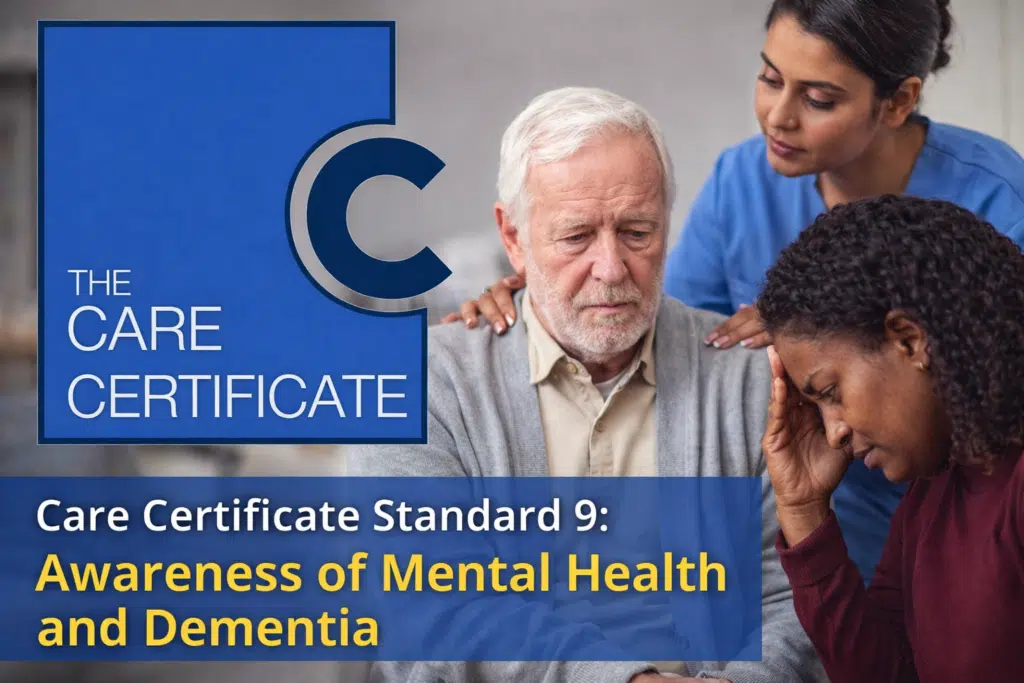
Care Certificate Standard 9: Awareness of Mental Health and Dementia
Written by Stephanie Austin, Owner & Lead Trainer, Prima Cura Training
Last reviewed: May 2026 | Next review: May 2027
The March 2025 Care Certificate framework published by Skills for Care emphasises this early understanding so that staff approach people with curiosity, patience and respect rather than assumptions.
This article forms part of the Care Certificate Standards series, where we explore each standard in practical terms for supervisors, assessors and care teams.
Care Certificate Standard 9 is one of the standards that often prompts the most questions from new care workers.
Many learners initially assume it will require detailed medical knowledge or clinical understanding of mental health conditions and dementia. In reality, that is not the purpose of this standard.
Standard 9 is about awareness rather than diagnosis.
It introduces workers to the ways mental health conditions and dementia may influence behaviour, communication, emotional responses and everyday decision-making. The aim is not to turn care staff into clinicians, but to ensure they recognise when someone may need understanding, adjustments in communication or additional support.
In health and social care settings, awareness can change how situations unfold. When staff understand that behaviour may have an underlying cause, they are far more likely to respond calmly and appropriately. When that awareness is missing, behaviour may be misinterpreted, which can unintentionally increase distress or risk.
What Care Certificate Standard 9 Really Requires
Within the Care Certificate framework, Standard 9 asks workers to develop a basic awareness of:
- Common mental health conditions
- Dementia and how it may affect individuals
- How mental health and dementia may influence behaviour and communication
- The importance of promoting understanding and reducing stigma
- When concerns should be reported or escalated
This is an awareness standard, not a clinical one.
Care workers are not expected to diagnose mental health conditions or interpret complex medical presentations. Their role is to recognise that someone’s behaviour, mood or communication may be influenced by their health and to respond in a way that supports dignity, safety and wellbeing.
Understanding this also links closely with responsibilities around Duty of Care, which we explored in Care Certificate Standard 3: Duty of Care.
Awareness helps ensure that support remains respectful and proportionate.
The Legal and Regulatory Context
Understanding mental health and dementia sits within a wider legal and regulatory framework governing safe care.
Key legislation and guidance influencing practice include:
- Health and Social Care Act 2008 (Regulated Activities) Regulations 2014
- Regulation 9 – Person-centred care
- Regulation 12 – Safe care and treatment
- Regulation 13 – Safeguarding service users from abuse and improper treatment
Oversight of these standards in England sits with the Care Quality Commission (CQC).
Mental health awareness is also closely connected to the Mental Capacity Act 2005, which protects the rights of people who may have difficulty making certain decisions.
You can read more about this in our guide to the Mental Capacity Act and our Mental Capacity Act training, which explores how capacity, decision-making and support intersect in everyday care.
If behaviour is misunderstood, communication is not adapted appropriately, or vulnerability is overlooked, situations can escalate into safeguarding concerns rather than simple misunderstandings.
Care Certificate Standard 9 introduces awareness early so that workers understand how to respond proportionately and seek guidance when needed.
Services often reinforce this understanding through Safeguarding training, helping staff recognise risk indicators and escalate concerns appropriately.
Mental Health: Understanding the Impact on Daily Life
Mental health conditions are common across all areas of health and social care.
People may experience a wide range of conditions, including anxiety disorders, depression, bipolar disorder, schizophrenia or trauma-related conditions. These experiences can influence how someone interacts with others and how they respond to everyday situations. Mental health may affect areas such as:
- Mood and emotional regulation
- Motivation and engagement
- Sleep patterns
- Appetite and physical wellbeing
- Communication style
- Social interaction
Someone who appears withdrawn may not be disengaged. A person who seems irritable may be feeling overwhelmed. Someone who avoids interaction may be experiencing anxiety rather than rudeness.
Standard 9 encourages workers to pause and consider possible causes rather than making assumptions about behaviour.
This awareness helps protect dignity and reduces stigma.
Dementia: Looking Beyond Memory
In everyday conversation, dementia is often associated mainly with memory loss. In practice, dementia can affect a much broader range of abilities.
Depending on the individual and the stage of the condition, dementia may influence:
- Communication and language
- Orientation to time and place
- Emotional regulation
- Perception and understanding
- Behaviour and personality
Behaviour that appears confusing or challenging often has meaning behind it. For example, agitation during personal care may reflect fear, pain or confusion rather than resistance. Repeated questions may signal anxiety rather than forgetfulness. Withdrawal may occur when a person feels overstimulated or overwhelmed.
Standard 9 encourages staff to explore possible causes calmly and to escalate concerns appropriately rather than reacting solely to behaviour.
This approach aligns closely with expectations around safe care and safeguarding.
Many services support this through structured Dementia Awareness training, helping staff understand how dementia affects communication, perception and behaviour.
Stigma and Professional Language
The language used in care settings has a powerful influence on workplace culture.
Describing someone as “attention-seeking” rather than “distressed” can alter how staff interpret their needs. Referring to someone as “difficult” rather than “overwhelmed” subtly shapes the way teams respond.
Care Certificate Standard 9 highlights the importance of professional and respectful language.
Reducing stigma is not about avoiding honest conversations. It is about recognising that the words used to describe people influence how others treat them.
Using thoughtful language helps reinforce dignity and inclusion across services.
This principle sits closely alongside Care Certificate Standard 7: Privacy and Dignity, which explores how respectful practice shapes people’s experiences of care.
Safeguarding and Vulnerability
Mental health conditions and dementia can sometimes increase vulnerability.
Individuals may experience changes in communication, behaviour or awareness that make it harder to express concerns or report abuse.
Staff therefore need to remain attentive to changes and recognise when support or safeguarding action may be required.
Standard 9 overlaps closely with safeguarding responsibilities under Regulation 13 – Safeguarding service users from abuse and improper treatment.
Awareness helps staff notice subtle changes in behaviour, mood or wellbeing and ensures concerns are documented clearly and escalated appropriately when necessary.
What a Robust Standard 9 Assessment Should Explore
Assessing Standard 9 effectively requires more than asking learners to define terms.
A meaningful assessment should include opportunities for discussion and reflection, such as:
- Scenario-based conversations
- Exploration of behaviour and possible causes
- Reflection on communication adjustments
- Awareness of escalation procedures
- Recognition of safeguarding considerations
You are not assessing clinical knowledge. Instead, you are assessing whether a worker recognises that behaviour may have context and that support should adapt accordingly.
For example, if someone is asked how they would respond when a person with dementia becomes distressed during personal care, a thoughtful answer should demonstrate patience, reassurance, awareness of possible triggers and confidence in seeking support when required.
Where Services Quietly Drift
Care Certificate Standard 9 often weakens gradually rather than dramatically. Drift may occur when:
- Training becomes overly theoretical
- Behaviour is labelled rather than explored
- Communication adjustments are inconsistent
- Distress becomes normalised within teams
- Language becomes shorthand or dismissive
These changes rarely happen intentionally. They often emerge through workload pressure or routine habits.
Why Standard 9 Matters for Safe and Compassionate Care
When staff develop a genuine awareness of mental health and dementia:
- They respond with greater patience
- Communication becomes more supportive
- Concerns are recognised earlier
- Safeguarding improves
- Stigma reduces within services
When awareness is limited, responses may become reactive or dismissive.
Care Certificate Standard 9 reminds us of a simple but important principle.
People should never be reduced to behaviour alone. Understanding the possible reasons behind behaviour is often what allows care to remain compassionate, respectful and safe.
Frequently Asked Questions
Does Care Certificate Standard 9 require clinical knowledge?
No. The focus is awareness and appropriate response rather than diagnosis or medical assessment.
Does this standard require observation during assessment?
Yes. Observing how workers communicate and respond to distress often provides the strongest evidence of understanding.
How does Standard 9 connect to safeguarding?
Recognising changes in behaviour or wellbeing helps staff identify potential risk earlier and escalate concerns appropriately.
Why Standard 9 Deserves Careful Attention
Care Certificate Standard 9 does not ask workers to become specialists in mental health or dementia.
What it encourages instead is awareness, curiosity and thoughtful responses.
If you are reviewing your Care Certificate framework, this is often the point where organisations pause and ask some important questions.
Do staff consider possible causes behind behaviour?
Are communication adjustments used consistently?
Is stigma challenged respectfully within the team?
Are concerns recognised and escalated appropriately?
Sometimes the most important difference in care begins with simply taking the time to understand.
This article is provided for educational guidance only and does not replace organisational policy or clinical advice. Providers should ensure their practices align with current legislation and regulatory expectations, including safeguarding responsibilities and oversight by the Care Quality Commission.