WAVE Training in Guildford: Eight Years of Welfare and Vulnerability Engagement in Practice
Written by Stephanie Austin — Owner & Lead Trainer, Prima Cura Training
Last reviewed: March 2026 | Next review: March 2027
Last week I was back in Guildford. Two days across the licensed economy, working through WAVE training with bar staff, door supervisors and venue managers. Then separate sessions for retail businesses across the town centre, from supermarkets to clothing stores, covering how vulnerability shows up in a completely different setting.
For eight years, I’ve been delivering this programme in Guildford now. And after all these years, the conversations still catch me off guard sometimes. Not because the content has changed, but because the people walking through the door keep finding themselves in situations nobody ever prepared them for. That’s exactly why this training still matters.
This piece covers the programme: how it’s funded, what it covers across both licensed premises and retail, how it connects to Guildford’s wider safety framework, and what other areas could genuinely take from the model.
| Key Facts: WAVE Training in Guildford |
| Programme: Welfare and Vulnerability Engagement (WAVE) training |
| Delivered by: Prima Cura Training (Stephanie Austin, Founder and Lead Trainer) |
| Funded by: Surrey Police and Crime Commissioner’s Office |
| Commissioned through: Experience Guildford (Guildford Business Improvement District) |
| Years of delivery: Eight years |
| Sectors covered: Licensed premises (bars, clubs, door supervisors, venue managers) and retail (supermarkets, clothing stores and high-street businesses) |
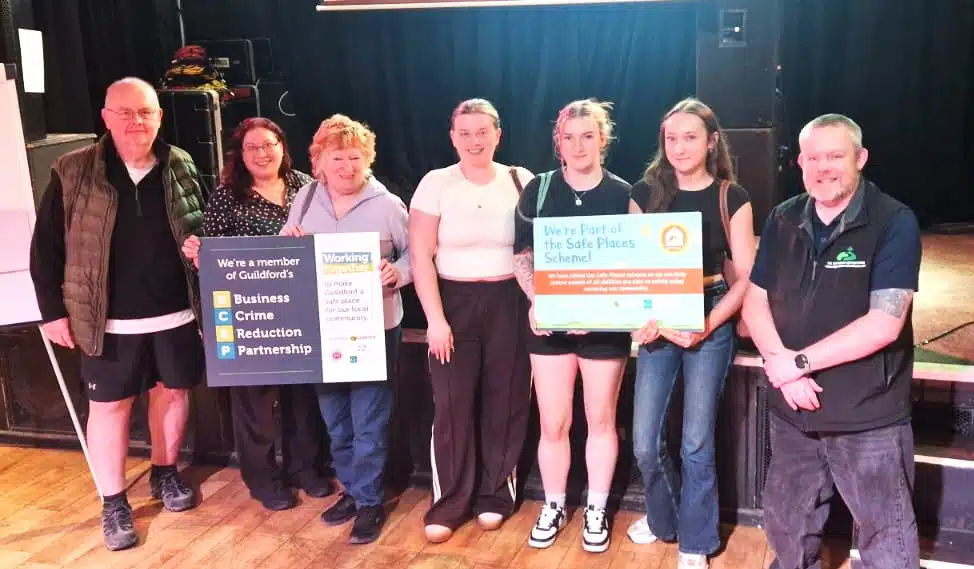
| Connected schemes: Ask for Angela, Best Bar None, Guildford Business Crime Reduction Partnership, Guildford Street Angels |
| Legislative framework: Licensing Act 2003, crime prevention and public safety objectives |

What Is WAVE Training?
Welfare and Vulnerability Engagement training is a safeguarding programme built specifically for staff working in licensed premises and the night-time economy. It covers how to recognise when a customer may be vulnerable, how to respond without making things worse, and how to support people in a way that protects both them and the venue.
Worth being clear about what WAVE isn’t. It’s not conflict management. It’s not physical intervention training. Those programmes deal with threatening or disruptive behaviour. WAVE works on something earlier and, frankly, harder: spotting vulnerability before anything goes wrong, and stepping in calmly and proportionately.
The training sits within the legal framework of the Licensing Act 2003, which sets four licensing objectives for all licensed premises in England and Wales. Two of those objectives, crime prevention and public safety, directly require venue staff to engage with vulnerability as part of running a responsible operation. WAVE training gives them the practical skills to actually do that.
Nationally, the Home Office has promoted safeguarding initiatives across the night-time economy, including the Ask for Angela scheme, and licensing authorities across England and Wales are increasingly expecting venues to demonstrate proactive welfare measures as part of their licensing responsibilities. This is no longer above-and-beyond territory. It’s a baseline expectation.
How the Guildford Programme Came Together
The WAVE training in Guildford is funded by the Surrey Police and Crime Commissioner’s Office and commissioned through Experience Guildford, which manages the Guildford Business Improvement District (BID). That structure matters. This isn’t voluntary training that a handful of motivated venue managers opted into. It’s a coordinated, town-wide commitment to raising the standard of vulnerability awareness across the night-time economy.
Prima Cura Training has delivered this programme across Guildford for 8 years, covering licensed premises and retail businesses alike. The reach of that commitment, from the PCC’s office to the BID to individual venues and high-street shops, is what sets Guildford’s approach apart from what most areas are doing. Training in isolation achieves something. Training embedded in a wider, coordinated system achieves considerably more.
What the WAVE Programme Covers: Licensed Premises
Every session starts with a question that sounds simple but almost never gets asked directly in operational training: What’s your actual responsibility to the people in your venue, and when does it end?
For most front-of-house staff who haven’t done this training, nobody has ever put that to them directly. They know how to manage conflict. They know Challenge 25. They know what to do after something has already gone wrong. WAVE works on the window before that point, when the signals are already there, but nobody’s been shown how to read them.
What vulnerability actually looks like in a licensed venue
Vulnerability in nightlife settings rarely announces itself. Staff who are only watching for someone who’s obviously distressed will miss most of the situations that actually need attention. In practice, it tends to look like this:
- A customer who’s more intoxicated than those around them, but is being encouraged to keep drinking
- Someone who looks disoriented and is being guided somewhere by a person they don’t appear to know well
- A guest who’s become separated from their group and seems uncertain, anxious or lost
- A person at the bar or cloakroom who seems to want to say something but can’t quite bring themselves to ask
- Signs a drink may have been interfered with: an odd taste reported, or intoxication setting in faster than it should
- Behaviour between two people suggesting coercion, control or intimidation
None of those situations announces itself clearly. They need staff who are observant, who trust their read on a situation, and who have a framework for responding that doesn’t mean working it out from scratch in the moment.
The full licensed premises programme covers:
- Recognising alcohol and drug intoxication, including the difference between someone drunk and someone whose drink has been spiked
- Sexual exploitation and predatory behaviour, and how it actually presents in a venue environment
- Theft and opportunist crime targeting vulnerable people
- Supporting customers who are alone, separated from their group, or showing signs of being under another person’s control
- The duty of care obligations that apply to licensed premises under the Licensing Act 2003
- The licensing objectives that venue staff are directly responsible for upholding
- When and how to escalate to police, and when that escalation isn’t just appropriate but required
- How Ask for Angela works in practice, including how to receive and act on a request without drawing attention to the person making it
The training is scenario-based throughout. When something happens in a venue, there’s no time to go and find the policy document. Confidence in real situations comes from rehearsing real situations, not from reading about them.
WAVE for Retail: Vulnerability Doesn’t Stop at the Pub Door
One of the most important things about Guildford’s approach is that the programme doesn’t end at the entrance to a licensed venue. Alongside the licensed premises sessions, Prima Cura Training delivers an adapted version of WAVE for retail businesses across Guildford town centre. Last week covered businesses from supermarkets to clothing stores and everything in between.
Vulnerability doesn’t recognise a licensing boundary. The same person who’s at risk on a Friday night can be in crisis on a Tuesday afternoon. High streets and retail spaces are often the first place a vulnerable person reaches, and retail staff, who have typically had no safeguarding training whatsoever, are frequently the first people in any position to help.
What the retail programme covers
The retail version of WAVE is adapted for the specific reality of daytime, high-street vulnerability. It incorporates the National Safe Spaces campaign, which formally establishes retail businesses as designated places of safety for anyone who feels at risk in a public space. The programme trains retail staff to:
- Recognise the forms of vulnerability most likely to show up in a retail setting, including people who are distressed, confused, being followed, in a controlling relationship, or in crisis
- Respond calmly and proportionately, without escalating the situation or drawing unwanted attention to the person who needs help
- See their premises as part of a wider community safety network, not a self-contained commercial space
- Know when and how to contact relevant support services, and how to keep someone safe while they wait
- Apply the National Safe Spaces principles in practice, confidently
The conversations in retail sessions are often the most telling of the whole week. Most of the staff who attend have already dealt with a situation they weren’t sure how to handle. They acted on instinct, or they didn’t act at all, because nobody had ever suggested it fell within their role to do so. Giving them a clear framework and the confidence to use it is the whole point.
Guildford’s Night-Time Economy Safety Framework: How the Pieces Fit
What genuinely impresses me about Guildford is that the training doesn’t operate on its own. It connects to and supports a set of overlapping schemes that together form a safety network across the whole town. It works best when every part of that network is reading the same signals, using the same language and responding in consistent ways.
Ask for Angela
‘Ask for Angela’ runs through the WAVE programme for licensed premises. The scheme, promoted nationally by the Home Office and adopted by councils and police forces across England and Wales, lets any customer who feels unsafe approach bar staff and quietly ask for ‘Angela.’ Trained staff know that’s a signal someone needs help, and can assist them in leaving safely, contacting someone they trust, or accessing appropriate services.
That only works if the people receiving the request have been properly briefed on what to do next. A poster on the wall with no trained staff behind it isn’t a safeguarding measure. It’s furniture. WAVE training closes that gap. More at askforangela.co.uk.
Best Bar None
Best Bar None is a national scheme, and Guildford’s venue accreditation scheme, recognising licensed premises that meet high standards in responsible operation, safety and customer welfare.
WAVE training is taken into account as part of the overall Best Bar None assessment, specifically around a venue’s safety practices and Ask for Angela compliance. Venues in the Prima Cura programme are building real, evidence-based demonstrations of the welfare-focused approach the scheme rewards.
Guildford Business Crime Reduction Partnership
The Guildford Business Crime Reduction Partnership brings together businesses across the town to share intelligence, coordinate responses to crime and disorder, and raise safety standards collectively. WAVE training supports effective GBCRP membership by making sure staff across member businesses are working from the same shared framework. A network where every venue reads the same signals and responds the same way is one that actually functions when it counts.
The Guildford Street Angels
If you’ve spent any time in Guildford town centre on a Friday or Saturday night, you’ve probably seen them. The Street Angels are volunteers who give up their evenings to be a visible, supportive presence across the night-time economy, working weekends through until 4 am. Not enforcement. Not police-affiliated. People who understand that someone who’s had too much to drink is a vulnerable person, not a nuisance, and that sometimes what a situation calls for is a calm human being rather than a formal response.
The link between the Street Angels and WAVE-trained venue staff is one of the most practical parts of the whole model. When a door supervisor spots someone who isn’t safe to leave on their own and contacts the Street Angels, or a bar team member identifies a concern and knows there’s a community resource to call on, the whole system delivers. The training and the volunteer presence reinforce each other in ways that neither achieves alone.

Who Is WAVE Training For?
Any staff member whose role puts them in contact with members of the public is a candidate for WAVE training. It’s not designed exclusively for designated safeguarding leads. It’s designed for the people who are actually there when something happens.
Licensed premises: the whole team
- Bar staff and bartenders
- Door supervisors and security personnel
- Venue managers and duty managers
- Cloakroom and floor staff
- Event and hospitality supervisors
Door supervisors and security staff have their own specific professional and legal obligations around vulnerability awareness — particularly since the SIA refresher requirements changed in April 2025. There’s more on that in Why WAVE Training Matters for Security Staff in Licensed Venues
Retail: every customer-facing employee
- Shop floor and checkout staff
- Team leaders and store managers
- Security and loss prevention staff
- Any retail employee who might be the first to encounter a member of the public in distress
In a smaller venue or retail unit, one or two trained people make a disproportionate difference. In a larger operation, having everyone working from the same framework means the response is consistent regardless of who the customer encounters first. WAVE sits alongside and complements existing training, including conflict management, first aid and fire safety.
Why the Guildford Model Works, and What Other Areas Can Take From It
Most towns and cities in the UK have a night-time economy. Most have concerns about alcohol-related harm, exploitation, theft and violence. Far fewer have a funded, coordinated, multi-agency programme that puts vulnerability awareness at the centre of how staff in those environments are actually prepared.
Guildford’s model works because nothing in it is carrying the load alone. The Surrey PCC’s funding makes it possible. Experience Guildford’s coordination makes it consistent. The connecting schemes, Ask for Angela, Best Bar None, GBCRP and the Street Angels, give the training a live framework to sit within. And the training itself is practical, specific and delivered by someone who has been doing it in this town for eight years (not to mention being an old Guildfordian, and experiencing nights out myself since the late 90s).
Take any one of those out, and the impact drops. That’s the lesson for any BID, licensing authority or commissioner thinking about replicating this: the model is the whole system. You can’t just bolt on the training and call it done.
For those organisations, the question isn’t whether this investment is justified. Eight years of delivery in Guildford is the answer to that. The question is what it costs when it’s absent.
Culture, Not Just Compliance
Compliance matters, and I won’t pretend otherwise. Venues operate under significant regulatory scrutiny, and being able to evidence that staff have received safeguarding training is increasingly expected by licensing committees, police liaison officers and responsible authority teams.
But the reason this training matters to me, after eight years of delivering it, has very little to do with a checklist. It’s the door supervisor who has never once been asked what their responsibility is once someone walks out of the venue. The retail worker who dealt with something last month and still isn’t sure whether they handled it right. The bar manager who’s had the Ask for Angela poster up for two years and hasn’t briefed a single member of their team on what it actually means.
Training builds the confidence that changes how those people respond next time. Multiply that across every venue and business in a programme like Guildford’s, and you get a town that’s genuinely safer, not just demonstrably compliant. There’s a difference. It’s significant.
Find Out About WAVE Training for Your Venue, BID or Town
Prima Cura Training delivers WAVE training for licensed premises teams, door supervisors, retail businesses and town-wide programmes across the UK. Sessions are practical, scenario-based and adapted to the specific context of each setting. No generic overviews. No tick-box exercises.
If you’re a venue operator, BID manager, licensing officer or part of a police and crime commissioner’s office, thinking about how WAVE could work in your area, I’m always happy to talk through what that looks like in practice.
Full course details: WAVE Training for Licensed Premises or WAVE Training for Retail Sector
Frequently Asked Questions: WAVE Training for Licensed Premises and Retail
What does WAVE stand for in WAVE training?
WAVE stands for Welfare and Vulnerability Engagement. It’s a safeguarding training programme built specifically for staff working in licensed premises and the night-time economy, covering how to recognise, respond to and support vulnerable individuals in those settings.
Is WAVE training a legal requirement for licensed premises?
WAVE training isn’t currently a statutory requirement, but it directly supports a venue’s obligations under the Licensing Act 2003, particularly the objectives of crime prevention and public safety. Licensing authorities across England and Wales increasingly expect venues to demonstrate proactive safeguarding measures, and staff training records are one of the clearest ways to evidence that. In areas where WAVE has been commissioned as part of a town-wide programme, as in Guildford, participation may be expected of BID member venues.
Who funds WAVE training in Guildford?
The WAVE programme in Guildford is currently funded by the Surrey Police and Crime Commissioner’s Office and commissioned through Experience Guildford, the organisation that manages the Guildford Business Improvement District. That funding structure means delivery is coordinated across the whole town rather than left to individual venues to opt into.
Does WAVE training contribute to Best Bar None accreditation in Guildford?
Yes. WAVE training is taken into account as part of the overall Best Bar None assessment in Guildford, specifically in relation to a venue’s safety practices and Ask for Angela compliance. Venues that have completed the programme are building a direct, evidence-based demonstration of the welfare-focused approach Best Bar None is designed to recognise.
Can WAVE training be adapted for retail businesses?
Yes. Prima Cura Training delivers a specifically adapted version of WAVE for retail businesses, covering the forms of vulnerability most likely to present in a daytime, high-street setting. The retail programme incorporates the National Safe Spaces campaign and has been delivered across Guildford town centre, from supermarkets to clothing stores, as part of the same town-wide funding partnership.
What is Ask for Angela, and how does it relate to WAVE training?
Ask for Angela is a safeguarding initiative, promoted nationally by the Home Office, that lets anyone who feels unsafe approach bar staff and quietly ask for a person called ‘Angela.’ That’s a signal for help. Trained staff respond by assisting the person to leave safely, contact someone they trust, or access appropriate support. WAVE training embeds Ask for Angela within a wider vulnerability awareness framework, so staff don’t just know the scheme exists, they know exactly what to do when someone uses it. A poster on a wall isn’t a safeguarding measure. Trained staff are.
Does Prima Cura Training deliver WAVE outside Guildford?
Yes. Prima Cura Training delivers WAVE training for licensed premises teams, door supervisors, retail businesses and town-wide programmes across the UK. The programme works as a standalone session for an individual venue, as part of an annual training calendar, or as a coordinated programme across a BID area or licensing authority. Enquiries from venue operators, BID managers, licensing officers and police and crime commissioners’ offices are all welcome.
This article is for general information and awareness only. It doesn’t constitute legal advice, licensing compliance advice or a formal safeguarding framework. The information reflects general UK practice and publicly available guidance as of the date of publication. Licensed venue operators and retail businesses should seek specific legal or regulatory advice in relation to their obligations under the Licensing Act 2003, their premises licence conditions and any applicable local authority requirements. WAVE training delivered by Prima Cura Training is adapted to individual contexts and doesn’t replace an organisation’s own safeguarding policies, procedures or statutory obligations.