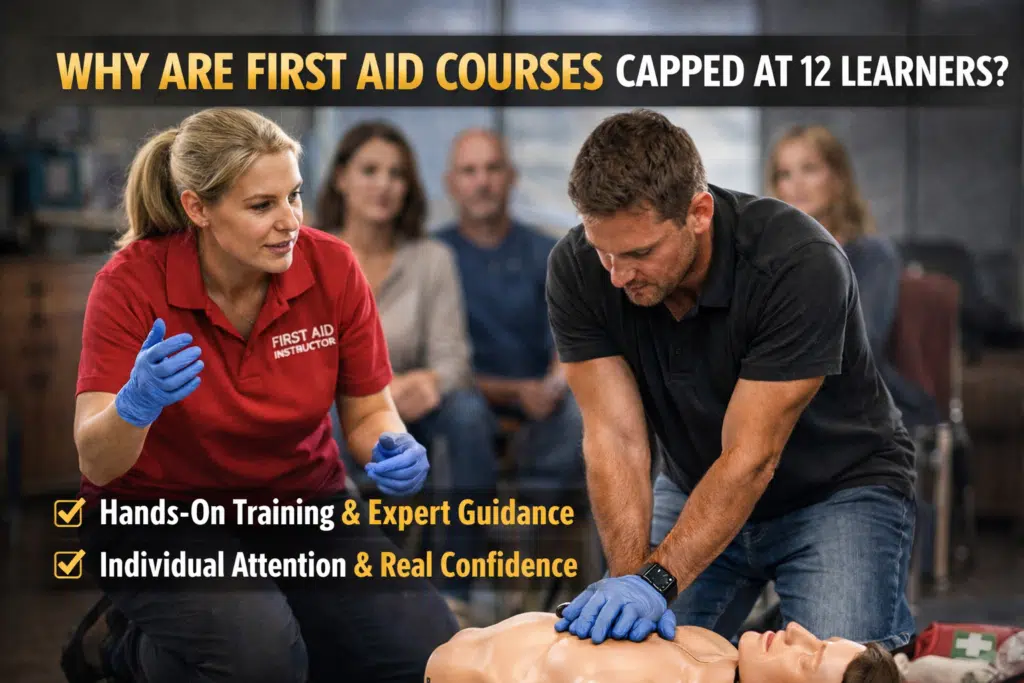
Why First Aid Courses Are Capped at 12 Learners
Written by Stephanie Austin — Owner & Lead Trainer, Prima Cura Training
Last reviewed: April 2026 | Next review: April 2027
Why First Aid Courses Are Capped at 12 Learners: The numbers, the regulations, and why it actually matters for your workplace
If you’ve ever booked first aid training and been told there’s a maximum of 12 people per class, you might have wondered whether that’s a genuine standard or just a provider being cautious about room bookings.
It’s a genuine standard. And it’s backed by the Health and Safety Executive, recognised industry bodies, and the awarding organisations that set the qualification specifications. This blog breaks down exactly where the 12-learner cap comes from, why it exists, and what it means for employers arranging first aid training for their teams.
| 12 The maximum number of learners per qualified trainer or assessor for first aid courses |
What Does the HSE Say?
The Health and Safety Executive no longer directly approves first aid training providers in the way it once did. Since 2013, employers have been responsible for selecting a competent provider and carrying out their own due diligence. That means checking trainer qualifications, assessment methods, quality assurance systems, and whether the training genuinely meets learners’ needs.
On class size, HSE guidance is clear: where first aid training is delivered in groups of more than 12, unless additional trainers or assessors are present, there may be concerns about whether individual learning needs are being met and whether competence is being properly assessed.
That wording matters. It isn’t framed as a legal absolute in every sentence, but the implication is direct: one qualified trainer managing a room of more than 12 learners is a red flag. The standard of teaching and the defensibility of the training becomes questionable.
| “Where class sizes greater than 12 are used, and additional trainers or assessors are not provided, there may be concerns about meeting individual learning needs and adequately assessing competence.” — Health and Safety Executive (HSE) — First Aid at Work Guidance |
What Does FAIB Say?
The First Aid Industry Body (FAIB) is even more direct about it. FAIB’s Training Provider Administrative Standards set a firm maximum of 12 students per Trainer/Assessor across all regulated first aid qualifications. That includes:
- First Aid at Work (FAW)
- FAW Requalification
- First Aid at Work Annual Refresher
- Emergency First Aid at Work (EFAW)
- Paediatric First Aid
- Emergency Paediatric First Aid
This isn’t a recommendation. It’s a delivery standard. Providers that breach it are operating outside the standards set by one of the key trade bodies for the first aid training sector.
| “First aid courses must not have more than 12 students per Trainer/Assessor.” – First Aid Industry Body (FAIB) — Training Provider Administrative Standards |
Is It Just FAIB? No.
The consistency across the sector is what makes this so clear-cut. Other recognised awarding organisations and qualification bodies use the same ratio in their qualification specifications: a maximum of 12 learners to 1 trainer or assessor, with additional qualified trainers required for larger groups.
When HSE guidance, FAIB standards, and multiple awarding bodies all align on the same number independently, it’s not a coincidence. It’s a conclusion drawn from what good, practical, properly assessed first aid training actually requires.
| ☑ HSE Guidance Warns that groups over 12 without additional trainers may not meet individual learning needs | ☑ FAIB Standards Sets a firm maximum of 12 learners per Trainer/Assessor across all regulated first aid qualifications | ☑ Awarding Bodies Qualification specifications state a 12:1 maximum, with additional trainers required above that |
Why Does the Cap Actually Exist?
Because first aid training is practical. Not theoretical, not a lecture series, not a workbook exercise. Learners are expected to demonstrate skills, not just absorb information.
A trainer running a first aid course needs to:
- Watch every learner perform CPR and correct technique in real time
- Observe choking response, bleeding control, and recovery position
- Provide individual feedback where technique is wrong or unsafe
- Manage questions without losing oversight of the room
- Assess each learner’s competence for the purposes of certification
- Hold documentary evidence that each learner achieved the required outcomes
Do all of that for 20 people simultaneously, and something gets missed. Either the observation is superficial, the assessment becomes a rubber stamp, or some learners barely get hands on a manikin before the session ends. None of those outcomes produces a genuinely competent first aider.
It’s Not Just About Numbers
The standards also cover the physical conditions of delivery. A first aid course requires adequate space, proper visibility, and sufficient equipment ratios, including manikins and other practical resources. Cramming 20 people into a meeting room doesn’t just stretch the trainer thin; it compromises the entire learning environment.
| 🦿 Manikin Ratios Enough equipment for proper hands-on practice, not waiting in a queue for a turn | 📏 Room Space Floor space for practical scenarios, not desks pushed aside and learners squeezed in | 👁 Visibility The trainer must be able to see every learner performing every skill, not just the front row |
What This Means for Employers
The Health and Safety (First Aid) Regulations 1981 require employers to make adequate first aid provision for their workforce. That means not just having trained people on site, but ensuring that training is genuinely adequate.
If a provider has put 25 people through a one-day first aid course with one trainer and no second assessor, the training may look fine on paper but carries real questions about quality, defensibility, and individual competence. If something goes wrong on site and the first aid training is scrutinised, employers will want to be confident that their provider was operating to recognised standards.
| ⚠️ Due Diligence Reminder: HSE guidance places the responsibility on employers to check that their first aid provider is operating to appropriate standards. Class size is one of those checks. |
The question employers should be asking isn’t, “How many can you fit in?” It’s, “Will everyone of my staff leave this room actually knowing what to do in an emergency?”
That’s a different question. And it gets a different answer when you’re in a room of 12 versus a room of 25.
At a Glance: The 12-Learner Rule
| Organisation / Body | Position on Class Size | Status |
| Health and Safety Executive (HSE) | Warns that groups over 12 without additional trainers raise concerns about learning needs and assessment | Qualification specs state a maximum 12:1 ratio; additional trainers are required above this |
| First Aid Industry Body (FAIB) | Sets a firm maximum of 12 learners per Trainer/Assessor across all regulated first aid courses | Mandatory trade body standard |
| Awarding Organisations | Qualification specs state a maximum 12:1 ratio; additional trainers required above this | Qualification standard |
| Industry consensus | Consistent 12-learner cap across all recognised frameworks | Accepted sector-wide standard |
First Aid Training Courses at Prima Cura Training
At Prima Cura Training, we’ve never run a course above the 12-learner limit. Not once. Not even when we’ve been asked. That’s not rigidity for the sake of it; it’s because we know what proper first aid training looks like from the inside, and a trainer stretched across 20+ learners isn’t it.
If you need a bigger group trained, we can arrange additional qualified trainers so that standards are maintained, and every learner gets what they came for.
Our first aid courses include:
| Course | Details |
| Emergency First Aid at Work (EFAW) | 1 day | Up to 12 learners | OA accredited |
| First Aid at Work (FAW) | 3 days | Up to 12 learners | OA accredited |
| Paediatric First Aid | 2 days | Up to 12 learners | OA accredited |
| Emergency Paediatric First Aid | 1 day | Up to 12 learners | OA accredited |
| Annual First Aid Refresher | Half day | Up to 12 learners | OA accredited |
| First Aid at Work Requalification | 2 days | Up to 12 learners | OA accredited |
| Basic First Aid | 1 day | Up to 12 learners | CPD Accredited |
For more information on choosing the right level of first aid cover for your workplace, read our complete guide to workplace first aid.
Further Reading
If this blog got you thinking about first aid training standards, here are some related reads from the Prima Cura blog:
| Ready to Book First Aid Training? Prima Cura Training delivers in-house first aid courses across Manchester, Greater Manchester, the North West, and throughout England. Every course runs to the 12-learner standard, every time. 📞 0333 999 8783 | 📧 info@primacuratraining.co.uk | 🌐 primacuratraining.co.uk |