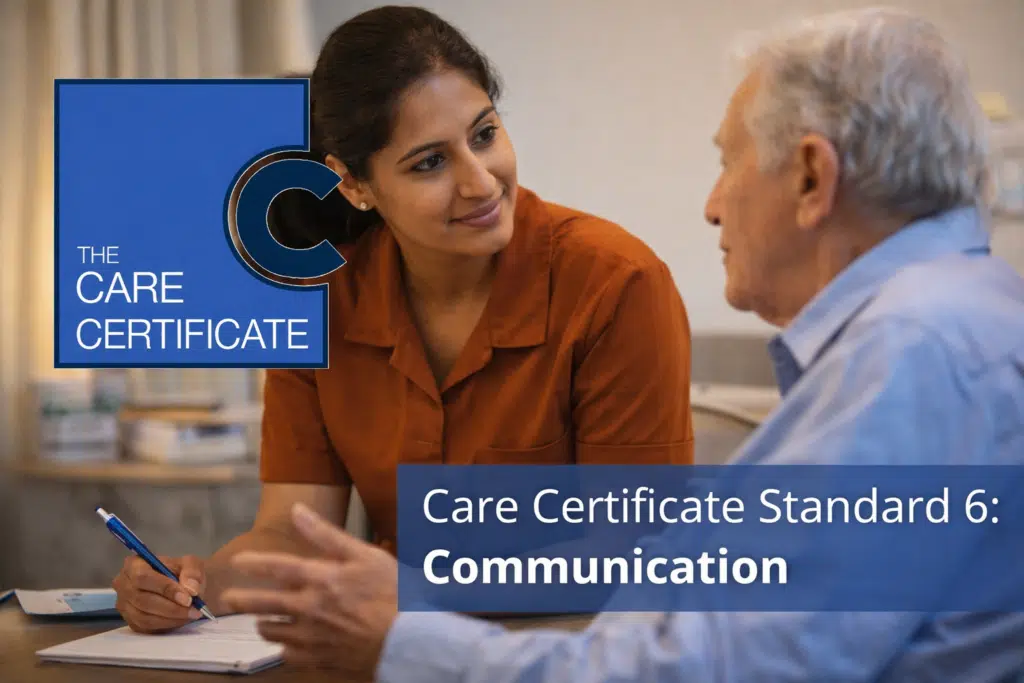
Care Certificate Standard 6: Communication
Written by Stephanie Austin – Owner & Lead Trainer, Prima Cura Training
Last reviewed: April 2026 | Next review: April 2027
Communication is often described as a “soft skill”. In health and social care, it rarely feels soft.
Care Certificate Standard 6 focuses on communication because it sits quietly at the centre of safe care. When communication is working well, teams function calmly, people feel heard, and services run with a sense of clarity. When communication begins to weaken, small issues can grow quickly.
Many safeguarding concerns, complaints, medication errors and misunderstandings begin with something surprisingly simple: a piece of information was not shared clearly, someone was not properly listened to, or something important was never written down.
The March 2025 Care Certificate framework recognises that reality. Standard 6 expects workers to understand not just how to speak, but how to listen, adapt communication methods, document information accurately and escalate concerns appropriately when something does not feel right.
Communication in care is not simply conversation. It is part of professional accountability.
What Care Certificate Standard 6 Really Requires
On paper, the expectations within Standard 6 look relatively straightforward. Workers are expected to understand:
- Why communication is essential in care settings
- Different methods of communication
- How to meet individual communication needs
- Barriers that may affect communication
- The importance of confidentiality
- Accurate recording and reporting
Yet communication in care rarely happens in controlled conditions. It takes place in busy environments, during personal care, during emotional conversations with families, or while supporting individuals who may struggle to express themselves clearly.
Emotion, vulnerability, sensory differences, cultural context and clinical information can all sit inside the same conversation. Adapting communication in this way forms part of person-centred care.
Understanding that complexity is part of professional competence.
Standard 6 therefore focuses less on scripted communication techniques and more on awareness. Workers need to recognise when communication needs to slow down, when someone needs more time to respond, and when information must be recorded or escalated clearly to protect safety.
The Legal and Regulatory Context
Communication in care does not exist in isolation. It connects directly to wider legal and governance responsibilities.
Clear communication and accurate documentation support requirements under the Health and Social Care Act 2008 (Regulated Activities) Regulations 2014, particularly:
Communication also links closely with safeguarding responsibilities under the Care Act 2014, where recognising concerns early and escalating them appropriately can prevent harm.
Regulated services in England are inspected by the Care Quality Commission, which reviews how information is recorded, shared and escalated across teams.
If records are unclear, handovers incomplete or concerns poorly communicated, the issue quickly becomes one of governance rather than interpersonal communication.
Care Certificate Standard 6 introduces these expectations early in induction so that communication is understood as a professional responsibility rather than simply a social skill.
Communication Is More Than Words
One of the first discussions explored during Standard 6 training is recognising that communication extends well beyond spoken language. Communication includes:
- Tone of voice
- Facial expression
- Body language
- Eye contact
- Timing
- Patience
- Silence
A rushed tone can unintentionally create anxiety. Closed body language can discourage someone from speaking openly. Interrupting repeatedly can signal that someone’s perspective is not valued.
Most of the time these behaviours are not intentional. They develop under pressure when services are busy and staff are trying to complete multiple tasks at once.
Standard 6 encourages workers to reflect on the difference between intention and impact. What someone experiences in a conversation often matters more than what was intended.
Listening as a Professional Skill
In busy services it is easy to hear words without truly listening.
A person might mention discomfort casually while staff are preparing medication. A relative might raise a quiet concern at the end of a visit. A colleague may express uncertainty during handover but move on quickly because the shift already feels rushed.
When communication is hurried, those signals can be missed.
Active listening requires deliberate attention. It involves asking open questions, clarifying understanding, reflecting back what has been said and allowing pauses rather than rushing to fill silence.
When people feel genuinely listened to, they are far more likely to share information that protects their safety.
That connection between communication and safeguarding is significant and appears repeatedly in serious case reviews. That connection between communication and safeguarding also links closely with responsibilities under duty of care.
Meeting Individual Communication Needs
Care Certificate Standard 6 also reminds us that communication cannot follow a single template. People may:
- Use communication aids
- Have hearing or visual impairments
- Experience cognitive decline
- Process information more slowly
- Communicate primarily through behaviour
- Speak English as an additional language
Competent practice involves recognising and adapting to these differences.
That may mean slowing down conversations, using visual prompts, simplifying language without sounding patronising, or checking understanding more than once.
Sometimes it involves working with family members, interpreters or advocates to ensure someone’s voice is still heard.
Adapting communication in this way is not optional. It forms part of person-centred and legally compliant care.
Understanding Barriers to Communication
When assessing Standard 6, it is important to explore barriers honestly.
Common barriers include environmental noise, fatigue, emotional distress, cultural misunderstanding and time pressure. Confidence can also influence communication. A new member of staff may hesitate to question a senior colleague, even when something does not feel right.
Equally, someone receiving care may hesitate to disclose concerns if they feel dismissed or rushed.
Communication breakdowns are rarely random. They are usually influenced by the culture and structure of the service. Recognising those barriers allows teams to address them more thoughtfully.
Recording and Reporting: The Written Side of Communication
Communication in care does not end when a conversation finishes. It must also be documented.
Accurate recording protects the person receiving care, the worker providing support and the organisation responsible for oversight. Standard 6 therefore expects workers to understand:
- The importance of factual and objective documentation
- The difference between observation and opinion
- The need for timely recording
- When and how concerns should be escalated
Poor documentation can undermine safeguarding processes. Incomplete notes can obscure changes in someone’s health. Subjective language can distort what actually occurred. Clear records support Regulation 17 governance requirements and help maintain continuity between staff and shifts.
Confidentiality and Responsible Information Sharing
Communication must always sit alongside confidentiality.
Workers need to understand what information is confidential, who it can be shared with and when consent is required. At the same time, they must recognise circumstances where safeguarding responsibilities require information to be shared.
Confidentiality does not mean secrecy. It means responsible information management that protects dignity while ensuring safety. Understanding that balance helps staff act confidently rather than hesitating when decisions need to be made.
These discussions are often explored further during reflective supervision sessions.
What a Meaningful Standard 6 Assessment Should Explore
A robust Care Certificate Standard 6 assessment should move beyond simple definitions. It should explore:
- How communication is adapted to individual needs
- How barriers are recognised and addressed
- How documentation is completed
- How concerns are escalated appropriately
- How confidentiality is maintained
Observation is particularly valuable. The way someone communicates in real time often reveals far more than written responses.
If a worker is asked how they would respond when someone becomes distressed or refuses to communicate, the thoughtfulness of their answer can provide insight into empathy, patience and professional judgement.
Communication skills are often strengthened through reflection and development introduced within Care Certificate Standard 2: Personal Development.
Where Services Quietly Drift
Communication rarely fails because of bad intentions. More often it erodes gradually.
Handover becomes rushed. Documentation is delayed. Staff rely on shorthand explanations rather than detailed notes. Concerns are mentioned casually rather than formally recorded.
Individually these changes may seem manageable. Over time they accumulate. Standard 6 reminds us that clarity is not optional. It is the foundation of safe care.
Why Standard 6 Supports Safety and Compliance
If communication weakens, safeguarding concerns may not be raised promptly. Changes in health may go unnoticed. Care plans may not reflect current needs.
Families may lose confidence and staff may feel uncertain about decisions.
When communication is strong, the opposite occurs. Issues are identified earlier, decisions are recorded clearly and people feel respected and heard.
Care Certificate Standard 6 therefore supports governance, safeguarding and regulatory compliance simultaneously. It is not simply about communication skills. It is about maintaining a safe and accountable service.
Frequently Asked Questions
Is Care Certificate Standard 6 just about communication skills?
No. It includes adapting communication methods, recognising barriers, maintaining confidentiality, documenting accurately and escalating concerns appropriately.
Does Standard 6 require observation during assessment?
Yes. Observation of real interactions often provides the strongest evidence that communication skills are embedded in practice.
How does communication relate to safeguarding?
Clear communication ensures concerns are recognised, recorded and escalated promptly, reducing the risk of harm.
Why Standard 6 Deserves Attention
Communication often feels ordinary because it happens constantly. That can make it easy to assume it will take care of itself.
Yet when communication breaks down, the consequences can be significant.
If you are reviewing your Care Certificate framework, this is the point where you pause and ask whether staff feel confident communicating, documenting and escalating concerns appropriately.
Communication failures are rarely dramatic. They tend to emerge slowly through assumptions, time pressure and missed information.
That is why this standard deserves careful attention.
This article is provided for guidance and educational purposes only. It does not replace organisational policy or legal advice. Providers should ensure alignment with current legislation and regulatory expectations, including governance and safeguarding duties overseen by the Care Quality Commission.