
Sickle Cell Disease Explained: Symptoms, Treatment and How to Support Staff at Work
Written by Stephanie Austin, Owner & Lead Trainer, Prima Cura Training | Last reviewed: September 2026 | Next review: September 2027
In 15+ years of delivering First Aid at Work and paediatric first aid courses, sickle cell disease comes up in most sessions. It’s usually met with blank faces.
That’s not a criticism of anyone in the room. It’s a symptom of something bigger. Sickle cell is the UK’s fastest-growing genetic disorder and the most common serious genetic condition in England, yet most people, including plenty of managers responsible for genuinely supporting the staff who have it, couldn’t tell you what a sickle cell crisis actually looks like, or what to do about it.
September is Sickle Cell Awareness Month. This is the explainer I wish landed on more desks.
What Is Sickle Cell Disease?
Sickle cell disease is the name for a group of inherited conditions that affect the red blood cells. The most serious form is called sickle cell anaemia.
It’s caused by a faulty gene that changes how haemoglobin, the protein that carries oxygen around the body, is made. Instead of the usual smooth, doughnut-shaped red blood cells, the body produces cells shaped like a crescent or sickle. These sickle cells are stiff and sticky. They don’t move through blood vessels easily; they can block them, and they die off after around 10 to 20 days instead of the normal 120, which is what causes the anaemia that comes with the condition.
You need to inherit the faulty gene from both parents to have sickle cell disease. If you only inherit it from one, you’re a carrier, known as having the sickle cell trait, and you won’t develop the disease yourself. If both parents are carriers, there’s a 1 in 4 chance of each child they have being born with sickle cell disease.
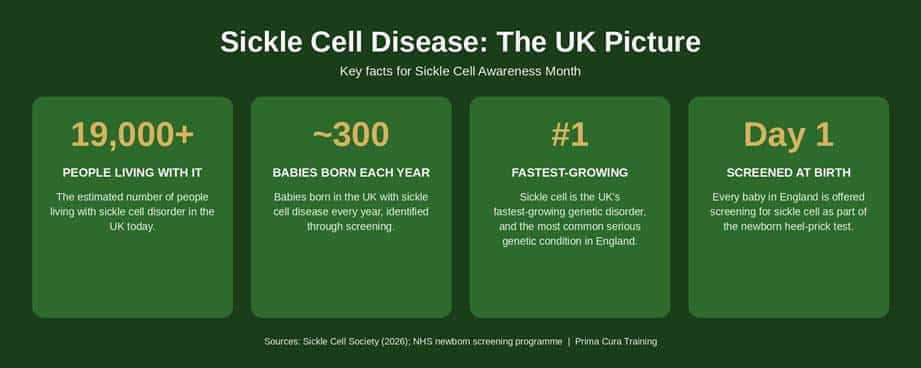
Sickle cell disease is particularly common in people with an African or Caribbean family background, and it also affects people of South Asian, Middle Eastern and Mediterranean heritage. An estimated 19,000 people are living with it in the UK, and around 300 babies are born with it here every year. Every baby in England is screened for it shortly after birth, as part of the newborn heel-prick test. You can find current UK figures at the Sickle Cell Society.
How Does Sickle Cell Disease Affect Someone Day to Day?
Symptoms usually start within the first few months of life, though early treatment means many children have few problems for a long time. The three main symptoms are painful episodes, a higher risk of infection, and anaemia.
Painful episodes, known as sickle cell crises, happen when blood vessels become blocked by sickle-shaped cells. They’re one of the most distressing parts of the condition. Pain is often severe, can affect any part of the body but is most common in the limbs, back, chest and abdomen, and can last anywhere from a few hours to several weeks. How often someone gets a crisis varies enormously, from less than once a year to weekly. Common triggers include cold weather, dehydration, stress, infection and strenuous exercise, though it isn’t always possible to identify a cause.
Because sickle cells don’t survive as long as healthy ones, almost everyone with the condition has some degree of anaemia, which can cause tiredness and breathlessness. People with sickle cell disease are also more vulnerable to infections, particularly as children, ranging from mild to seriously dangerous.
There’s a wider list of complications that can develop, including delayed growth and puberty, gallstones, leg ulcers, eyesight problems, and painful, persistent erections. Two are worth knowing specifically because they’re medical emergencies: acute chest syndrome, a serious lung complication causing fever, cough, chest pain and breathing difficulty, and stroke, for which the risk is highest in children between the ages of 2 and 16.
The unpredictable, invisible nature of all this is what makes sickle cell disease so easy to misunderstand at work. Someone can look and feel completely well between crises, then become seriously unwell with very little warning. The NHS symptoms guide covers the full list in more detail.
How Is Sickle Cell Disease Treated?
Sickle cell disease is a lifelong condition. There’s no single, universally available cure, though a small number of specific treatments now come close.
Day to day, treatment is about preventing crises and managing symptoms. That includes drinking plenty of fluids and staying warm, daily antibiotics (usually penicillin) and regular vaccinations to reduce infection risk, and painkillers ranging from paracetamol and ibuprofen for milder pain up to stronger, hospital-administered medication for a severe crisis. NICE guidance recommends that anyone in a sickle cell crisis is given strong pain relief within 30 minutes of arriving at an emergency department, which reflects how seriously it needs to be taken.
A medicine called hydroxycarbamide is often prescribed to reduce how often crises happen. Some people need regular or emergency blood transfusions, particularly if their anaemia is severe or there are signs of organ damage.
The only established cure has historically been a stem cell or bone marrow transplant, which isn’t offered often because of the risks involved and the need for a matched donor. That changed in January 2025, when NICE approved a gene therapy called Casgevy (exagamglogene autotemcel, or exa-cel) for NHS use in England. It works by editing a patient’s own stem cells in a lab to switch on production of a healthy form of haemoglobin, then returning them to the body, offering the prospect of a cure without needing a donor. It’s currently available through a managed access scheme for people aged 12 and over with a severe form of the disease who don’t have a matched donor, and the NHS expects to treat around 50 people a year through it.
Most people with sickle cell disease are supported by a specialist sickle cell centre, with a team of different healthcare professionals working to an individual care plan built around their specific pattern of symptoms. Full treatment details are available on the NHS sickle cell disease pages.
Is Sickle Cell Disease a Disability Under the Equality Act 2010?
In practice, for most people with sickle cell disease, yes.
The Equality Act 2010 defines a disability as a physical or mental impairment that has a substantial and long-term adverse effect on someone’s ability to carry out normal day-to-day activities. Long-term means it has lasted, or is likely to last, 12 months or more. Substantial means more than minor or trivial, not necessarily severe.
Sickle cell disease is a lifelong condition, so it clears the long-term test by default. Whether it’s substantial enough to meet the legal definition depends on the individual, but given the unpredictability of crises, fatigue and the other complications covered above, most people living with sickle cell disease are likely to be considered disabled for the purposes of the Act, even during periods when they seem entirely well.
That triggers two duties for employers: a duty to make reasonable adjustments, and a duty not to treat someone unfavourably because of something connected to their disability, which includes disability-linked sickness absence. It’s also worth employers bearing in mind that because sickle cell disproportionately affects Black African and Black Caribbean communities, getting this wrong isn’t only a disability issue. Poor understanding or unfair treatment linked to the condition can shade into indirect race discrimination too.
How Can Organisations Actually Support Staff With Sickle Cell Disease?
Good support here is rarely expensive. It’s mostly about planning ahead and taking the condition seriously before a crisis happens, not scrambling to respond once it has.
An individual support plan, built with the employee rather than imposed on them, is the single most useful thing most organisations can put in place. It should cover their specific triggers, what they need day to day, and what should happen if they become unwell at work, then get reviewed at least once a year or whenever circumstances change.
Alongside that, small physical adjustments make a real difference: easy access to water, some control over heating or seating away from cold draughts and air conditioning, and rest breaks built into the working day rather than treated as a favour.
Flexibility matters too. That might mean adjusted shift patterns, the option to work from home during a flare-up, or sickness policies that don’t quietly penalise disability-linked absence the same way they would unrelated time off, which is where a lot of well-meaning employers unintentionally fall foul of the law. This kind of individual planning sits close to what we cover in our Duty of Care course too.
Finally, make sure managers and colleagues actually understand the condition. A sickle cell crisis can look, to someone who doesn’t know better, like an exaggeration or a convenient excuse. Basic awareness training closes that gap fast, and it’s exactly the kind of thing we build into wider first aid and health and safety training when it’s relevant to a workplace.

Common Questions About Sickle Cell Disease
Who is most affected by sickle cell disease in the UK?
Sickle cell disease is particularly common in people with an African or Caribbean family background, and also affects people of South Asian, Middle Eastern and Mediterranean heritage. Around 19,000 people are living with it in the UK, and it’s the country’s fastest-growing genetic disorder.
What triggers a sickle cell crisis?
Common triggers include cold weather, dehydration, stress, infection and strenuous exercise, though it isn’t always possible to identify a clear cause for a particular crisis.
Is there a cure for sickle cell disease?
There’s no universal cure, though a stem cell or bone marrow transplant can cure some people. Since January 2025, a gene therapy called Casgevy has also been available on the NHS for some people aged 12 and over with severe sickle cell disease who don’t have a matched donor.
What should I do if a colleague has a sickle cell crisis at work?
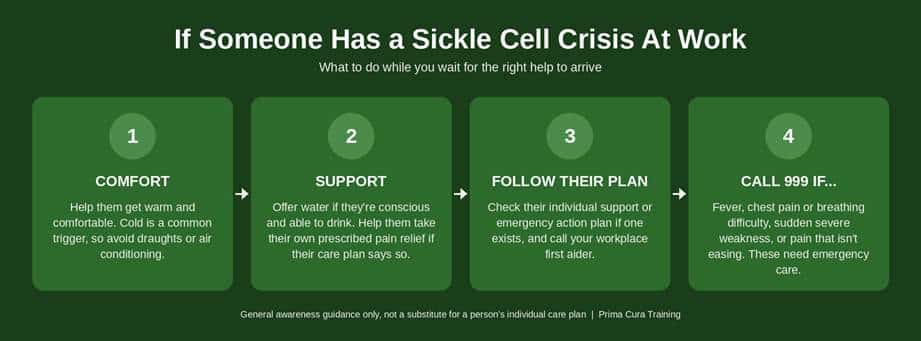
Help them get warm and comfortable, offer water if they’re able to drink, and check whether they have an individual support or emergency action plan in place. Call 999 if they develop a fever, chest pain, breathing difficulty, sudden severe weakness, or pain that isn’t easing.
Where Sickle Cell Fits Into Our First Aid Training
We cover sickle cell disease briefly within both our First Aid at Work and 2-Day Paediatric & Early Years First Aid courses, focused on recognising a genuine medical emergency and knowing when to escalate to 999.
For workplaces and care settings managing prescribed medication as part of someone’s day-to-day condition management, our Safe Medication Administration course covers safe handling and administration more broadly.
Get in touch if you’d like to talk through what’s right for your team.
This article reflects UK medical and legal guidance current at the time of writing, including NHS clinical information, Sickle Cell Society data, NICE guidance and the Equality Act 2010. It’s shared for general information and awareness. It isn’t medical advice and doesn’t replace guidance from a GP, a specialist sickle cell team, or qualified employment law advice specific to your circumstances. If someone is showing signs of a serious sickle cell complication, such as fever, chest pain, breathing difficulty or sudden severe weakness, call 999.