Fire Safety in Care Homes: Why Getting Everyone Out Isn’t Always the Right Answer
Written by Stephanie Austin, Owner & Lead Trainer, Prima Cura Training | Last reviewed: August 2026 | Next review: August 2027
In a large care home I train with regularly, a fire started in the laundry room. It was contained quickly; the fire service responded quickly, and not one resident had to be moved through smoke or fear. The reason it went that well has nothing to do with luck. It’s down to a decision that was made months earlier: when a fire breaks out, getting everyone out isn’t automatically the safest thing to do.
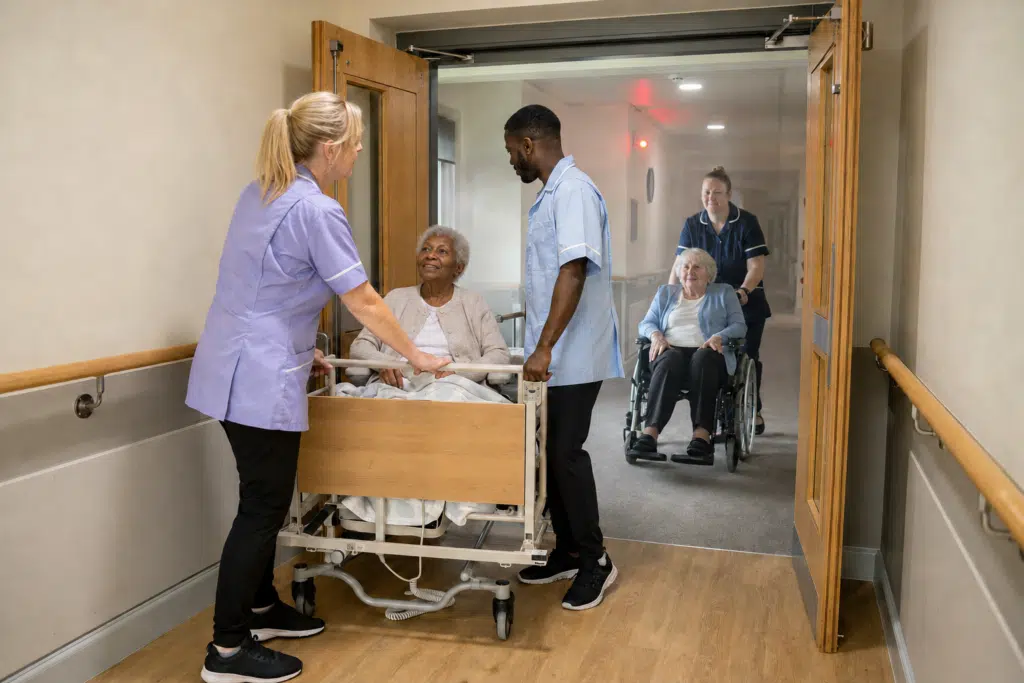
That sounds counterintuitive if you’ve only ever thought about fire safety in terms of “get out and stay out.” But for a care home with residents being nursed in bed, living with dementia, or needing two staff to move ten feet, a full building evacuation can be more dangerous than the fire itself. This is why progressive horizontal evacuation exists, and why more care homes need to understand it properly rather than just having it written into a policy folder nobody’s read since the last inspection.
What Is Progressive Horizontal Evacuation?
Progressive horizontal evacuation (PHE) moves residents away from a fire in stages, rather than straight out of the building. Instead of an immediate dash for the exit, residents are moved through fire doors into an adjoining, fire-resisting compartment on the same floor. That compartment is designed to hold back fire and smoke for a set period, usually at least 30 minutes, giving staff time and the fire service time to arrive.
If the fire spreads further, residents move again, compartment by compartment, only leaving the building entirely as a last resort. A full evacuation is still the plan if it’s ever needed. It’s just not the first move, because for a lot of residents, it shouldn’t be.
The short version: move first, evacuate fully only if you have to. It only works if the building, the alarm system, and the staff are all set up to make it work.

Why Not Just Evacuate Everyone, Every Time?
Because for a resident who is bed-bound, on oxygen, or in the later stages of dementia, being rushed out of a building at 3 am is its own risk. Falls, distress, missed medication, hypothermia in winter. A care home with a mixed-dependency unit, some residents mobile, some needing full assistance, can’t move everyone at the same speed. Trying to get the whole building out at once, in a genuine emergency, with two or three staff on a night shift, is where evacuations go wrong.
The Regulatory Reform (Fire Safety) Order 2005 places the duty on the “responsible person” (usually the registered manager or provider) to carry out a fire risk assessment and put in place an evacuation strategy that’s actually workable for the people in the building, not a generic one lifted from a template. For most care homes, that means PHE.
What Actually Has to Be in Place
This is where a lot of care homes come unstuck. PHE isn’t a policy decision you can make on paper and leave there. It depends on:
- Compartmentation that genuinely works. Fire doors that close properly and aren’t wedged open “just for today.” Walls and floors that hold back fire for the time your strategy assumes they will.
- An alarm and control panel set up for a staged response, not a single all-or-nothing siren. The home I mentioned upgraded their fire alarm and control panel specifically so it could support a progressive strategy, showing staff exactly where an alert had triggered and which compartment needed attention first.
- Personal Emergency Evacuation Plans (PEEPs) for every resident who needs assistance, reviewed regularly and updated the moment someone’s mobility or condition changes.
- Staff who’ve actually practised it, not just read about it. Fire drills that test the real evacuation of your most dependent residents, including at night when staffing is lowest.
Miss any one of these, and PHE stops being a safe strategy and becomes a false sense of security.
The Night It Was Tested for Real
I did the fire safety training for the care home I mentioned earlier and worked with them on their evacuation processes. They’d invested properly: the alarm system upgrade, a control panel that reflected their progressive strategy, and staff training that went well beyond a box-ticking exercise. Their drills were sharp. Staff knew their compartments, knew their PEEPs, knew exactly what to do without needing to think about it.
Then it happened for real. A fire started in the laundry room in 2024. Because staff had that level of training and knew the system inside out, it was dealt with correctly from the first alarm. The fire was contained, the fire service had a quick response time, and the outcome was as good as it could possibly have been. Their insurers covered the damage without a fight, in large part because the home could show a current fire risk assessment, a properly maintained system, and documented staff training. That’s not a coincidence. Insurers look for exactly that evidence when something goes wrong.
I’ve delivered fire safety training in a lot of care settings over the years, and the difference between homes that just have a policy and homes that have genuinely practised it is night and day. You can see it in how staff talk about it. The ones who’ve drilled it don’t hesitate.
Is Your Care Home Actually Ready for This?
A few honest questions worth asking, whether you’re a registered manager or the person responsible for fire safety on site:

If any of those gave you pause, that’s worth addressing before your next fire risk assessment review, not after an incident.
Fire Safety Law and Guidance for Care Homes
Fire safety in care settings sits under several pieces of legislation and guidance, and it’s worth knowing what applies where:
- The Regulatory Reform (Fire Safety) Order 2005 is the core legislation. It puts the duty on the responsible person to assess risk and maintain a workable evacuation strategy.
- The Fire Safety Act 2021 strengthened requirements around external walls and flat entrance doors, relevant where care homes sit within mixed-use or supported living buildings.
- The Fire Safety (England) Regulations 2022 added further duties for certain premises, including stricter requirements around evacuation planning documentation.
- The Care Quality Commission (CQC) assesses fire safety as part of how well a service is led and how safe it is, and inspectors will ask staff directly about evacuation procedures.
- The Health and Safety Executive (HSE) provides broader guidance on fire risk assessment for employers, which sits alongside your fire safety duties as a care provider.
None of this replaces a proper fire risk assessment carried out by a competent person for your specific building. But knowing which framework you’re being assessed against helps you ask the right questions of whoever carries that out for you.
Frequently Asked Questions
Is progressive horizontal evacuation a legal requirement?
There’s no single law that names PHE specifically, but the Regulatory Reform (Fire Safety) Order 2005 requires the responsible person to put in place an evacuation strategy that’s workable for the people in the building. For most care homes with residents who can’t self-evacuate quickly, PHE is the strategy that meets that duty in practice.
How often should care home fire drills be carried out?
Fire drills in care homes should be carried out regularly, with at least one taking place during a night shift when staffing levels are typically lower. Drills should test the evacuation of your most dependent unit or compartment, not just the easiest one, and should be fully recorded, including timings and any issues identified.
Do all residents need a Personal Emergency Evacuation Plan?
Any resident who would need assistance to evacuate, whether due to mobility, cognitive impairment, sensory loss, or being bed-bound, should have an individual PEEP. It should set out exactly how that person will be moved, what equipment is needed, and who is responsible, and it needs reviewing whenever their needs change.
What happens if a care home’s fire compartmentation fails?
If compartment walls, floors, or fire doors don’t perform as designed, a progressive horizontal evacuation strategy can fail, because it depends entirely on fire and smoke being held back for a set period. This is why fire risk assessments need to check compartmentation directly, not just assume it based on the building’s age or design.
Get Fire Safety Training That Actually Gets Used
Having a fire safety policy is one thing. Having staff who could evacuate your most dependent unit at 3 am without hesitating is another.
Our Fire Marshal training and Fire Safety Awareness courses are built around exactly the kind of practical, compartment-by-compartment scenarios care homes actually face, not a generic office fire drill adapted for a different setting.
If you’d like to talk through what fire safety training would look like for your setting, get in touch, and we’ll talk it through properly.
This article reflects general guidance on fire safety strategy in care settings and Prima Cura Training’s practical experience delivering fire safety training. It is not a substitute for a fire risk assessment carried out by a competent person for your specific premises, and readers should always seek an assessment tailored to their building and residents. Legislation and guidance referenced here reflect the position at the time of writing and may be subject to change.