Can You Deliver Benedict’s Law Training to 200 Staff in 90 Minutes? Here’s Why I Said No
Written by Stephanie Austin, Owner & Lead Trainer, Prima Cura Training | Last reviewed: October 2026 | Next review: October 2027
Two schools asked me to compress Benedict’s Law training into a fraction of the time it needs. Here’s the maths behind why I turned them down, and what actually worked instead.
“Can you deliver Benedict’s Law training to 200 members of staff in 90 minutes?”
That was a genuine question, put to me by a school earlier this year. Not long after, a Learning Partnership got in touch, a group of schools that pool their training days across a shared catchment area, and asked for their entire combined staff trained in a single hour.
I said no to both.
Not because I was being difficult, and not because I don’t understand the pressure schools are under. INSET days are precious, budgets are tight, and September brought a genuine deadline: Benedict’s Law, the Department for Education’s Allergy Safety in Schools statutory guidance, came into force on 1 September 2026. Every school covered by it now has a legal duty to have allergy awareness training in place for every member of staff on site, not just the first aiders.
I said no because there is a difference between training staff and processing them, and 200 people in 90 minutes is processing.
It Wasn’t a One-Off Request
I want to be clear about something: neither of these was an isolated ask. I get versions of this request regularly, and I understand exactly why. A school with 200 staff and one INSET afternoon is trying to fit an enormous list of statutory training (safeguarding, first aid, data protection, and now allergy safety) into a handful of hours that were already spoken for before Benedict’s Law existed. A Learning Partnership trying to train every school in its catchment on the same day multiplies that problem across several sites at once.
That’s a real constraint, and it deserves a real answer, not a shrug and a stopwatch.
What Must Benedict’s Law Training Actually Cover?
The DfE’s guidance is specific about what allergy awareness training has to achieve, and it says outright that first aid training on its own does not meet the requirement. Staff need to come away understanding what allergy actually is, how it differs from a food intolerance or an autoimmune condition like coeliac disease, how to recognise the full range of allergic reactions (not just anaphylaxis), how to check a pupil’s Individual Healthcare Plan, and how to locate and use an adrenaline device in an emergency, including the school’s spare pens.
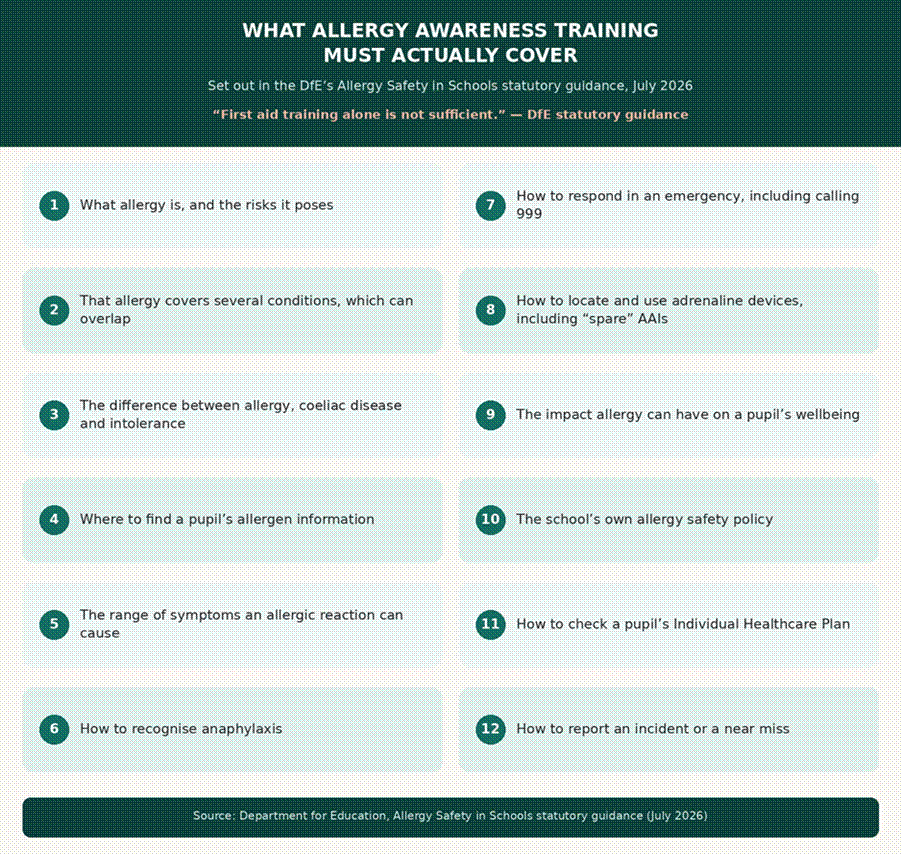
What allergy awareness training must actually cover, per the DfE’s Allergy Safety in Schools statutory guidance (July 2026).
That’s 12 distinct things a member of staff needs to genuinely understand and, in the case of the adrenaline device, physically practise. Not sit through. Understand. There’s a real difference between a room full of people who have heard something and a room full of people who could act on it if a child in front of them stopped breathing properly.
Why 200 Staff in 90 Minutes Doesn’t Add Up
Here’s where the maths gets uncomfortable for anyone hoping to tick this box quickly.
My Benedict’s Law training runs to a maximum of 25 learners per session, delivered over three hours. That cap isn’t arbitrary. Every person in the room needs to physically handle a trainer adrenaline pen, practise the technique, and ask the questions that only occur to you once you’ve actually held the device. If I shrink the group to something smaller, say 12, I can bring the session down to two hours at an absolute minimum, and even that is pushing it.

What was asked for, versus what compliant Benedict’s Law training actually takes.
Run the numbers on 200 staff at that ratio, and you need eight separate sessions of three hours each: 24 hours of training delivered properly, not the 90 minutes on offer. That’s not me being precious about my own diary. It’s what it actually takes for 200 individual adults to each get hands-on time with equipment they might one day need to use on a five-year-old.
The guidance is blunt about why the practical element matters this much. In a genuine anaphylactic reaction, adrenaline needs to be given within five minutes, and investigations into fatal reactions show there’s typically only a twenty to thirty minute window in which action can prevent death. That’s not something you can build real confidence in by watching a slide of someone else doing it.
What I Actually Said
I didn’t just decline and leave it there. I wrote back to both the school and the Learning Partnership with the training section of the DfE’s statutory guidance attached, and set out plainly what it requires. I told them I’d be glad to deliver the training if they could allocate more time, whether that meant a longer single session, smaller groups, or spreading delivery across more than one date.
And I explained why I couldn’t do what they’d originally asked for: pushing that volume of content to that many people in that short a window isn’t effective training or effective learning, for anyone involved. I wouldn’t be able to certificate people at the end of it and feel I’d done so ethically, or that the certificate meant what it’s supposed to mean.
Why I Won’t Put My Name to a Rushed Certificate
I could race through a slide deck, tick the register, and hand out 200 certificates by lunchtime. Plenty of providers would. But a certificate is meant to say something: that the person holding it understands what anaphylaxis looks like, knows where the spare pens are kept, and could pick one up and use it without hesitating. Sign 200 of those in an hour and a half, and the certificate stops meaning anything at all.
Benedict’s Law exists because gaps in allergy safety within schools can have devastating consequences. Racing through training to hit a timetable slot is exactly the kind of gap this law was written to close.
If that makes me the trainer who’s “too ethical” about a training slot, I’m entirely comfortable with that.
How Schools and Learning Partnerships Can Actually Make This Work
None of this means Benedict’s Law training has to blow up your INSET calendar. It means building it properly rather than squeezing it in. In practice, that usually looks like one of the following:
- Splitting the day into waves. Instead of one all-staff slot, run several smaller groups across the same INSET day, or spread them across a twilight session and a training day.
- Sharing the load across a Learning Partnership properly, rather than trying to cover every school’s staff in one combined slot. Staggering delivery school by school, or site by site, keeps group sizes workable.
- Blending theory with practical. The policy, the wellbeing content, and the difference between allergy, intolerance and coeliac disease can be covered ahead of time, which frees up the face-to-face session to focus on hands-on adrenaline pen practice and questions.
- Booking early. The closer you get to September, the fewer providers have the capacity to give you a properly sized session, which is exactly how schools end up asking for 200 people in 90 minutes in the first place.
None of these cost more time overall than the rushed version, once you account for the eight sessions it actually takes. They just spread that time out sensibly instead of pretending it doesn’t exist.
Frequently Asked Questions
How long should Benedict’s Law allergy awareness training take?
The DfE’s guidance doesn’t set a fixed number of hours, but it does set out everything staff need to understand and practise, including hands-on use of an adrenaline device. In practice, a properly delivered session for a full-size group runs to around 2-3 hours, longer if the group is large or new to the content.
How many staff can be trained in one Benedict’s Law session?
That depends on the practical element. Groups need to stay small enough for everyone to handle a trainer adrenaline pen and get individual feedback, which is why Prima Cura caps sessions at 25 learners. Larger staff numbers mean more sessions, not a longer single session with everyone crammed in.
Is first aid training enough to meet the Benedict’s Law training requirement?
No. The DfE’s statutory guidance is explicit that first aid training on its own does not meet the requirement. Allergy awareness training has to cover the full spectrum of allergic conditions, the difference between allergy, intolerance and coeliac disease, and a school’s own allergy safety policy, not just emergency first aid.
Does Benedict’s Law training have to be delivered face-to-face?
The guidance doesn’t set out a delivery format in so many words, but it does expect staff to be able to locate and use an adrenaline device in an emergency. In my experience, that kind of physical competence and confidence is very hard to build without hands-on practice with a trainer pen, in the room, in front of someone who can correct technique.
What should schools ask a training provider before booking Benedict’s Law training?
Ask about the maximum group size for the practical element, whether staff get hands-on time with a trainer adrenaline pen, and how the session covers the difference between allergy, coeliac disease and food intolerance. If a provider will certificate any group size in any timeframe, that’s worth asking about too.
| Training That Actually Meets the Standard If your school or Learning Partnership needs Benedict’s Law training that holds up, properly sized and properly timed, that’s what Prima Cura delivers. Phone: 0333 999 8783 Email: info@primacuratraining.co.uk |
Take a look at our Allergy Awareness (Benedict’s Law) training, built around the DfE’s statutory guidance and delivered in groups small enough for everyone to get hands-on practice. We also deliver Anaphylaxis Awareness training for workplaces outside the school sector, and Emergency First Aid for Schools for settings that need first aid and allergy response covered together.
For the full breakdown of what Benedict’s Law requires beyond training, including Individual Healthcare Plans and spare adrenaline devices, our earlier guide, What Benedict’s Law Requires, and Why It Goes Far Beyond the EpiPen, covers it in full.
This article reflects the Department for Education’s statutory guidance, Allergy Safety in Schools, published 6 July 2026 and in force from 1 September 2026, along with Prima Cura’s own training delivery model at the time of writing. It is general information, not legal advice. Further duties are expected through forthcoming regulations, and guidance can change, so schools should read the full DfE guidance and take their own advice on how it applies to their setting.