Myth Busting Monday: Should You Keep a Concussed Person Awake All Night?
Written by Stephanie Austin, Owner and Lead Trainer, Prima Cura Training | Last reviewed: October 2026 | Next review: October 2027
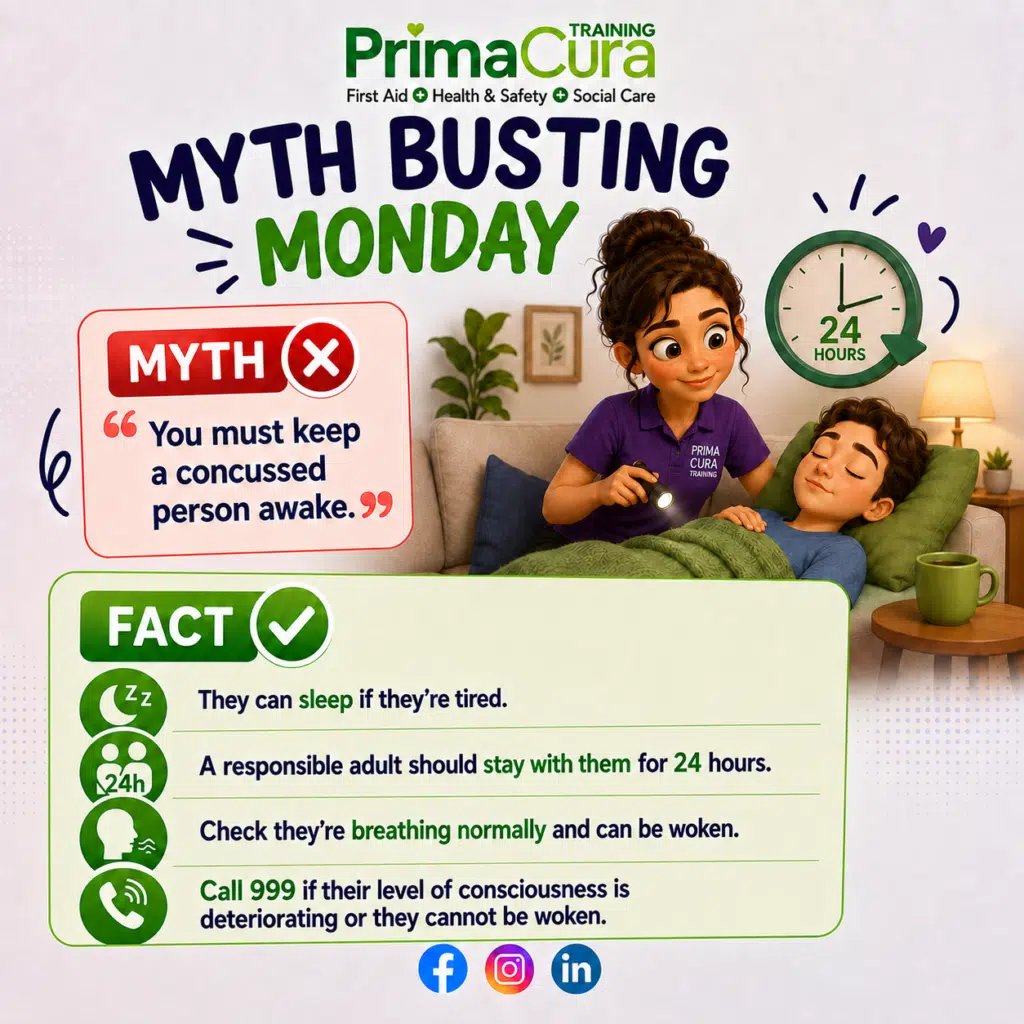
| MYTH | “Keep a concussed person awake all night.” |
| FACT | They can sleep. Sleep is part of how the brain recovers, and NHS advice is that someone with a head injury does not need to stay awake if they are tired. What matters is that a responsible adult stays with them for at least the first 24 hours and knows the red flags: repeated vomiting, worsening headache, confusion, a seizure, or being difficult to rouse. Any of those, get help. |
Ask a room what you do after a bang on the head, and somebody will describe an entire night of setting alarms and prodding a teenager awake at 2am. They’re not being daft. They’re doing what they were told. It’s just that what they were told stopped being the advice about thirty years ago.
Where does the “keep them awake” myth come from?
It comes from a real medical worry, which is why it’s stuck around so well.
There’s a type of bleed on the brain, most often an extradural haematoma, where somebody seems perfectly fine straight after the injury and then deteriorates hours later as the pressure builds. That gap is sometimes called a lucid interval. It’s rare and it’s serious.
Before CT scanning was routine, there was no way to look inside somebody’s skull and rule it out, so the safety net was a person at the bedside checking through the night that the patient could still be roused. Hourly waking wasn’t a folk remedy. It was clinical practice, in the absence of anything better.
We have something better now. When a head injury is assessed in hospital, the decision about whether it needs a scan is made there, against NICE guidance, before anyone is sent home. The all-night vigil is a leftover from a time when that wasn’t possible.
So what does the guidance actually say?
Three things, and only one of them is about sleep.
A responsible adult stays with them for at least 24 hours. That’s the NHS advice, and it’s in the NICE head injury guideline too. Staying with someone is not the same as keeping them awake. It means being in the house, near enough to notice if something changes.
They can sleep normally. No alarms, no hourly prodding. Rest for the first 24 to 48 hours, easy activities and gentle walking, no intense exercise, and keep the screens down.
Watch for the red flags, and act on them. That’s the whole job. Not vigilance for its own sake, but knowing exactly what you’re looking for.
There’s a practical argument here as well as a clinical one. A person who has been dragged awake six times overnight is groggy, irritable, headachy and slow to answer questions by morning. So is a person whose brain injury is getting worse. Sleep deprivation produces a passable imitation of the exact symptoms you’re supposed to be watching for, which makes it harder, not easier, to spot genuine deterioration.
Why hourly waking was standard before CT scanning, and what replaced it.
Sleeping, or not able to be woken?
This is the distinction that settles most people’s nerves, and it’s the bit worth teaching properly.
A person who is asleep will rouse normally. Say their name, give them a shake, and they surface, grumble at you, and make sense. That’s sleep. It’s fine, and you can let them go back off.
A person you cannot rouse, or who wakes but is confused, doesn’t know where they are, can’t keep their eyes open or drifts straight back under, is not asleep. That is a reduced level of consciousness, and it’s a 999 call.
So there is a check-in there. It’s just one check, done once if something worries you, rather than a rota of alarms all night. If you genuinely can’t settle without looking in on them, look in on them. Watch them breathe. That tells you almost everything and wakes nobody up.
What to watch for in the first 24 hours
Call 999 if the person:
- has been knocked out and hasn’t woken up, or can’t stay awake or keep their eyes open
- has a fit or seizure
- has clear fluid coming from the ears or nose, is bleeding from the ears, or has bruising behind the ears
- is increasingly confused, doesn’t recognise where they are, or is behaving oddly
- has weakness in an arm or leg, problems with speech, vision or balance
- has a headache that keeps getting worse
- is vomiting repeatedly
Contact NHS 111 urgently if they’ve been sick once, feel dizzy, took alcohol or drugs at the time, or take anticoagulant medication.
Symptoms can take a couple of weeks to settle. The first 24 hours is the window that needs somebody in the house, not two weeks of surveillance.
Who needs checking over regardless of how well they seem
This is the part that gets missed, and in care settings it’s the part that matters most.
Anyone on blood thinners: Warfarin, apixaban, rivaroxaban, clopidogrel and similar. A bleed on the brain is both more likely and faster in someone whose blood doesn’t clot properly, and it can happen after a knock that wouldn’t trouble anybody else. NICE NG232 recommends considering a CT head scan within 8 hours of injury for people on these medicines, even with no other worrying signs. A resident who has fallen and banged their head while on a blood thinner does not get monitored on the unit and reviewed in the morning. They get assessed.
People who don’t remember the fall, who were found on the floor, or where nobody saw what happened. If you can’t establish whether they were knocked out, assume they might have been.
Older people, babies and toddlers, and anyone who’s had alcohol, because both the injury and the assessment get more complicated.
And one for the record book: you can absolutely have a concussion without ever being knocked out. Loss of consciousness is not the test. Feeling dazed, confused, sick or headachy after a bang on the head is enough to count.
Sport, school and work
The UK now has one national standard for grassroots sport, and it’s blunt on purpose. If in doubt, sit them out. Anyone with a suspected concussion comes off immediately and doesn’t go back on that day, whatever the score is and whatever they say about feeling fine.
After that, the guidelines set out a graduated return, and the timescales surprise people. Return to competition comes no earlier than day 21, and only after 14 consecutive days free of symptoms. The NHS advice is the same in shorter form: no contact sport for at least three weeks.
At work, any loss of consciousness caused by a work-related head injury to a worker is classed as a specified injury under RIDDOR 2013 and must be reported. Different reporting rules apply when the injured person is a visitor, customer, service user or other non-worker.
Frequently asked questions
Is it safe to sleep after a concussion?
Yes. Sleep does not need to be avoided after a head injury, and NHS advice is that you or your child do not need to stay awake if you’re tired. What matters is that a responsible adult stays with you for at least the first 24 hours and knows the red flags to watch for, not that anyone stays awake.
How long do concussion symptoms usually last?
Most people recover within a couple of weeks, and NHS guidance says you might have symptoms for up to two weeks after a head injury. If symptoms are still there after that, or they’re getting worse rather than settling, see your GP.
Should I call 999 or contact NHS 111 after a head injury?
Call 999 if the person has been knocked out and hasn’t come round, is having a seizure, is increasingly confused, or has any of the other red flags listed above. Contact NHS 111 urgently if they’ve been sick once, feel dizzy, had alcohol or drugs at the time, or take anticoagulant medication, even without a red flag present.
Can you have a concussion without being knocked out?
Yes. Loss of consciousness is not the test for concussion. Feeling dazed, confused, sick or headachy after a bang on the head is enough to count, so someone can be concussed even if they never blacked out.
Training that answers this before the 2am panic does
Falls in care homes, playground knocks, a warehouse accident, a Sunday morning rugby pitch. The people who deal with head injuries are rarely doctors, and the advice they’re working from is often decades out of date.
Emergency First Aid at Work (EFAW) is the level most workplaces need, and higher risk settings usually need the three-day First Aid at Work qualification. Schools should look at Emergency First Aid for Schools, and anyone working with young children needs Emergency Paediatric First Aid or the two day Paediatric and Early Years First Aid for Ofsted compliance. If most of your head injuries start with somebody going over, Fall Prevention Awareness deals with the other end of the problem.
Give us a call on 0333 999 8783 or drop us a message and we’ll work out what your team needs.
THE VERDICT: BUSTED
Let them sleep. Stay in the house, know your red flags, and if you can’t wake them properly, that’s when you pick up the phone. The all-night alarm clock helps nobody, least of all the person trying to recover.
This article is provided for general information and awareness only and reflects NHS guidance, NICE guideline NG232 and the UK Concussion Guidelines for Non-Elite (Grassroots) Sport current as at August 2026. It does not constitute medical advice, and it is not a substitute for accredited, hands-on first aid training. Guidance can change, and how it applies depends on the person in front of you, including their age and any medication they take. If you are worried about someone after a head injury, contact NHS 111, or call 999 if any red flag is present.