Myth Busting Monday: Can You Put a Plaster on a Child at School?
Written by Stephanie Austin, Owner and Lead Trainer, Prima Cura Training | Last reviewed: November 2026 | Next review: November 2027
Yes. No law or national guidance in England stops school staff putting a plaster on a child, and plasters are on the HSE’s list of basic first aid kit contents. What decides it in your school is your school’s own first aid policy, which should cover who treats minor injuries, how allergies are checked and how parents are told.
| MYTH | “You can’t use plasters on children in schools.” A belief so common that plenty of school staff hold it without anyone ever having told them. |
| FACT | Plasters can be used in schools. The Department for Education’s guidance on first aid in schools lists sterile adhesive dressings in the HSE minimum first aid kit, and the early years written permission rule applies to medicines, not dressings. Check for allergies, follow your school’s procedures, and use an alternative dressing if a plaster isn’t suitable. |
I hear this one all the time, and not only from people who work in schools. It’s one of those things everybody seems to know.
Where it really landed for me was on a paediatric first aid course with a group of teaching assistants. We reached minor wounds, and it became clear that a few of them genuinely believed they weren’t allowed to put a plaster on a child. So they didn’t. Every cut and every graze went to the school office instead.
They weren’t aware of what their school’s first aid policy actually said. And they didn’t know the school already had permission forms from parents covering first aid, plasters included. Their own school had said yes. They just hadn’t heard it.
That’s the thing about this myth. It usually isn’t a rule. It’s a rumour that has set hard into one.
Where does the idea that schools can’t use plasters come from?
Allergies. Some people react to the adhesive on plasters, and a generation ago latex worried people too. One child with a known reaction is a very good reason to use something else for that child. Somewhere along the line it turns into “we don’t do plasters” for everyone.
Mixing up plasters and medicines. Schools are rightly strict about medicines. The early years foundation stage (EYFS) statutory framework says medicine can only be given to a child with written permission from a parent or carer for that particular medicine. That caution leaks across to everything in the first aid box, including the bits that aren’t medicines at all.
Fear of getting the blame. If a parent complains, or a child has a reaction, will it come back on me? It’s the same worry that sits behind the most common question in first aid, which we answered in Can You Be Sued for Giving First Aid? back in Week 1.
One school’s choice repeated as law. Some schools and nurseries do decide not to use plasters, or not on very young children, where anything that peels off a finger tends to end up in a mouth. That’s a legitimate local decision. Repeated across a staff room and out of the school gate, it becomes “schools aren’t allowed”.
What does the guidance actually say about plasters in schools?
The Health and Safety (First-Aid) Regulations 1981 require employers to provide adequate and appropriate first aid for their employees. The Department for Education’s guidance on first aid in schools, early years and further education points out that the regulations don’t cover pupils, but strongly recommends that schools consider pupils’ needs too, through a first aid policy and a first aid needs assessment.
On the kit itself, the same guidance sets out the HSE minimum contents for a first aid box, and the first item on the list is 20 individually wrapped sterile adhesive dressings in assorted sizes. Its minimum travelling kit for trips includes six more. The HSE’s own kit list calls them what everyone else does: individually wrapped sterile plasters of assorted sizes.
What the guidance does rule out is medication. Medicines shouldn’t be kept in a first aid box, and first aid at work doesn’t include giving tablets or medicines. A plaster is neither.
For early years, including Reception classes, the EYFS framework that applies from September 2026 adds two duties around any first aid: keep a written record of accidents, injuries and first aid treatment, and tell parents about any accident or injury and any first aid given, on the same day or as soon as reasonably practicable. Neither of those requires permission before a plaster goes on. They require you to write it down and let parents know afterwards.
In plain English: nobody has banned plasters in schools nationally. If your school doesn’t use them, that’s a local decision, and it should be written into your first aid policy with the reason and the alternative.
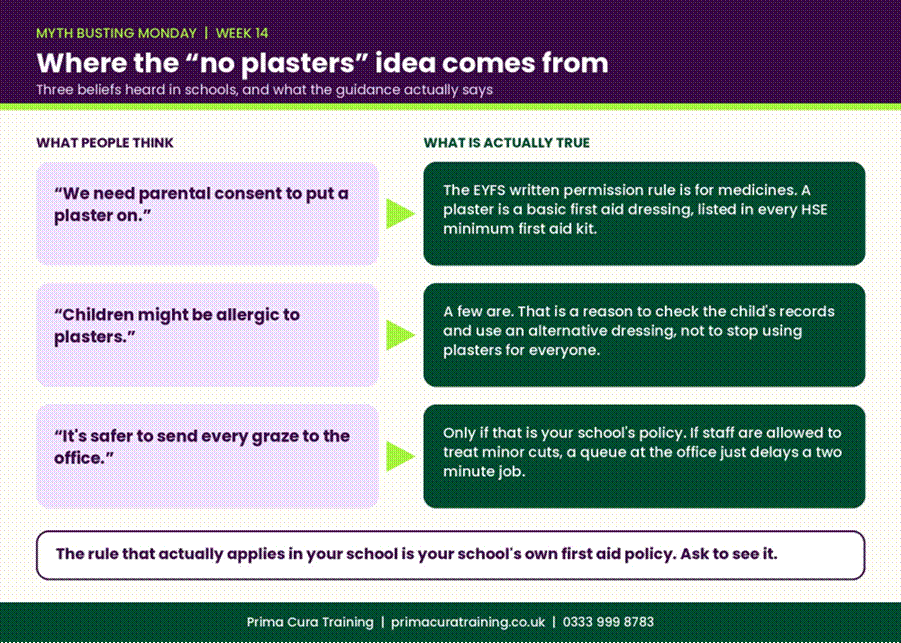
Three beliefs about plasters heard in schools, and what the guidance actually says.
Do you need parental permission to put a plaster on a child?
Not under national guidance. The written permission rule in the EYFS framework is about medicines, and the DfE guidance on first aid in schools doesn’t require separate consent for basic first aid such as cleaning and covering a graze.
Plenty of schools do collect consent for first aid anyway, usually in the paperwork parents complete when a child starts. That was exactly the situation with those teaching assistants: the permission was already sitting in a filing cabinet. If your school works that way, the answer isn’t to assume no. It’s to find out what’s already been agreed, and which children, if any, have an exception recorded against their name.
What about children who are allergic to plasters?
Some children do react to the adhesive, usually with a red, itchy patch exactly where the plaster was stuck. It’s a reason to check, not a reason to stop.
- Know before you need to. Schools ask about allergies when children start. Make sure plaster and adhesive allergies are part of that question, and that the staff who actually deal with grazes can see the answer, not just the office.
- Keep an alternative in every kit. Hypoallergenic plasters, or a sterile non-adhesive dressing held in place with a bandage, cover the same wound without the adhesive on the skin.
- Ask the child if they’re old enough to tell you. Plenty of children know perfectly well that plasters make them itchy.
- If you’re not sure, use the non-adhesive option. It does the same job.
Allergy information is only useful if it reaches the person holding the plaster. That’s a school process question, and it’s worth checking it works before a dinner time rather than during one.
Why does sending every graze to the office matter?
It sounds like the cautious option. It isn’t a neutral one.
The child misses part of a lesson for something that takes two minutes to sort. The wound stays uncovered while they walk through school. The office may be dealing with a phone call, a late arrival and a lost coat at the same time, and the person on the desk may not be a first aider at all. And if the trained first aider is busy with a queue of grazes, they’re less available for the injury that genuinely needs them.
There’s a quieter cost, too. Staff who’ve been told, or have come to believe, that they can’t do the basics start to doubt themselves on everything else. That’s the opposite of what you want from the adults nearest to a child when something more serious happens.
How should school staff treat a cut or graze?
Following NHS advice on cuts and grazes, and assuming your school’s policy allows you to treat minor injuries:
- Wash your hands and put on disposable gloves. Every DfE minimum kit includes them.
- Stop the bleeding. Press on it with a clean pad or dressing, and raise the arm or leg if you can.
- Clean it. Rinse with tap water or a sterile wipe, wash the skin around it with soap and water, wiping away from the wound, then pat it dry.
- Check before you cover. Any plaster or adhesive allergy on the child’s record? Use a non-adhesive dressing instead.
- Cover it. A plaster or a sterile dressing. A waterproof one helps keep it clean and dry.
- Record it and tell parents. Write it in the accident record and let parents know in whatever way your policy sets out. For early years, that’s the same day or as soon as reasonably practicable.
The NHS says the dressing can come off after a few days once the wound has closed, which is useful to put on the note home.
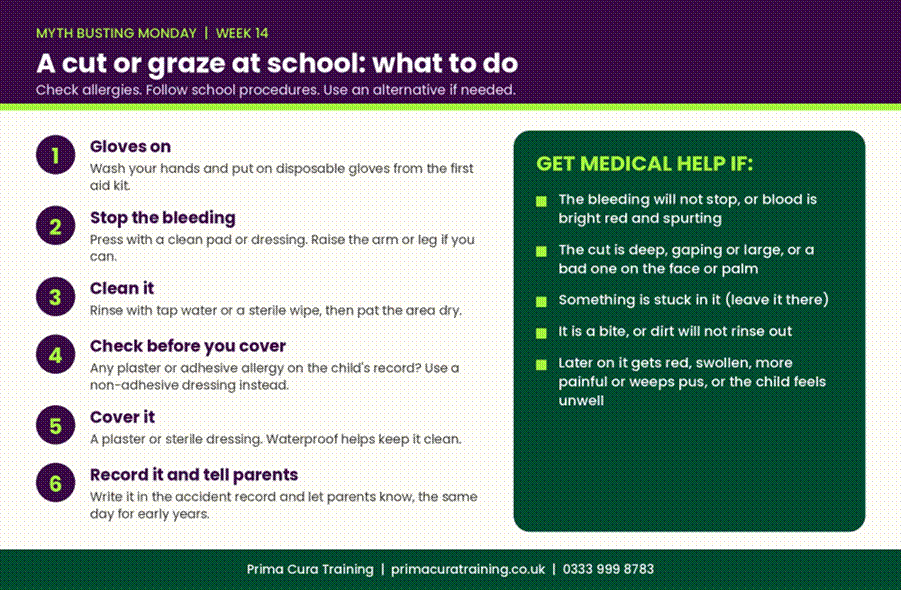
Six steps for a cut or graze at school, and when it needs more than a plaster.
When is a plaster not enough?
Most playground grazes are exactly what they look like. The NHS is clear about the ones that aren’t.
Call 999 or go to A&E if the bleeding won’t stop, the blood is bright red and spurting, the cut is deep or very large, it’s a bad cut on the face or the palm of the hand, there’s loss of feeling or movement, or something is stuck in it. Leave anything embedded exactly where it is and press around it, as we covered in Should You Pull Glass Out of a Wound?
Get an urgent GP appointment or call 111 if there’s dirt, soil or pus in the wound, it’s a bite, it’s around 5cm or larger, or it becomes swollen, red or more painful, or the child develops a high temperature or seems unwell. That last group often shows up days later, at home, which is another reason the note to parents matters.
And burns are a different job entirely. A burn needs 20 minutes under cool running water and a loose covering of cling film, not a plaster, as we set out in Does Butter Soothe a Burn?
What should a school first aid policy say about plasters?
If your policy is vague on this, or nobody below senior leadership has read it, these are the points worth having in writing:
- Who can treat minor injuries. The DfE guidance notes that staff can be asked to take on first aid but can’t be required to, so be clear about who has agreed to it
- Whether plasters are used, and any exceptions, such as age, particular children, or particular areas of the body
- How allergies, including plaster and adhesive allergies, are recorded, and how that information reaches the staff who treat injuries
- What alternative dressings are kept in each kit, including the travelling kits that go on trips
- How first aid is recorded, and how and when parents are told
- Where the kits are, and who restocks them
Then make sure the people at the sharp end have actually seen it. Teaching assistants, midday supervisors and anyone covering the playground. The gap I saw on that course wasn’t a gap in the policy. It was a gap between the policy and the people who needed it.
Frequently asked questions
Are schools allowed to put plasters on children?
Yes. No law or national guidance in England prevents school staff from putting a plaster on a child. The Department for Education’s guidance on first aid in schools lists individually wrapped sterile adhesive dressings in the HSE minimum first aid kit, and each school’s own first aid policy sets out who treats minor injuries and how.
Do schools need parental consent to use a plaster?
National guidance does not require separate parental consent for basic first aid such as cleaning and covering a graze. The EYFS rule on written parental permission applies to medicines, not dressings. Many schools still collect first aid consent when a child starts, so staff should check their own school’s policy and any exceptions recorded for individual children.
Can a teaching assistant put a plaster on a child?
Yes, if the school’s first aid policy allows staff to treat minor injuries. Department for Education guidance says staff can be asked to take on first aid but cannot be required to. Teaching assistants should check what their school’s policy says and whether any children have allergies or exceptions recorded.
When does a cut at school need medical attention?
NHS advice is to call 999 or go to A&E if bleeding will not stop, blood is bright red and spurting, the cut is deep or very large, or something is stuck in it. Call 111 or get an urgent GP appointment for bites, wounds containing dirt or pus, cuts around 5cm or larger, or signs of infection such as swelling, redness, increasing pain or a high temperature.
Training that settles it before the next grazed knee
This myth survives because nobody stops to check it. A paediatric first aid course is often the first time school staff hear, from someone who has read the guidance, what they can and can’t do, and how their school’s policy fits around it.
Emergency First Aid for Schools is built for school staff. Anyone working with young children, including Reception class teams, needs Emergency Paediatric First Aid or the two day Paediatric and Early Years First Aid for Ofsted compliance. Your designated workplace first aiders will usually need Emergency First Aid at Work (EFAW), and for midday supervisors and support staff who just want the practical basics, Basic First Aid covers it.
Not sure what your setting needs? Our Workplace First Aid UK Guide walks through needs assessments and qualification levels. Give us a call on 0333 999 8783 or drop us a message and we’ll help you work it out.
THE VERDICT: BUSTED
Plasters aren’t banned in schools. Check the child’s record for allergies, follow your school’s policy, keep an alternative in the kit, and if nobody has ever shown you that policy, ask to see it this week.
This article is provided for general information and awareness only and reflects Department for Education, HSE and NHS guidance and the EYFS statutory framework applying in England as at October 2026. It does not constitute medical or legal advice, and it is not a substitute for accredited, hands-on first aid training. Each school’s or setting’s own first aid policy and needs assessment sets out how first aid is given there, and staff should follow it. Guidance can change. If a wound is deep, will not stop bleeding or shows signs of infection, seek medical advice. In an emergency, always call 999.