Myth Busting Monday: Can You Be Sued for Giving First Aid?
Written by Stephanie Austin, Owner and Lead Trainer, Prima Cura Training | Last reviewed: August 2026 | Next review: August 2027
Every course I run, somebody repeats something about first aid that simply isn’t true. Myth Busting Monday is where we take one of those apart properly, with the actual law and guidelines sitting next to it rather than the version that gets passed around workplaces.
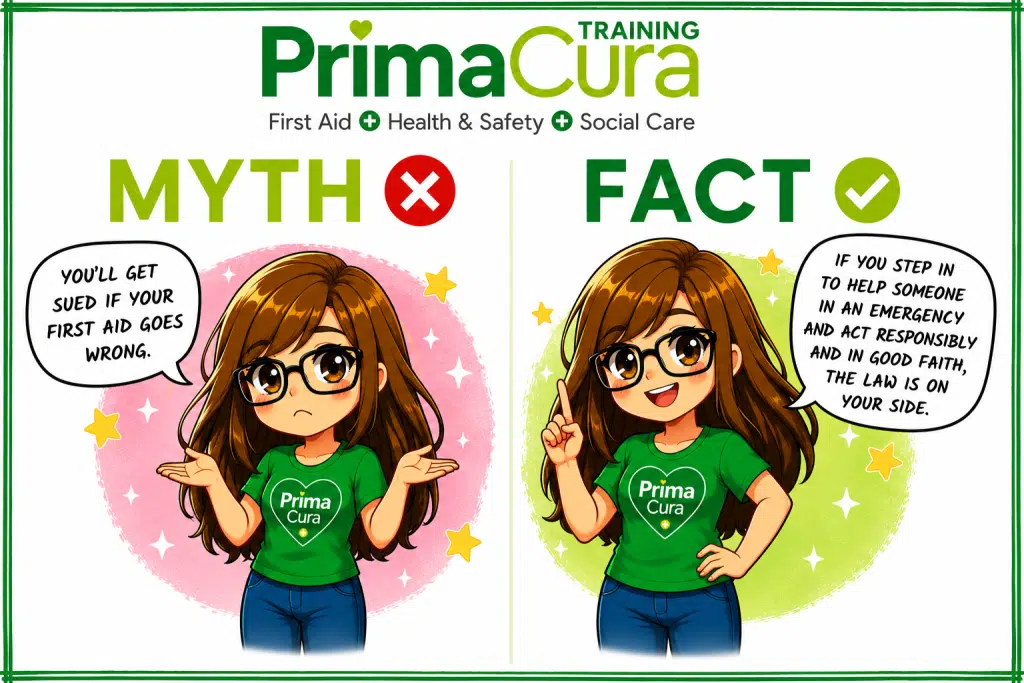
| MYTH | “If I get it wrong, or they die, I can be sued.” The single most common worry I meet in a first aid room. |
| FACT | If you step in to help someone in an emergency and act responsibly and in good faith, the law is on your side. The Social Action, Responsibility and Heroism Act 2015 requires a court to take a helper’s good intentions into account. A negligence claim would have to prove that a duty of care was owed, that the standard reasonably expected was breached, and that the breach caused harm the person would not otherwise have suffered. The real legal risk sits with not being ready to act, not with acting. |
I can usually tell when it’s coming. We’re halfway through the CPR practical, somebody is knelt over a manikin with their hands in the right place for the first time, and they sit back on their heels and look up at me.
“What if I break their ribs?”
Then, nearly always, the real question follows. “What if they die? Can I be sued?”
In 15+ years of training I have heard that in more rooms than I could count. Not now and again. Most courses. Care staff ask it, school staff ask it, door supervisors ask it, office managers ask it.
The box above is the short answer, and it is the right one. The rest of this post is why it is right, plus the part almost nobody covers: what changes when first aid is written into your job description rather than something you happen to walk past in the street.
Where does this myth come from?
Partly American television, where Good Samaritan laws get name-checked in every medical drama, and the assumption follows that if helpers need a law to protect them, helpers must be at risk. Partly the compensation culture stories the papers have been running since the nineties.
And partly because nobody has ever sat these people down and told them what a negligence claim actually requires. The fear gets repeated in workplaces, passed between colleagues, and never once tested against the law.
The result is a room full of trained, capable people who are quietly less likely to act.
What does a negligence claim actually have to prove?
Three separate things, and all three of them. That you owed the person a duty of care. That you fell below the standard reasonably expected of someone with your level of training. And that your actions caused them harm they would not otherwise have suffered. Miss one and there is no claim.
Now hold that against what actually happens in a first aid emergency. Someone’s heart has stopped. Without compressions they will die. You start compressions. If a rib cracks, that is not a mistake, it is a recognised consequence of compressions delivered deep enough to work. And any harm you are supposed to have caused has to be measured against an outcome that was already the worst one on the table.

The three tests a negligence claim has to pass, and why cracked ribs are not one of them.
That is not a legal loophole. That is how negligence has always worked.
What does the Social Action, Responsibility and Heroism Act 2015 actually say?
The Social Action, Responsibility and Heroism Act 2015 received Royal Assent on 12 February 2015 and came into force on 13 April 2015. It applies in England and Wales only, and only to acts or omissions from that date onwards.
It tells a court that, when deciding a claim in negligence or breach of statutory duty, it must have regard to whether the person was acting for the benefit of society, whether they showed a predominantly responsible approach towards protecting the safety of others, and whether they were acting heroically by intervening in an emergency to assist someone in danger.
Here is the honest bit, because I would rather you had the real version than a comfortable one. The Act does not hand you immunity. Anyone telling you it makes a claim impossible is overselling it. What it does is place a statutory obligation on the court to weigh your good intentions in the balance. Parliament wrote that down because it accepted that fear of being sued was stopping people from helping. That fear is the problem the law was built to answer.
If you are a member of the public, what does the law expect?
If you come across a stranger collapsed in the street, the law in England and Wales imposes no general duty on you to help. You can walk past. Morally that is a hard one to sit with. Legally, you are entitled to keep walking.
What changes the moment you do step in is that you are expected to act reasonably. In practice that comes down to three things:
- Do what you have been trained to do, and do not go beyond it
- Call 999 early, and stay on the line if the call handler asks you to
- Stay with the casualty until somebody with equal or greater skill takes over
Do those and you have behaved exactly as the law expects of you.
What if you are at work and first aid is part of the job?
This is where the answer changes, and where most articles on this subject stop.
A designated workplace first aider, a care worker on shift, a teaching assistant covering the playground: you are not a passing member of the public. You are acting in the course of your employment, and the legal picture shifts in two important ways.
First, your employer carries the liability. Where an employee causes harm while acting in the course of their employment, responsibility sits with the organisation, not with the individual. Employers are also legally required to hold employers’ liability insurance under the Employers’ Liability (Compulsory Insurance) Act 1969. When something goes wrong at work, a claim is aimed at the organisation and its insurer.
Second, the scrutiny lands on the arrangements, not on your technique. Under regulation 3 of the Health and Safety (First-Aid) Regulations 1981, every employer must provide equipment, facilities and personnel that are adequate and appropriate for enabling first aid to be given to employees who are injured or become ill at work. What counts as adequate comes out of a first aid needs assessment, set out in the HSE Approved Code of Practice L74.
So after a serious workplace incident, the questions asked are these. Was there a current needs assessment? Were there enough trained first aiders on that shift? Were the certificates in date? Was the defibrillator accessible and working? Nobody is asking whether one individual’s compressions hit exactly the right depth.

Two lanes, two different legal positions. Most people are standing in the second one without realising it.
The flip side: if responding is part of your role and you choose not to, that is where your exposure actually sits. Not a claim from a stranger, but a contractual and regulatory problem with your employer, your professional body, and in regulated care, the CQC.
So where is the real risk?
Not in helping. In not being ready to.
What I see is rarely people doing first aid badly. It is trained people hesitating anyway, because nobody has ever told them the law is on their side. A pause of a few seconds before starting compressions has a genuine clinical cost, and in this case it is caused entirely by something that is not true.
What this looks like in a real training room
When I answer this question properly rather than waving it away, you can watch it land. Shoulders drop. The person who had been tapping politely at the manikin’s chest goes at it properly on the next attempt.
The pattern in who asks is worth naming too. It is never the person messing about at the back. It is the conscientious one. The care worker thinking about the family. The teaching assistant thinking about the parent. The venue manager thinking about the licence. The fear is not ignorance. It is the same care that made them want to do the training in the first place, pointed in the wrong direction.
That is why I answer it in full every single time instead of saying “don’t worry about it”. Don’t worry does not survive contact with a real emergency. Knowing what the law actually asks of you does.
Frequently asked questions
Am I legally required to give first aid to a stranger?
No. There is no general legal duty in England and Wales requiring a member of the public to rescue or assist a stranger. The position changes if first aid forms part of your job or your professional role, in which case a duty can arise through your contract of employment or your professional standards
Can I be sued if I break someone’s ribs performing CPR?
Rib injury is a recognised consequence of chest compressions delivered at the depth needed to circulate blood. It is an indication that CPR was being performed effectively, not evidence of a mistake, and it is not a realistic basis for a negligence claim against somebody attempting resuscitation on a person in cardiac arrest.
Is a workplace first aider personally liable if something goes wrong?
Where an employee acts within the course of their employment, liability sits with the employer rather than the individual, and employers are required to hold employers’ liability insurance under the Employers’ Liability (Compulsory Insurance) Act 1969. Investigations after a workplace incident focus on whether the employer’s first aid arrangements were adequate under the Health and Safety (First-Aid) Regulations 1981
Does holding a first aid certificate make me more legally responsible?
Holding a qualification does not create a legal duty to assist a stranger in the street, but it does raise the standard you will be measured against if you do act, because you are judged against what is reasonable for someone with your level of training. Keeping certificates current and practising skills regularly is the practical answer to that.
Training that answers this before the emergency does
Every course we run covers the legal position properly, because a first aider who is confident about where they stand is a first aider who starts compressions three seconds sooner. If your team have been carrying this worry around, it takes about ten minutes to put it down for good.
If your workplace needs a designated first aider, our Emergency First Aid at Work (EFAW) course is the one most organisations need. Higher-risk environments usually need the three-day First Aid at Work qualification instead, and if your certificates are still valid but the skills have gone rusty, Basic Life Support and AED Training is the refresher that keeps them sharp. Schools can look at Emergency First Aid for Schools.
Not sure which level your organisation needs? Our Workplace First Aid UK Guide walks through needs assessments and qualification levels, and the EFAW vs FAW comparison covers the choice in detail. Give us a call on 0333 999 8783 or drop us a message and we will help you work it out before you commit to anything.
THE VERDICT: BUSTED
If you step in to help someone in an emergency and act responsibly and in good faith, the law is on your side.
Next Monday: the myth that CPR Restarts the Heart
This article is provided for general information and awareness only and reflects UK legislation and guidance applying in England and Wales as at July 2026. It does not constitute legal advice, and it is not a substitute for accredited, hands-on first aid training. Legislation and guidance can change, and the way the law applies depends on the facts of an individual situation. Employers remain responsible for carrying out a first aid needs assessment and for meeting their duties under the Health and Safety (First-Aid) Regulations 1981. If you need advice on a specific incident or claim, seek qualified legal advice.