Myth Busting Monday: Can Young People Have a Stroke?
Written by Stephanie Austin, Owner and Lead Trainer, Prima Cura Training | Last reviewed: November 2026 | Next review: November 2027
Yes. A stroke can happen at any age, including to children, and one in four strokes in the UK happens to someone of working age. Age makes a stroke more likely, but it is never a reason to dismiss the signs. If someone’s face droops, an arm goes weak or their speech goes wrong, call 999 straight away, whether they’re 8, 38 or 88.
| MYTH | “Strokes only happen to old people.” The belief that turns a 30-something with a drooping face into someone who “just needs a sit down”. |
| FACT | A stroke can happen at any age. The Stroke Association says one in four strokes in the UK happens to people of working age, and children have strokes too. Age raises the risk, but it doesn’t decide who has one. Spot a sign using FAST, call 999 immediately, and don’t let anyone’s age talk you out of it. |
Picture a shared office kitchen on a Tuesday afternoon. A woman in her thirties is making a coffee when her hand stops doing what she tells it to. The mug tips. She tries to laugh it off and the words come out wrong, thick and slow, as if she’s had a drink.
“You’re shattered,” somebody says. “Sit down for ten minutes.”
Nobody says the word stroke. Not because they don’t know the signs, but because she’s 34, and everyone knows strokes happen to grandparents.
That pause, the ten minutes on a chair to see if it passes, is exactly what this myth costs. A stroke is a medical emergency at any age, and the treatments that limit the damage depend on how quickly someone gets to hospital.
Where does the idea that strokes only happen to older people come from?
Partly because it’s half true. Age genuinely is a risk factor. The Stroke Association explains that arteries become harder and narrower as we get older, which makes a blockage more likely, and the British Heart Foundation lists being over 55 among the things that raise the risk. Most people who have a stroke are older.
But “most” has quietly become “only”. The picture most of us carry of someone having a stroke is an older person, so that’s who people look out for. And when the person in front of them is young, fit and otherwise well, the brain reaches for a more comfortable explanation first: they’re drunk, they’ve got a migraine, they’re exhausted, they’re having a panic attack.
The Stroke Association’s own research shows how deep this runs. In a 2023 survey, 60% of UK adults wrongly believed that strokes don’t happen to young adults, and more than a third of stroke survivors aged 18 to 60 said they hadn’t thought strokes happened to people their age until it happened to them. A quarter of survivors aged 60 and under were first diagnosed with another illness before their stroke was identified.
How common are strokes in younger people?
More common than most people would guess. The Stroke Association puts the figure at around 100,000 strokes a year in the UK, roughly one every five minutes, and says one in four of them happens to people of working age.
Children are not exempt either. The Royal College of Paediatrics and Child Health’s stroke in childhood guideline says stroke affects several hundred children and young people in the UK every year, and tells clinicians to use FAST to recognise it in children as well as adults.
Those are not rare exotic cases. They’re colleagues, students, parents on the school run, and the person next to you at the gym.
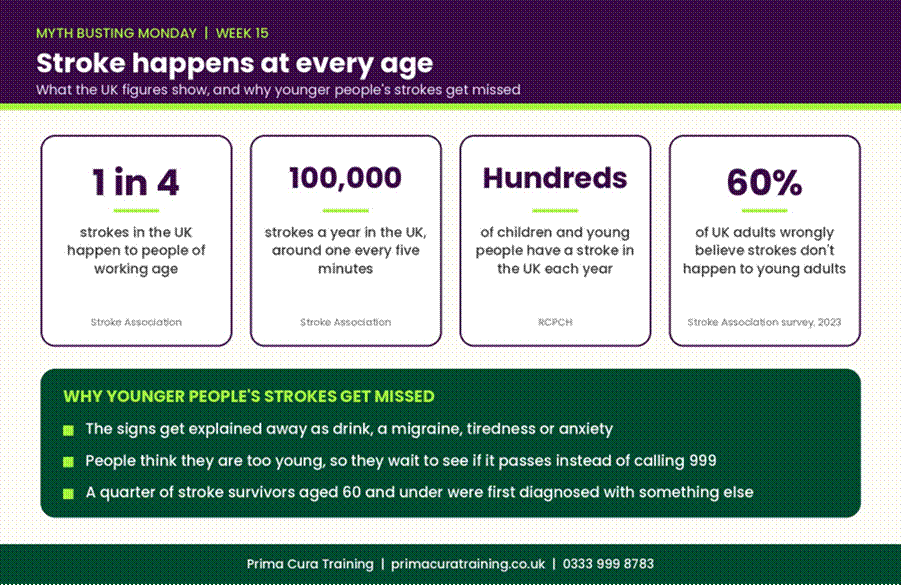
The UK figures on stroke at every age, and the reasons younger people’s strokes get missed.
What causes a stroke in a younger person?
A stroke happens when the blood supply to part of the brain is cut off, either by a blockage or by bleeding in or around the brain. That’s the same at any age. What can differ is why it happens.
The familiar risk factors, such as high blood pressure, diabetes, high cholesterol, smoking and an irregular heartbeat called atrial fibrillation, don’t wait until retirement. Some people have them in their twenties and thirties without knowing. The Stroke Association also lists other risk factors, including migraine, sickle cell disease and risk factors specific to women, and the British Heart Foundation notes that strokes in children have different causes from those in adults.
For a first aider, the cause doesn’t matter on the day. Nobody is expected to work out why someone is having a stroke. The only job is to recognise that they might be, and to get help moving.
How do you recognise a stroke at any age?
NICE guideline NG128 tells clinicians to use a validated tool such as FAST to screen people with sudden neurological symptoms outside hospital. It’s the same test everyone can use, and it works the same whatever age the person is.
- Face. Has one side of the face, mouth or eye drooped? Ask them to smile.
- Arms. Can they lift both arms and keep them there? One may drift down or not lift at all.
- Speech. Is their speech slurred or muddled, or are they struggling to find words or understand you?
- Time. Time to call 999 if you see any one of these signs.
FAST catches most strokes, but not all of them. The British Heart Foundation also lists sudden numbness or weakness down one side of the body, blurred vision or loss of sight in one or both eyes, confusion, memory loss and a sudden severe headache. The Stroke Association adds dizziness or a sudden fall. Sudden is the key word in all of them.
And one sign on its own is enough. You don’t need the full set, and you don’t need to be sure.
What should you do if you think someone is having a stroke?
- Call 999 straight away. Say you think it’s a stroke and describe what you’ve seen. Don’t drive them to hospital yourself. London Ambulance Service explains that crews take people with a suspected stroke straight to a specialist stroke centre, which may not be your nearest A&E.
- Note the time the symptoms started. Or, if nobody saw it begin, the last time they were known to be well. Hospital treatment decisions depend on it.
- Stay with them and keep them comfortable. Sitting or lying in whatever position is easiest for them, supported if they’re slumping to one side.
- Don’t give them anything to eat or drink. A stroke can affect swallowing, and choking is the last thing they need.
- Keep talking to them, even if they can’t answer properly. They may understand far more than they can say, and they’ll be frightened.
- If they become unresponsive but are breathing normally, put them in the recovery position and keep checking their breathing. If they’re not breathing normally, start CPR. We covered what CPR actually does in Does CPR Restart the Heart?
- Tell the paramedics what you know. When it started, what you saw, any medical conditions or medicines you’re aware of, particularly blood thinners or diabetes.

FAST, the other sudden signs, and what to do while you wait for the ambulance.
Why does every minute count in a stroke?
Because the brain tissue affected by a stroke is losing its blood supply the whole time, and the most effective treatments only work within a window.
For strokes caused by a clot, NICE covers clot-busting medicines for treating stroke within 4.5 hours of symptoms starting, and thrombectomy, a procedure to physically remove the clot, as soon as possible and within 6 hours, or up to 24 hours in some people where scans show there’s still brain tissue to save. Those clocks start when the symptoms start, not when someone finally decides to ring 999.
That’s why the time the symptoms began matters so much to the hospital, and why ten minutes on a chair “to see if it passes” is ten minutes the person can’t get back.
What if the symptoms go away?
Still get help, urgently. Stroke symptoms that come and go, or clear up after a few minutes, may be a transient ischaemic attack, often called a mini-stroke, or TIA.
The Stroke Association’s guide to TIA is clear on this: call 999 as soon as symptoms start, don’t wait to see if they pass, and get medical help right away even if the person feels fine afterwards. It describes a TIA as a major warning sign of a much higher than normal risk of stroke, with the risk greatest in the first days and weeks.
NICE guidance is that anyone with a suspected TIA should be referred to be seen by a specialist within 24 hours of their symptoms starting. A TIA that gets brushed off because the person is young and feels better is a warning that has been ignored.
What does this mean at work?
If one in four strokes happens to people of working age, then workplaces are where a good number of them will be spotted, or missed. Offices, warehouses, building sites, classrooms and care settings are full of people under 65.
A designated first aider who only expects a stroke in an older person is working from the same myth as everyone else. The fix is simple: everyone in the building should know FAST, and everyone should know that age is never a reason to wait. That includes the person at reception who takes the call, the line manager who says “take ten minutes”, and the colleague who offers to drive them home.
It’s also worth thinking about the person who’s on their own. Someone working alone, or a lone worker on a site, may be the only person who can recognise their own symptoms. Knowing that a sudden weak arm or a face that feels wrong means 999 rather than an early night could be the most useful thing they ever learn.
Frequently asked questions
What are the signs of a stroke?
Use FAST: a face that has drooped on one side, weakness in one arm, slurred or muddled speech, and time to call 999. Other sudden signs include numbness or weakness down one side of the body, loss of vision, confusion, dizziness or a fall, and a sudden severe headache. Any one sign is enough to call 999.
What should you do if someone is having a stroke?
Call 999 immediately and say you think it is a stroke. Note the time the symptoms started, stay with the person, keep them comfortable and give them nothing to eat or drink. If they become unresponsive and are breathing normally, put them in the recovery position, and if they are not breathing normally, start CPR.
Can children have strokes?
Yes. The Royal College of Paediatrics and Child Health says stroke affects several hundred children and young people in the UK each year. Its guideline recommends using FAST to recognise stroke in children as well as adults, and says a child with a suspected stroke should have a brain scan within one hour of arriving at hospital.
Should you drive someone with stroke symptoms to hospital?
No. Call 999 instead. Ambulance crews can assess the person on the way and take them directly to a specialist stroke centre, which may not be the nearest A&E. Driving them yourself can lose time and take them to the wrong hospital.
Training that makes FAST automatic
Recognising a stroke takes seconds once you know what you’re looking at. The hard part is acting on it when the person doesn’t fit the picture you had in your head. That’s what proper training changes.
Our Stroke Awareness course goes deeper into what a stroke is, how to recognise it and how to support someone afterwards, and it’s built for care teams in particular. For first aid cover at work, the three day First Aid at Work qualification includes recognising and responding to serious illness, and Emergency First Aid at Work (EFAW) is the one most workplaces need for a designated first aider. Basic Life Support and AED keeps CPR skills sharp for the moment a stroke turns into something worse, and Basic First Aid covers the practical basics for a small team.
Not sure what your organisation needs? Our Workplace First Aid UK Guide walks through needs assessments and qualification levels. Give us a call on 0333 999 8783 or drop us a message and we’ll help you work it out.
THE VERDICT: BUSTED
A stroke doesn’t check anyone’s date of birth first. Face, Arms, Speech, Time: if you see a sign, call 999, whoever is in front of you.
This article is provided for general information and awareness only and reflects NICE guidance and information from the Stroke Association, British Heart Foundation and Royal College of Paediatrics and Child Health current as at October 2026. It does not constitute medical advice, and it is not a substitute for accredited, hands-on first aid training. Guidance can change, and how it applies depends on the individual. If you think someone is having a stroke, or has had symptoms that have now gone, call 999 immediately.