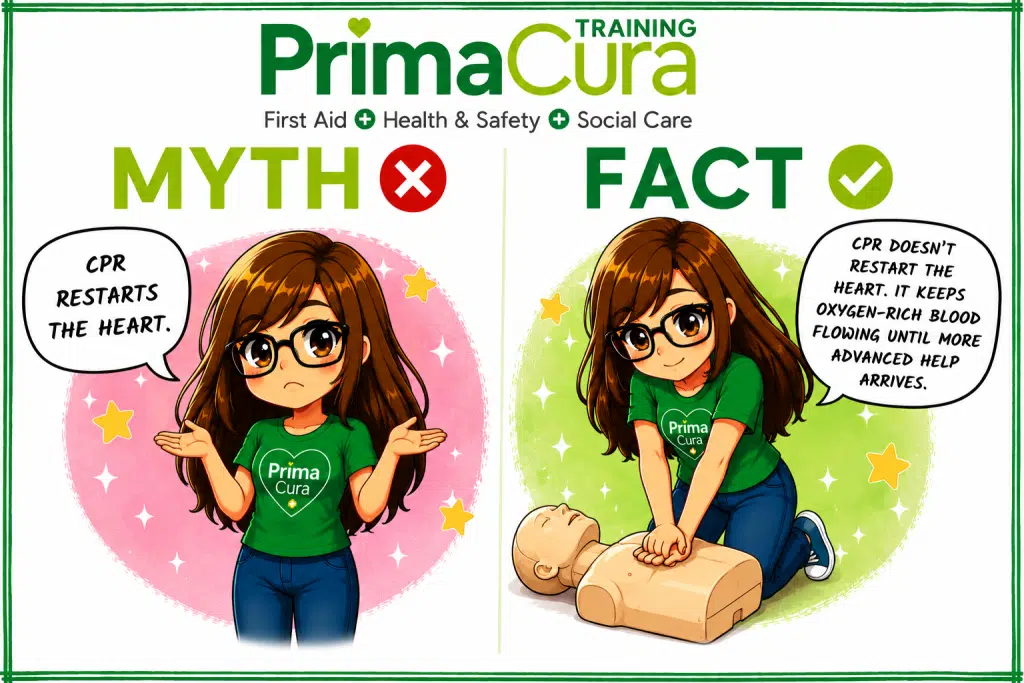
Myth Busting Monday: Does CPR Restart the Heart?
Written by Stephanie Austin – Owner & Lead Trainer, Prima Cura Training | Last reviewed: August 2026 | Next review: August 2027
Ask a room of first aiders what CPR is for, and most will tell you it restarts the heart. It doesn’t, and that single gap in understanding can leave people who did everything right carrying guilt that was never theirs to carry.
| MYTH | “CPR restarts the heart.” |
| FACT | CPR doesn’t restart anything. It keeps oxygenated blood moving to the brain, the heart itself and other vital organs, buying time until a defibrillator and paramedics can attempt to restore a normal rhythm. The real job of CPR is to keep the blood moving. Restarting a working rhythm is a defibrillator’s job, and even then it only works on certain rhythms. |
I can usually tell when it’s coming, too, just a little later in the session than the sued question. We’ve done the physiology, we’ve done the compressions, and somebody sits back on their heels from the manikin, slightly out of breath, and asks it anyway: “So if I keep going long enough, does the heart just start again?”
Nearly always, the room assumes the answer is yes. Television has told them so for thirty years. A few firm pushes on the chest, a gasp, eyes flick open, cut to credits.
It doesn’t work like that, and getting it right matters more than it may seem.
Where does this myth come from?
Mostly the screen. In a hospital drama, a flat line on the monitor turns into a shockable rhythm the moment the story needs it to, a defibrillator delivers one dramatic jolt, and the patient gasps back to consciousness within the same scene. None of that is how cardiac arrest actually responds to treatment. A flat line, properly called asystole, is not a rhythm that any defibrillator can shock back into. And chest compressions were never built to restart a heart in the first place.
Part of it is a language problem too. “Resuscitation” sounds like a single dramatic act, so people assume the compressions themselves are doing the reviving. They’re not. They’re doing something quieter, and in its own way, more important.
What does CPR actually do to the body?

What happens inside the chest during a normal heartbeat, compared with cardiac arrest and CPR.
A heart in cardiac arrest hasn’t broken down like a car that won’t start. Its electrical system has either stopped altogether or fallen into a rhythm that can’t move blood properly. Chest compressions don’t repair that fault. What they do is entirely mechanical: pressing down on the breastbone squeezes the heart between it and the spine, forcing blood out and around the body anyway, oxygen and all.
That’s the whole job of CPR. Keep the blood moving. Keep the brain, the heart itself and the other organs supplied with oxygen for long enough that there’s still something worth saving by the time proper help arrives. The Resuscitation Council UK’s Adult Basic Life Support Guidelines 2025, published on 27 October 2025, are built around exactly this principle: early, uninterrupted compressions, early defibrillation, and getting an ambulance on its way as fast as possible.
So what actually restarts a heart?

CPR and defibrillation do two different jobs. Confusing the two is where this myth comes from.
Only two heart rhythms respond to a defibrillator’s shock: ventricular fibrillation and pulseless ventricular tachycardia. Both are chaotic electrical storms that a shock can sometimes reset back into something organised. Asystole, the flat line most people picture, is not shockable. Neither is pulseless electrical activity, where there’s electrical signal but no effective pump behind it. Both need different treatment entirely, usually drugs and continued compressions delivered by paramedics, and even then the odds are not in anyone’s favour.
That’s the honest bit. Even a defibrillator doesn’t “restart” a heart the way the word suggests. It gives a heart that’s already misfiring a chance to fall back into a workable rhythm. Nothing shocks a heart from nothing into something. CPR and defibrillation are two separate jobs, done by two different tools, and neither one is a reset button.
Why understanding this changes how people act
On every course I run, whatever the level, I teach how the heart works before I teach anyone how to press on it. It isn’t a detour. It’s the part that makes everything after it make sense.
I’ve watched it land as a genuine “ta-dah” moment more times than I can count. The compressions stop being a mysterious ritual you perform and hope for the best, and start being something with a clear, logical purpose: you are the pump, for now, until someone or something better can take over.
One learner told me why that mattered more than I’d realised. She’d performed CPR on her mum. Afterwards she carried a quiet guilt that she hadn’t managed to restart her heart, as though that had been the test and she’d failed it. When I explained what CPR is actually designed to do, and what it was never designed to do, she came back afterwards to thank me. She said it felt like a weight had come off her shoulders. Understanding the mechanics of it meant she could finally see that she hadn’t failed her mum. She’d done exactly what CPR is for.
That conversation has stayed with me. It’s why this myth isn’t just a piece of trivia to correct. Left uncorrected, it can leave people who did everything right carrying guilt that was never theirs to carry.
If you’ve done CPR and it felt like it didn’t work
If you’ve been in that situation yourself, the outcome not going the way you hoped doesn’t mean you did it wrong. In most cases, resuscitation attempts don’t end with the person waking up there and then, even when every step was done correctly. That’s the hard reality of cardiac arrest, not a reflection of your effort.
The Resuscitation Council UK now recognises how emotionally difficult attempting resuscitation can be for lay rescuers and bystanders, and has a dedicated support page for anyone affected by cardiac arrest, whether you were the person who stepped in, a witness, or someone close to the person involved. If this is something you’re carrying, that’s a good place to start, and so is a conversation with your GP.
What to actually do, and why you don’t stop
- Call 999 as soon as you find someone unresponsive and not breathing normally. Do this before you start compressions if you’re on your own.
- Start chest compressions straight away: hard, fast, centre of the chest, and don’t stop to check whether it’s “working”.
- If you’re trained and willing, add rescue breaths at 30 compressions to 2 breaths. If you’re not trained or not comfortable, continuous compressions alone are still effective and better than nothing.
- Keep going until an AED arrives and you can follow its prompts, the person shows clear signs of life, paramedics take over, or you’re physically unable to continue.
- If an AED is nearby, use it. You don’t need training to use one. It only delivers a shock if the rhythm needs one, and it talks you through every step.
None of this depends on the heart restarting mid-compression. It depends on you keeping blood moving until someone with a defibrillator, drugs and further training can take the next step.
Frequently asked questions
Why do films and TV shows make it look like CPR restarts the heart?
Dramatic timing. A single shock followed by an immediate gasp back to consciousness makes for good television, but it isn’t how cardiac arrest responds to treatment in reality, and it has shaped what several generations of viewers assume CPR does.
Should I stop CPR to check if it’s worked?
No. Stopping compressions to check interrupts the blood flow you’ve just created. Keep going until an AED arrives and can be used, the person shows clear signs of life, paramedics take over, or you’re unable to continue.
I did CPR and the person didn’t survive. Did I do something wrong?
Not necessarily, and often not at all. Most cardiac arrests do not end in survival even when CPR is performed correctly. Doing CPR is the right action regardless of the outcome, and support is available through the Resuscitation Council UK’s dedicated page for anyone affected by cardiac arrest.
Training that answers this before the emergency does
Understanding what CPR does is the first step. Practising it on a manikin, under guidance, until it becomes muscle memory, is what turns that understanding into confidence when it counts.
Our Basic Life Support and AED course covers exactly this: hands-on compressions, AED use, and the reasoning behind each step, not just the sequence. It’s the annual refresher we’d recommend for EFAW and FAW certificate holders, and for any workplace team that wants genuine hands-on competence rather than a certificate that’s never been tested. If your workplace needs a designated first aider from scratch, our Emergency First Aid at Work (EFAW) course is usually the right starting point, and higher-risk environments should look at the three-day First Aid at Work qualification instead.
If you missed the first Mythbusting Monday post on whether you can be sued for stepping in to help, you can read it here. And if you want the full picture from our CPR and AED Awareness Week, the round-up covers all seven posts, including the chain of survival and what the 2025 guideline changes mean in practice.
THE VERDICT: BUSTED
CPR was never the reset button television made it look like. It’s the bridge, keeping blood and oxygen moving until a defibrillator, paramedics, or both, get the chance to do the part CPR was never designed to do.
Last Monday: Can You Be Sued for Giving First Aid?
Next Monday: the myth that CPR usually works, as it does on the telly.
This article is provided for general information and awareness only and reflects Resuscitation Council UK Guidelines 2025 and general medical guidance current as at July 2026. It does not constitute medical advice, and it is not a substitute for accredited, hands-on first aid training. Guidance can change, and how it applies depends on the specifics of an individual situation. In a medical emergency, always call 999.