A Heart Attack and Cardiac Arrest Are Not the Same Thing
Written by Stephanie Austin, Owner & Lead Trainer, Prima Cura Training |Last reviewed: August 2026 | Next review: August 2027
In over 25 years of working in health and social care, I’ve trained thousands of people in first aid.
And in almost every single course, at some point, someone uses “heart attack” and “cardiac arrest” as though they mean the same thing. I can’t blame them. Films and television have been doing it for decades. The character clutches their chest, collapses, and someone shouts, “he’s having a heart attack!” But what’s actually being depicted is almost certainly cardiac arrest. The terms get swapped in dramas, in news reports, even in casual conversation, so often that most people genuinely don’t know there’s a difference.
There is. And it matters.
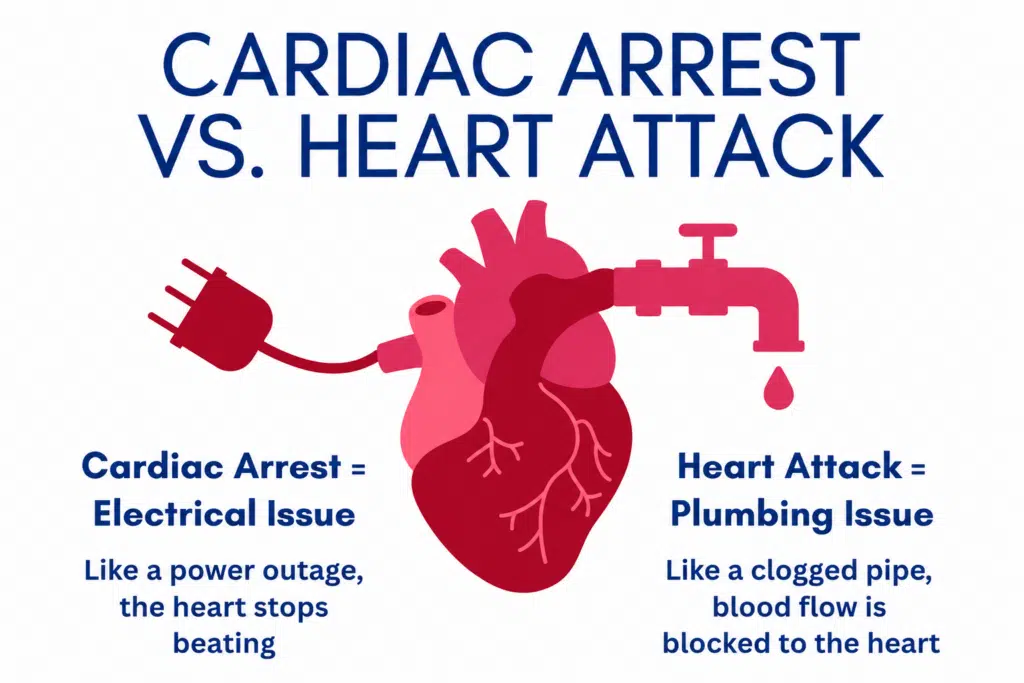
A heart attack is a circulatory problem. Cardiac arrest is an electrical problem. Both are medical emergencies. But they present differently, they require different responses, and knowing which is which could be the reason someone lives or dies.
At a Glance: Key Differences
| Heart Attack | Cardiac Arrest | |
| What it is | A blockage stopping blood reaching the heart muscle | The heart stops beating effectively |
| Is the person conscious? | Usually yes | No |
| Are they breathing? | Usually yes | No (or only gasping) |
| What do you do? | Call 999. Keep them calm. Sit them down in the ‘W’ position | Call 999. Start CPR immediately |
| Does an AED help? | No | Yes |
What Actually Happens During a Heart Attack?
The heart is a muscle. Like every other muscle in the body, it needs a constant supply of oxygenated blood to function. That blood is delivered via the coronary arteries. A heart attack, known medically as a myocardial infarction, happens when one of those arteries becomes blocked, usually by a build-up of fatty deposits that rupture and form a clot. When the blood supply is cut off, part of the heart muscle starts to die.
The person is still conscious. They’re still breathing. But they’re in serious trouble, and time is critical. The longer the blockage goes untreated, the more heart muscle is lost.
Signs of a heart attack include:
- Chest pain or pressure, often described as tightness, heaviness, or a squeezing sensation
- Pain spreading to the arm (usually the left), jaw, neck, or back
- Shortness of breath
- Nausea or feeling sick
- Sweating
- Dizziness or light-headedness
Some people, particularly women, older adults, and people with diabetes, may experience more subtle symptoms: discomfort without pronounced chest pain or symptoms that feel more like indigestion or extreme fatigue. These presentations are just as serious and just as deserving of emergency attention.
What Actually Happens During Cardiac Arrest?
Cardiac arrest is a different kind of emergency. The heart’s electrical system, which controls the rhythm that keeps it pumping, suddenly malfunctions. The heart stops beating in any useful way. Blood stops circulating. The brain and vital organs are deprived of oxygen within seconds.
The person will be unresponsive. They won’t be breathing normally. They may take occasional irregular gasps, known as agonal breathing, but this is not effective breathing and should not be mistaken for normal respiration.
Without CPR and defibrillation, cardiac arrest is fatal. The brain can sustain irreversible damage within four to six minutes of the blood supply stopping. This is why the response to cardiac arrest is so time-critical. Every minute without CPR or defibrillation reduces the chance of survival. When CPR is started immediately and a defibrillator is used within the first few minutes, survival rates improve significantly.
Can a Heart Attack Lead to Cardiac Arrest?
Yes. This is where the two conditions intersect, and it’s part of the reason people confuse them.
A heart attack can trigger cardiac arrest. The damage to the heart muscle can disrupt the electrical system and cause the heart to go into a dangerous abnormal rhythm, most commonly ventricular fibrillation, where the heart quivers rapidly instead of pumping effectively. When that happens, a heart attack becomes cardiac arrest.
But cardiac arrest can also occur without any prior heart attack. It can be caused by other electrical abnormalities, severe trauma, drowning, choking, a drug overdose, or any number of events that suddenly disrupt the heart’s rhythm.
They are related, but they are not interchangeable. One can lead to the other. They can occur together. But a heart attack is not cardiac arrest, and cardiac arrest is not always caused by a heart attack.
What Should You Do If You Think Someone Is Having a Heart Attack?
Call 999 immediately. Don’t wait to see if it gets better. Don’t drive them to the hospital yourself. Call for an ambulance.
While you wait:
- Help them sit down in a comfortable position, either semi-reclined or sitting on the floor with their back supported and knees bent
- Loosen any tight clothing around the chest and neck
- Keep them calm and reassure them
- If they are conscious, not allergic to aspirin, and aspirin is available, the 999 operator may advise them to chew (not swallow whole) a 300mg aspirin tablet
- Do not leave them alone
- Monitor their condition closely. If they lose consciousness and stop breathing normally, they are now in cardiac arrest and you need to start CPR immediately
Do not give them food or drink. Do not let them walk it off. Do not dismiss the symptoms as indigestion or anxiety.
What Should You Do If Someone Goes Into Cardiac Arrest?
Act immediately. Every second counts.
- Shout for help and ask someone specific to call 999 and find the nearest AED. If you are alone, call 999 yourself and put it on speaker.
- Check for breathing. Look for chest movement, listen, feel for breath on your cheek. Take no more than ten seconds.
- Start CPR. Place the heel of your hand on the centre of the chest, interlace your fingers, and press down hard and fast. Aim for 5cm deep, at 100 to 120 compressions per minute. The Resuscitation Council UK recommends a ratio of 30 compressions to 2 rescue breaths if you are trained and willing to give them. If not, continuous chest compressions without breaths is effective and the right call.
- Use the AED as soon as it arrives. Switch it on and follow the voice instructions. It will analyse the heart rhythm and tell you whether a shock is needed. You cannot cause harm by using one. The AED will not deliver a shock unless one is required.
Keep going until the ambulance arrives, the person shows signs of life, or you are physically unable to continue.
Why Does the Difference Matter?
Because the right response in the first few minutes can be the difference between someone walking out of the hospital and not making it.
If you treat cardiac arrest like a heart attack, sitting the person down, waiting for an ambulance, and not starting CPR, they will almost certainly die. The brain does not have the luxury of waiting.
If you understand the difference, you can act appropriately and confidently in both scenarios. That’s not a trivial skill. It’s one I take time to cover in every first aid course I run, because it’s one of the areas where confusion is most common, and the stakes are highest.
You don’t need to be a medical professional to recognise the signs of either condition or to know what to do. You just need the knowledge.
Train to Respond With Confidence
Knowing the difference is the start. Practising the response is what builds the kind of confidence that holds up when it matters most.
At Prima Cura Training, every first aid course covers the recognition and response to both heart attack and cardiac arrest, including hands-on CPR practice and AED familiarisation. Whether you’re looking for a one-day qualification or a more in-depth programme, there’s an option for your team.
Explore our courses: Basic Life Support and AED | Emergency First Aid at Work (EFAW) | First Aid at Work (FAW)
Get in touch: info@primacuratraining.co.uk | 0333 999 8783
This article is intended for general information purposes only and does not constitute medical or professional advice. All information reflects current Resuscitation Council UK guidance and NHS guidance at the time of writing and is correct as of August 2026. Guidance may be updated; readers should always refer to current official sources for the latest information. In an emergency situation, call 999 immediately.