How to Verify a First Aid Training Provider in the UK: What the HSE Expects Employers to Check
Written by Stephanie Austin — Owner & Lead Trainer, Prima Cura Training
Last reviewed: March 2026 | Next review: March 2027
How to Verify a First Aid Training Provider in the UK
This guide explains how employers can verify a first aid training provider in the UK using the due diligence checks outlined in HSE guidance GEIS3.
Here is an uncomfortable truth that the training industry does not exactly shout about: in the UK, pretty much anyone can set up a first aid training business. There is no single statutory registration body policing the door, which means that right now, alongside genuinely excellent, properly qualified providers, others are a laptop, a printer, and a confident tone of voice away from putting certificates in people’s hands that are not worth the paper they are printed on.
We say that as a business that has been delivering first aid and health and safety training since 2015. Not to alarm you, and not to be dramatic about it. But because the gap between a credible provider and a questionable one is verifiable, if you know what to look for (and most employers simply do not).
Fortunately, the Health and Safety Executive has done a good chunk of the work for you. HSE Information Sheet GEIS3, Selecting a First-Aid Training Provider: A Guide for Employers, sets out a specific due diligence framework covering trainer qualifications, quality assurance systems, course content, minimum contact hours, and what must appear on every certificate your staff receives.
This guide walks you through all of it in plain English, because ‘check their credentials’ is not actually useful advice if nobody tells you which credentials, what they mean, or how to verify them.
Why This Is Your Legal Responsibility (and Not Just a Box to Tick)
Under the Health and Safety (First-Aid) Regulations 1981, employers must provide adequate and appropriate first aid equipment, facilities, and personnel. Where a first-aid needs assessment identifies that trained first-aiders are needed, the training must be competently delivered and appropriate to the risks your workplace presents. The HSE is clear that this responsibility does not end at booking a course. It extends to how you selected the provider in the first place.
GEIS3 states that any choice of training provider must be ‘appropriate and adequate, based on a needs assessment and appropriate due diligence (reasonable investigation) being conducted.’ The word ‘reasonable’ carries legal weight there. It does not mean exhaustive. It means proportionate, documented, and something you could explain to an HSE inspector if asked.
And they can ask. HSE inspectors are entitled to enquire about how you selected your training provider. The guidance actually notes that retaining a written record of your checks allows you to demonstrate to an employee, a safety representative, or an inspector how that decision was made. Worth a moment’s thought before you book based on whoever had the lowest quote.
Beyond the regulatory angle, there is a more human reason to get this right. First aid training only does its job if it is taught properly. Someone trained poorly, by an underqualified instructor delivering out-of-date content in a room of twenty delegates with one manikin between them, may respond to an emergency with confidence they have not actually earned. That false sense of security is one of the quieter risks in this industry, and it does not appear on any price comparison.
The Three Types of First Aid Training Providers
Before we get into the specific checks, it helps to understand how the HSE itself categorises the types of first aid training providers available in the UK. Guidance sets out three broad options, and it is worth knowing the difference.
The first type delivers nationally regulated qualifications through training centres recognised by an awarding organisation (AO) that is regulated by a national qualifications regulator. In England, that is Ofqual.
The second type operates under voluntary accreditation schemes, including trade and industry bodies. These providers are not regulated by Ofqual but operate within a recognised professional framework maintained by a membership organisation. Membership typically requires evidence that standards are met, and member lists are publicly available for verification.
The third type operates independently of any accreditation scheme altogether. This is the category that puts the most weight on your shoulders as an employer, because there is no external body providing any baseline assurance. Independent providers can be excellent. But the full burden of verification sits with you.
| Here is the thing: the HSE does not require employers to choose any specific type of provider. It does not endorse or promote any particular awarding body or accreditation scheme. What it does require is that whichever provider you choose can demonstrate they meet the due diligence criteria below. That is the standard, regardless of how a provider presents itself. |
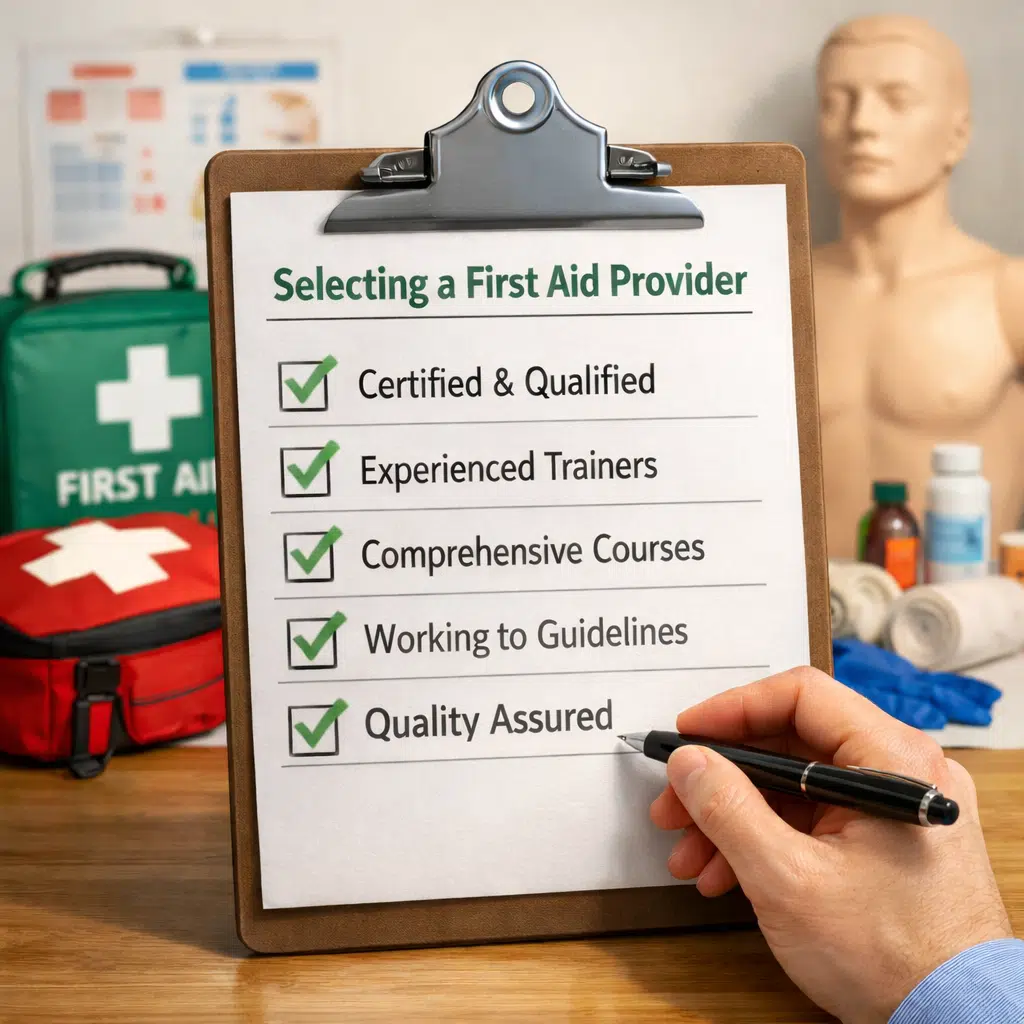
The HSE Due Diligence Criteria: Five Things to Check Before You Book
GEIS3 organises employer due diligence into five areas. Here is what each area actually means in practice.

1. Trainer and Assessor Qualifications
This is the most important area and, conveniently, the one where it is easiest to spot a problem if you know what to look for. First aid training is only as good as the person delivering it.
GEIS3 is specific: trainers and assessors must be able to demonstrate first-aid competence through one of the following:
- A current, valid First Aid at Work (FAW) certificate
- Current registration as a doctor with the General Medical Council
- Registration as a nurse with the Nursing and Midwifery Council; or
- Registration as a paramedic with the Health and Care Professions Council
That competence must then be combined with a recognised training or assessing qualification. The guidance provides a list of acceptable qualifications, which includes:
- The Level 3 Award in Education and Training
- Level 4 Certificate in Education and Training,
- Level 5 Diploma in Education and Training
- Cert Ed, PGCE, B Ed, M Ed, CTLLS, DTLLS, etc.
The principle is simple enough: being excellent at first aid and being an effective teacher are two different skills. A qualified trainer needs to hold both demonstrably.
Where a provider uses separate individuals for training delivery and formal assessment, which is perfectly acceptable, each person needs qualifications appropriate for their specific role. Ask the provider who will be delivering your course and what their qualifications are. If the answer is vague, press harder. If it is still vague, that is your answer.
2. Quality Assurance Systems
GEIS3 is specific about what a quality assurance system should look like, and it goes considerably further than a general claim to ‘maintain high standards’. The requirement is for documented systems, meaning paperwork that exists and that you can ask to see.
The provider should have a documented QA plan naming a specific individual as responsible for quality assurance. This person should be independent of day-to-day training delivery and should formally assess trainer and assessor performance at least annually. They must hold their own first-aid competence and a recognised assessing and verifying qualification.
Beyond that, expect a documented course evaluation procedure that includes learner feedback, a documented complaints procedure, and a system for retaining assessment records for a minimum of three years after each course.
Equipment matters too: GEIS3 specifies that providers must have sufficient, well-maintained equipment for every candidate to complete training and assessment within the required contact hours. A room of fifteen people sharing two manikins is not that.
3. Teaching to Current Standards
First aid guidance is not static. The Resuscitation Council UK, which sets the evidence-based standards for CPR and resuscitation practice, updated its guidelines in 2025.
GEIS3 is explicit: training must be delivered in accordance with current guidelines published by the Resuscitation Council UK, alongside the current edition of the first aid manual of the Voluntary Aid Societies.
Any provider whose CPR and resuscitation content has not been reviewed and updated in line with the 2025 guidance is, by definition, not delivering best practice. Ask specifically: when was your course content last reviewed, and does it reflect the current Resuscitation Council UK guidelines? A provider who cannot answer that confidently has told you something useful.
Class size is also addressed directly in the guidance. Where training involves groups larger than 12, the guidance notes that without additional trainers or assessors, there may be concerns about addressing individual learning needs and adequately assessing competence. That is the HSE’s polite way of saying: overcrowded sessions are a quality problem, not just an inconvenience.
4. Syllabus Content and Contact Hours
This is one of the more concrete checks available to you, because the minimum requirements are defined in GEIS3 and are not negotiable.
First Aid at Work (FAW) must involve at least 18 hours of training and assessment, not including breaks, delivered over a minimum of three days. FAW requalification requires at least 12 hours over two days. Emergency First Aid at Work (EFAW) must be at least six hours over one day, with requalification following the same structure.
If a provider is advertising an EFAW as a half-day session or offering FAW compressed into less than three days without a very specific and HSE-compliant justification, the course does not meet the minimum requirements. Attractive pricing and convenient scheduling are not a substitute for adequate contact time, and those hours exist because the practical skills being assessed require sufficient time to teach, practise, and formally evaluate.
The full syllabus breakdown for both FAW and EFAW is available in the appendices of GEIS3. It is worth reviewing so that when a provider shares their course overview with you, you can check whether it actually covers everything it should.
5. Certification
The certificate your staff receive is their evidence of competency, and in an inspection or incident investigation, it may come under scrutiny. The HSE has a specific and detailed view on what a valid certificate must contain.

The most common omissions in practice are the explicit reference to the Health and Safety (First-Aid) Regulations 1981 and the statement that teaching was delivered in accordance with currently accepted first-aid practice. Neither of those is decorative. They are there because a certificate is a document that may be presented to an inspector or used in a legal context, and it should accurately reflect the regulatory basis on which the training was delivered.
If a provider issues certificates that do not include all of the required elements, they are not fully compliant with HSE requirements.
A Note on Blended Learning and Online Courses
Blended learning (online theory combined with face-to-face practical training and assessment) is an accepted and increasingly popular method of delivering workplace first aid training. It works well when it is done properly, and GEIS3 specifically addresses the additional checks required when choosing this route.
Before booking a blended or e-learning course, you should satisfy yourself that the learner will have adequate technology access, that the provider has a clear means of supporting learners during the online phase, that there are systems in place to prevent identity fraud during the e-learning element, and that sufficient time is allocated to practical training and assessment in person.
That last point is the one that catches people out. The HSE strongly recommends that practical elements of a first aid qualification are assessed by direct observation. An online module where a learner ticks a box to confirm they understand CPR does not constitute a practical assessment. Watching someone actually perform chest compressions competently does. Any blended provider worth their salt will be clear about how they handle this.
Fully online first aid courses with no face-to-face practical element at all are generally not considered adequate for workplace first aid qualifications under HSE guidance. If a provider is offering a fully remote FAW or EFAW certificate with no in-person assessment, that is a problem worth taking seriously.
What Any Reputable Provider Should Be Able to Demonstrate
Regardless of whether a provider delivers nationally regulated qualifications, operates under a voluntary accreditation scheme, or works independently, the HSE’s position is clear: all providers should be able and prepared to demonstrate how they satisfy the five due diligence criteria. There is no requirement to choose one type of provider over another, and no single awarding or accreditation framework that is automatically considered superior for compliance purposes.
This is worth saying plainly, because there is a common misconception that regulated qualifications through an Ofqual-regulated awarding organisation are the only route that inspecting bodies will accept. That is not the case. Whether your business is subject to CQC inspection, Ofsted review under the Early Years Foundation Stage, or any other regulatory framework, what those bodies are looking for is whether your staff received competent, up-to-date training from a provider who can demonstrate they meet the HSE’s due diligence criteria. The type of provider is far less important than their ability to actually demonstrate what the guidance asks of them.
What you are looking for, regardless of provider type, is transparency. Can they name the trainer who will deliver your course and confirm their qualifications? Do they have a documented QA plan they are willing to share? Can they show you their complaints procedure before you book? Can they confirm that the course content reflects current Resuscitation Council UK guidance? Can they show you a sample certificate that contains everything GEIS3 requires?
For providers who operate under voluntary accreditation schemes, you can typically verify membership status directly on the accrediting body’s own website. Do this, rather than relying on logos displayed on the provider’s site. The check takes under two minutes and gives you something concrete to note if you are keeping a record of your selection process, which, as GEIS3 suggests, is worth doing.
A provider who is happy to answer your questions openly, without becoming defensive or vague, is a provider who is confident in what they are delivering. The ones worth being cautious about are the ones who treat due diligence questions as an inconvenience rather than a reasonable expectation.
| At Prima Cura Training, our founder Stephanie Austin’s credentials are published openly. Our QA processes are documented, our complaints procedure is available on request, and our course content is reviewed and updated in line with current Resuscitation Council UK guidance, including the 2025 updates. We are happy to answer every question on the checklist below before you book anything. That is not us being magnanimous. It is just how it should work. |
Red Flags Worth Knowing About
Based on the HSE’s due diligence framework and our own two decades of working in this industry, here is what should make you stop and ask more questions before you commit.

That final point deserves a moment of reflection. Pressure to book quickly, without adequate time to ask questions and receive proper answers, is rarely a sign that a provider is simply very busy. More often, it is a sign that slower consideration is not in their interests. A provider who is confident in the quality of what they deliver will welcome scrutiny because they know they can answer it.
Questions to Ask Before You Book (Save This)
Here is the pre-booking checklist we would use if we were in your position. Every competent, professionally run training provider should be able to answer every single one of these without hesitation, evasion, or that slightly defensive pause that tells you the answer is coming from a place of uncertainty rather than confidence.

If you ask those questions and you are happy with every answer, you are in a good place. If anything feels incomplete, inconsistent, or harder to pin down than it should be, trust that feeling. You are not being difficult. You are doing exactly what the HSE expects of you as an employer.
How Prima Cura Training Measures Up
We are not going to pretend this blog post is entirely selfless. We wrote it because we believe informed buyers make better decisions, and because Prima Cura Training is genuinely built to withstand exactly this kind of scrutiny. Not as a selling point. As a baseline expectation for any provider operating in this space.
Our founder, Stephanie Austin, has over 20 years of experience in first aid, health & safety, and social care training. Her professional background and credentials are published because we think transparency should be the default rather than something a client has to push for. Our trainers hold membership with recognised professional bodies. We (and our trainers) deliver qualifications through accredited awarding organisations such as FAIB, Highfield, RLSS, Nuco, and WorkSafe. Our course content is reviewed in line with current Resuscitation Council UK guidance, including the 2025 updates.
Our QA processes are documented. Our complaints procedure exists and is available to read before you book. Our certificates reference the Health and Safety (First-Aid) Regulations 1981 because they should. And our 98.9% learner satisfaction rate, reviewed every six months from real delegate feedback, is a number that gets earned on every single course, not quoted once and left to gather dust.
We deliver face-to-face & blended first aid, health and safety, and social care training to businesses across Greater Manchester, the North West, and beyond. We work with care homes, schools, construction companies, and corporate teams.
Does the HSE have a specific checklist for selecting a first aid training provider?
Yes. The HSE publishes detailed guidance in GEIS3, Selecting a First-Aid Training Provider: A Guide for Employers, which includes a formal checklist covering trainer qualifications, quality assurance systems, teaching standards, syllabus content, and certification requirements. The guidance also recommends retaining a written record of the checks you carry out, which can be used to demonstrate to an HSE inspector how your training provider was selected.
Do I have to choose a provider that delivers Ofqual-regulated qualifications?
No. The HSE does not require employers to use any specific type of provider or awarding framework. Providers who deliver nationally regulated qualifications, those who operate under voluntary accreditation schemes, and those who work independently are all valid options, provided they can demonstrate they meet the HSE’s due diligence criteria.
Inspecting bodies such as the CQC and Ofsted are similarly interested in whether training was competent and appropriate, not in which specific awarding or accreditation framework it was delivered under.
How can I check whether a first aid training provider is legitimate?
Start with the HSE’s GEIS3 checklist: verify trainer qualifications, ask for the quality assurance system and complaints procedure. Check that the course syllabus and contact hours meet HSE minimum requirements, and confirm what information appears on the certificates your staff will receive. For providers operating under voluntary accreditation schemes or as recognised centres for an awarding organisation, verify their status directly on that body’s own website.
What qualifications should a first aid trainer hold?
According to HSE GEIS3, trainers must demonstrate first-aid competence through a current FAW certificate, or through registration as a doctor (GMC), nurse (NMC), or paramedic (HCPC).
That must be combined with a recognised training or assessing qualification, such as the Level 3 Award in Education and Training, Level 4 Certificate in Education and Training, Cert Ed, PGCE, B Ed, M Ed, CTLLS, DTLLS, or equivalent qualifications listed in the guidance.
Operational first-aid competence and effective teaching are two different skills, and a qualified trainer needs to demonstrably hold both.
How many hours should a first aid course be?
HSE GEIS3 sets the minimums. First Aid at Work (FAW) must be at least 18 contact hours, not including breaks, over a minimum of three days. FAW requalification is at least 12 hours over two days.
Emergency First Aid at Work (EFAW) must be at least six hours over one day, with requalification at the same duration. Any course advertised as shorter than these thresholds does not meet HSE standards.
Are online first aid certificates valid for workplace compliance?
Blended learning (online theory combined with in-person practical assessment) is an accepted approach under HSE guidance, provided the provider meets the additional due diligence criteria set out in GEIS3.
Fully online courses with no face-to-face practical assessment are generally not considered adequate for workplace first aid qualifications.
The HSE strongly recommends that practical elements are assessed by direct observation, and a tick-box online module is not the same thing.
This article is provided for general information and educational purposes only. While care has been taken to ensure accuracy at the time of publication, guidance and legislation relating to workplace first aid may change. Employers remain responsible for ensuring their arrangements comply with the Health and Safety (First-Aid) Regulations 1981 and relevant guidance from the Health and Safety Executive. The content of this article should not be considered legal advice. Organisations should carry out their own risk assessments and due diligence when selecting training providers or implementing workplace first aid arrangements.