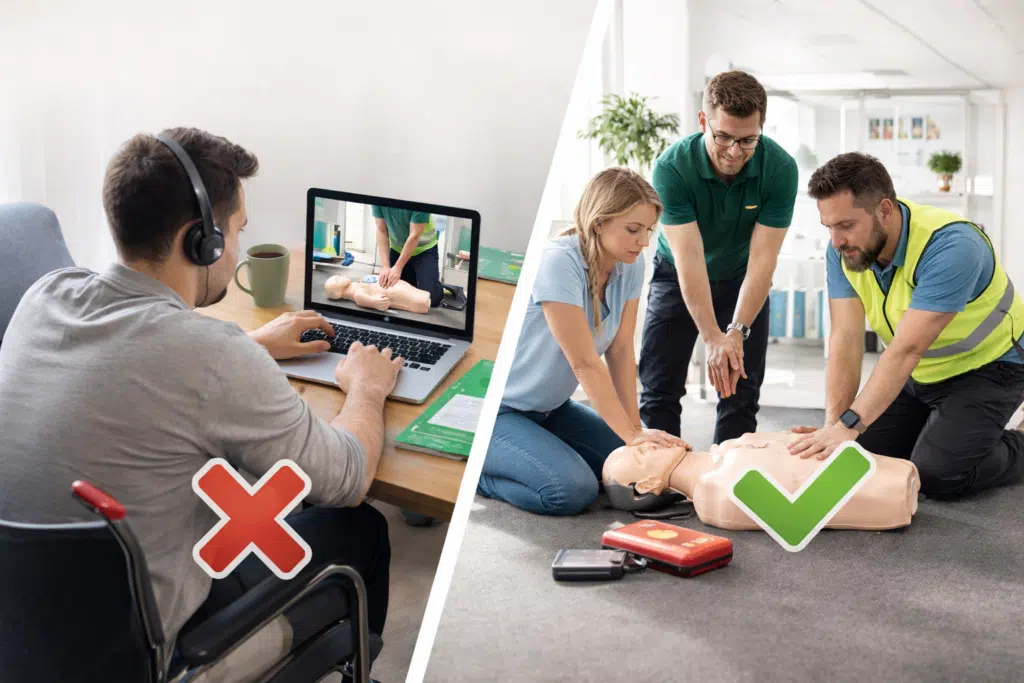
Why Online Only First Aid Training is Not Compliant for Workplaces
Written by Stephanie Austin, Founder & Lead Trainer, Prima Cura Training | Reviewed & updated: 27th July 2026 | Next review: July 2027
A client rang me a few weeks ago wanting to compare e-learning platforms, not to talk about first aid at all. Somewhere in that conversation it came out that their whole team’s Emergency First Aid at Work certificates had been completed entirely online. Log in, click through the theory, print the certificate. Nobody had picked up a bandage. Nobody had practised CPR on a manikin. Nobody had been watched doing any of it.
That’s the point the call stopped being about platforms.
Fully online first aid training does not meet the legal standard for workplace first aid in the UK. That’s not my opinion or a sales line. It’s the position set out by the Health and Safety Executive (HSE) in the guidance behind the Health and Safety (First-Aid) Regulations 1981, and it genuinely isn’t a grey area.
Here’s what the law actually requires, why online-only training falls short of it, and what happened when that client found out.
The Short Version
- The 1981 Regulations require “adequate and appropriate” first aid provision. HSE ties that directly to competence, not simply to holding a certificate.
- A fully online course, with no in-person practical assessment, does not meet that standard for Emergency First Aid at Work (EFAW) or First Aid at Work (FAW).
- Blended learning (theory completed online, practical skills taught and assessed face to face) is recognised by HSE and can be compliant.
- Since a 2013 amendment, HSE no longer approves or vets training providers directly. Checking that a provider’s course actually meets the standard is the employer’s job, not HSE’s.
What Does the Health and Safety (First-Aid) Regulations 1981 Actually Require?
Workplace first aid in England and Wales is governed by the Health and Safety (First-Aid) Regulations 1981, enforced by HSE. Regulation 3 requires employers to provide first aid equipment, facilities, and personnel that are “adequate and appropriate in the circumstances.”
HSE expands on that duty in L74, its guidance on the regulations, most recently updated in 2024. That update put more weight on employees’ mental health within first aid needs assessments, and clarified how blended learning fits within the standard.
“Adequate and appropriate” is decided through a first aid needs assessment: workforce size, the nature of the work, and the specific risks on site. That assessment is what decides whether Emergency First Aid at Work (one day) or the fuller First Aid at Work qualification (three days) is the right fit. We’ve covered the difference in detail in our post on FAW vs EFAW, and walked through how many first aiders a typical team needs in our guide on how many staff need first aid training.
The word doing the heavy lifting in all of this is competent. A first aider needs to be able to act when something goes wrong, not just describe what they’d do if a form asked them to.
| Emergency First Aid at Work (EFAW) | First Aid at Work (FAW) | |
| Duration | 1 day (6 hours) | 3 days (18 hours), or blended: 6 hours e-learning plus 2 days face to face |
| Delivery | Face to face only | Face to face, or blended (theory online, practical face to face) |
| Certificate validity | 3 years | 3 years |
| Typically suits | Lower-risk workplaces | Higher-risk workplaces and larger teams |
Why Watching It Isn’t the Same as Doing It
First aid is a physical skill. CPR has a depth, a rate, and a rhythm that only really makes sense once you’ve felt it under your own hands. Recovery position becomes second nature once you’ve turned someone over, checked their airway, and had a trainer correct your hand position while you’re doing it. An AED stops being intimidating once you’ve actually opened the case and heard it talk you through the pads.
None of that can be checked through a video call, a multiple-choice quiz, or a webcam pointed at a screen. A fully online course cannot:
- Watch whether chest compressions are hitting the right depth and rate
- See whether someone is using an AED correctly under pressure
- Check that a recovery position keeps the airway open
- Correct poor technique in the moment, before it becomes a habit
- Build the muscle memory that shows up in a genuine emergency
The current content standard for CPR and defibrillation reflects the Resuscitation Council UK’s 2025 Guidelines, which are themselves built around supervised, hands-on practice. HSE is clear that for both EFAW and FAW, practical training and in-person assessment are essential parts of the qualification, not optional extras. Take that away and what’s left, however well produced, isn’t a compliant first aid course. It’s awareness content wearing a first aid certificate’s clothes.
Is Blended Learning First Aid Training Compliant?
Yes, when it’s done properly. This is also where most of the confusion sits.
HSE’s guidance recognises blended learning as a legitimate delivery model: the theory is completed online, in the learner’s own time, and the practical skills are taught and assessed face to face by a qualified trainer. Our own Blended First Aid at Work course works this way. Six hours of e-learning comes first, then two full days are spent in the room, on the floor, being assessed on the skills that actually matter.
What blended learning is not is a shortcut around the practical element. If there’s no in-person assessment of practical skills, whatever the course is called, it hasn’t met the standard. That distinction, online-only versus blended, is the one that catches employers out most often.
It’s also worth knowing that a one-day Emergency First Aid at Work course isn’t something we offer as blended. There simply isn’t enough of the day to split sensibly between online theory and face-to-face practice, so our 1-day EFAW course is delivered face to face, in full, every time.

Whose Job Is It to Check This?
Here’s a detail that surprises a lot of employers. Since a 2013 amendment to the regulations, HSE no longer approves or vets first aid training providers directly. HSE’s guidance on choosing a provider, GEIS3, sets out what employers should be checking for themselves: qualified trainers and assessors, a genuine quality assurance process, a syllabus that reflects current practice, and certification that actually meets the standard.
In other words, nobody checks this for you before the fact. That responsibility sits with the employer, which is exactly why it matters to understand what a compliant course looks like before you book it, not after an inspection.
What Happened When a Client Found Out
The client I mentioned at the start hadn’t done anything careless. They’d booked online EFAW training in good faith, years earlier, and had never had a reason to question it since. They only got in touch because they wanted to move their e-learning to a different platform and thought I’d be able to help with the switch.
Working through it with them on the phone, it became clear their entire first aid provision had never actually been assessed in person, not once, for anyone on the team. They were mortified. Not annoyed at me for raising it. Genuinely mortified that they’d been carrying that risk for years without knowing.
We didn’t just leave them with the bad news. I talked them through their first aid needs assessment there and then, sent over the relevant HSE guidance with my own plain-English notes attached so their team could actually make sense of it, and helped them work out what level of qualification they genuinely needed. They ended up booking Emergency First Aid at Work training for their whole team with us.
What stuck with me afterwards was what they said in thanks. Not for the sale. For the time I’d spent working through the problem with them honestly, instead of just quoting a price and moving on.
What Happens If This Gets Checked
This isn’t really about paperwork. If an incident happens and first aid arrangements get looked at closely, whether that’s by HSE, insurers, or a solicitor, training that doesn’t meet the standard becomes a serious problem quickly. Not a technicality.
Relying on online-only first aid training can mean:
- First aiders holding certificates that don’t meet the workplace standard
- Increased exposure if an incident happens and provision is reviewed afterwards
- Staff who lack confidence exactly when it matters most
- Uncomfortable questions during an HSE inspection about how the needs assessment was carried out
None of that is scaremongering. It’s simply what tends to surface when online-only training gets looked at properly for the first time, as it was for the client above.
What Compliant First Aid Training Should Actually Include
Whatever the delivery format, face-to-face or blended, compliant workplace first aid training should always include the following.

If any one of those is missing, it’s worth asking questions before you rely on it.
Where Does Online Learning Still Have a Place?
Online first aid content isn’t without value. It genuinely works well for:
- General first aid awareness for people who don’t need a statutory qualification
- Refreshing knowledge between full requalifications
- Covering the theory portion of a properly structured blended course
What it should never be used for is meeting the legal requirement for workplace first aid on its own. Awareness is useful. It isn’t the same thing as a qualification.
Get Your First Aid Provision Right the First Time
If you’re responsible for health and safety and you’re not entirely sure your current first aid training has ever been assessed face to face, it’s worth checking before an inspection or an incident forces the question.
We deliver Emergency First Aid at Work, Blended First Aid at Work, and face-to-face First Aid at Work training across Greater Manchester, London, Birmingham, Surrey and Warwickshire, always assessed properly and always face-to-face for the practical element. If you’d like a hand working out what your team actually needs, get in touch, and we’ll talk it through, the same way we did on that phone call.
Frequently Asked Questions
Is online-only first aid training legal for UK workplaces?
No. HSE guidance on the Health and Safety (First-Aid) Regulations 1981 requires practical first aid skills to be taught and assessed in person. A course completed entirely online, with no face-to-face practical element, does not meet the standard for Emergency First Aid at Work or First Aid at Work.
Can I complete my First Aid at Work qualification fully online?
No. First Aid at Work can be delivered as blended learning, with the theory completed online and the practical skills taught and assessed over two in-person days, but it can’t be completed entirely online. The in-person assessment is a required part of the qualification, not an optional extra.
What is blended learning first aid training, and is it compliant?
Blended learning first aid training means completing the theory online in your own time, then attending in-person sessions where practical skills are taught and formally assessed by a qualified trainer. HSE guidance recognises this model as compliant, provided the practical element is genuinely delivered and assessed face to face.
Does Emergency First Aid at Work have to be delivered face to face?
Yes. Because EFAW is a single day, there isn’t enough time within the course to split it sensibly between online theory and face-to-face practical training, so it’s delivered face to face in full.
How do I know if my current first aid training is actually compliant?
Ask your provider directly whether the practical skills were taught and assessed in person, by a qualified trainer, using direct observation. If the honest answer is no, it’s worth having your first aid needs assessment reviewed before you need to rely on that training in an emergency.
What happens if my staff’s online-only certificates are checked during an HSE inspection?
If first aid provision is reviewed and the training doesn’t meet the standard, employers can find themselves needing to arrange proper practical training and assessment quickly, often under pressure. It can also raise wider questions about how the first aid needs assessment was carried out in the first place.
This article is for general information purposes only and reflects UK guidance current at the time of review (July 2026). It doesn’t constitute legal advice. Workplace first aid requirements vary depending on your organisation’s risk assessment, industry, staff numbers, and working environment. Employers must ensure their first aid provision complies with current Health and Safety Executive guidance and relevant UK legislation. For advice specific to your organisation, refer directly to official HSE guidance or seek professional health and safety support.