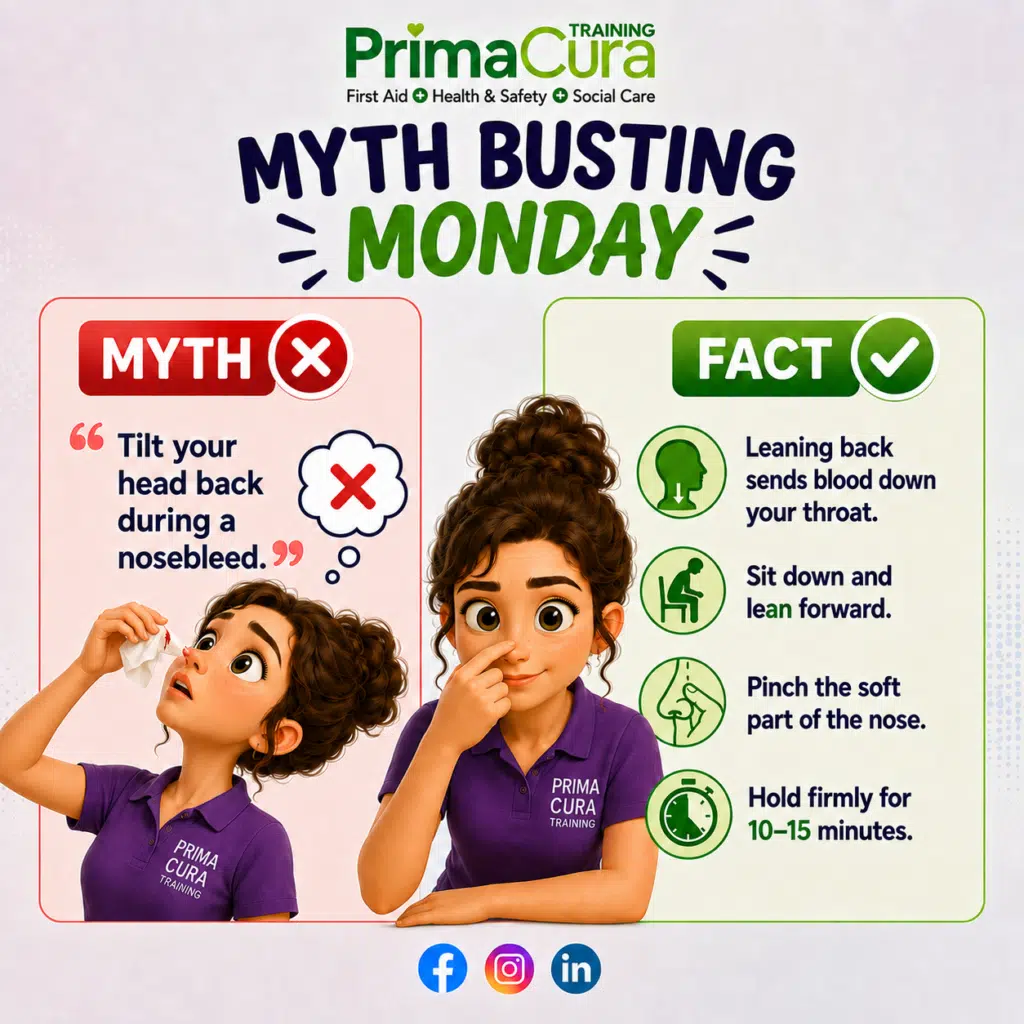
Myth Busting Monday: Should You Tilt Your Head Back During a Nosebleed?
Written by Stephanie Austin, Owner and Lead Trainer, Prima Cura Training | Last reviewed: September 2026 | Next review: September 2027
| MYTH | “Tilt the head back to stop a nosebleed.” |
| FACT | Tipping the head back sends blood down the throat, where it gets swallowed, irritates the stomach and can cause vomiting or choking. NHS advice is to sit down and lean forward with the head tilted forward and the mouth open, then pinch the soft part of the nose just above the nostrils for 10 to 15 minutes. |
A friend of mine rang me earlier this year to tell me her child had had a nosebleed, and that she’d done the thing almost everyone does without thinking. Tilted the head back. I explained why that’s not the advice any more, and she thanked me for it afterwards, properly relieved to know. That’s the pattern with this myth. Nobody’s being careless. Nobody’s actually told them it’s changed.
Nosebleeds are one of the few injuries almost everyone has dealt with, which is exactly why the wrong technique is so well embedded. Nobody looks it up. You do what was done to you when you were seven, and what was done to you when you were seven was somebody putting a hand on your forehead and pushing.
Where does the head tilt come from?
It looks like it works. That’s the whole problem.
Tip the head back and blood stops coming out of the nostrils within a second or two. To anyone watching, the bleed has stopped. What’s actually happened is that gravity has redirected it into the throat, where nobody can see it. The bleeding carries on at the same rate.
There’s a bit of tidiness in it too. Tilting back keeps blood off clothes, off the carpet and off the person helping. Leaning forward over a bowl looks messier, which is unfortunate, because messy is the correct answer here.
What happens when you tilt the head back?
Blood runs down the back of the throat and gets swallowed. Swallowed blood irritates the stomach lining, and a stomach full of blood tends to come back up. So now you have vomiting on top of a nosebleed, in someone who was probably already upset.
Two bigger risks sit behind that. In anyone drowsy, unwell, elderly, very young or not fully alert, blood tracking down the throat is a choking and airway risk. And because nobody can see it, nobody has any idea how much blood has been lost. A bleed that looked like it settled in thirty seconds can quietly carry on for twenty minutes.
Lying down flat does the same thing for the same reason. Upright and forward, whatever it does to the upholstery.
Where the blood goes when the head is tipped back, compared with sitting up and leaning forward.
What actually stops a nosebleed?
Pressure, in the right place, for long enough. There’s no clever trick.
- Sit them down, upright, not lying back. Sitting is steadier if they feel faint.
- Lean them forward, head tilted forward, mouth open. Blood should run out of the nose, not down the throat. Give them a bowl or a towel.
- Pinch the soft part of the nose, just above the nostrils. Firm and continuous. If they can do it themselves, let them, because people get the pressure about right on their own face.
- Hold for 10 to 15 minutes without letting go. Breathe through the mouth, spit blood out rather than swallowing it.
- Still bleeding after 10 to 15 minutes of proper pressure? That’s the point to get medical help, not to start another quarter of an hour.
Two things to leave out. Packing the nostrils with tissue or cotton wool can look like it’s working, but pulling it out takes the fresh clot with it and restarts the bleed. And cold keys down the back of the neck is a lovely piece of folklore that does nothing at all. An ice pack held on the top of the nose is mentioned by the NHS as something that may help, though the evidence is thin. It’s a nice-to-have, not the treatment.
Why the pinch has to be in the right place
Most nosebleeds come from a small patch of blood vessels just inside the front of the septum, close to the surface and easy to damage. A knock, a cold, dry central heating, a bit of enthusiastic nose blowing, and off it goes.
Because those vessels sit at the front and low down, pinching the soft fleshy part squeezes them shut against the septum. Pinching the hard bony bridge higher up, which is what most people do, achieves nothing. You’re squeezing bone. The bleeding point is a centimetre or two below your fingers.
Moving the fingers down is often the difference between a bleed that stops in ten minutes and one that drags on for half an hour. So is not letting go to have a look. Every peek pulls the forming clot away and resets the clock, so set a timer and stop guessing.
When a nosebleed isn’t just a nosebleed
Most are harmless. These are the ones that need more than a pinch and a bowl.
After a head injury. A nosebleed following a blow to the head needs assessment at A&E. Call 999 if the person has lost consciousness, cannot stay awake, has clear fluid coming from the nose or ears, is bleeding from the ears or shows other signs of a serious head injury. Do not pack the nose.
Bleeding that won’t stop after 10 to 15 minutes of firm continuous pressure, or heavy enough that the volume worries you.
They’ve swallowed a lot of blood and are vomiting.
They feel weak, dizzy or short of breath, or look pale and clammy. Signs of real blood loss, not squeamishness.
Anyone on anticoagulants. Warfarin, apixaban, rivaroxaban, clopidogrel and similar are everywhere in care settings and in anyone over 70. Those nosebleeds are harder to stop, more likely to need clinical help, and worth recording rather than filing under “just a nosebleed”.
Children under two, or anyone getting them repeatedly. GP conversation rather than an emergency, but worth having.
If they lose consciousness, call 999 and put them in the recovery position so blood drains out and the airway stays clear.
Once it’s stopped, the clot is fragile. For about 24 hours: no nose blowing or picking, no picking at the scab, no hot drinks or alcohol, no heavy lifting or strenuous exercise, and don’t lie flat. The people who come unstuck are almost always the ones who blew their nose an hour later to clear it out.
Sit up, lean forward, pinch the soft part, and the situations where a nosebleed needs medical help.
Frequently asked questions
Can I put tissue or cotton wool up my nose to stop the bleeding?
No. It might look like it’s helping, but pulling it back out drags the fresh clot away with it and starts the bleed again. Use a tissue or bowl to catch what runs out the front, not to pack inside the nostril, and pinch the soft part of the nose instead.
How long should a nosebleed last before I should worry?
Most nosebleeds stop within 10 to 15 minutes of firm, continuous pressure on the soft part of the nose. If it’s still bleeding after that, or the amount of blood lost is worrying you, that’s the point to get medical help rather than trying for another quarter of an hour.
Why do I keep getting nosebleeds?
Frequent nosebleeds are usually down to something ordinary, dry air from central heating, a cold, or the nose being blown or knocked too often, rather than anything more serious. If they’re happening regularly or without an obvious cause, see your GP so they can check for a reason behind it.
Training that gets the small things right
Nosebleeds sit in the same category as burns and minor wounds. Common enough that everyone assumes they know what to do, and done wrong often enough to be worth ten minutes of anyone’s time.
Emergency First Aid at Work (EFAW) is the one most workplaces need for a designated first aider, and higher risk settings usually need the three day First Aid at Work qualification. Schools should look at Emergency First Aid for Schools, and anyone working with young children needs Emergency Paediatric First Aid or the two day Paediatric and Early Years First Aid for Ofsted compliance.
Give us a call on 0333 999 8783 or drop us a message and we’ll point you at the right one.
THE VERDICT: BUSTED
Head forward, not back. Pinch the soft bit, not the bone. Hold it for ten minutes without peeking. Three corrections, none of them difficult, and between them they cover nearly every nosebleed you’ll ever meet.
This article is provided for general information and awareness only and reflects NHS guidance current as at August 2026. It does not constitute medical advice, and it is not a substitute for accredited, hands-on first aid training. Guidance can change, and how it applies depends on the person in front of you, including any medication they take. If a nosebleed is heavy, prolonged or follows a head injury, seek medical help. In an emergency, always call 999.