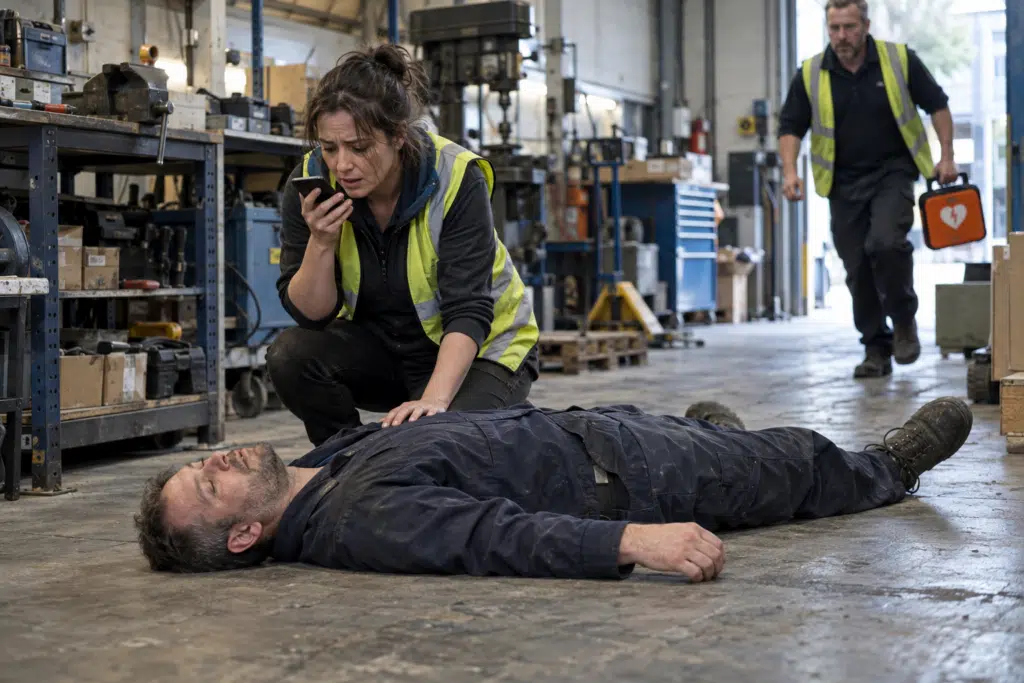
What Should You Do If Someone Becomes Unconscious?
The order changed in October 2025. Call 999 first, then check breathing. Here is the current sequence, and the two situations where the recovery position is now the wrong move.
Written by Stephanie Austin, Owner & Lead Trainer, Prima Cura Training | Last reviewed: October 2026 | Next review: October 2027
If someone becomes unconscious, call 999 first and check their breathing while you wait for the call to be answered. That is the opposite order to the one most people were taught, and it changed on 27 October 2025 when Resuscitation Council UK published its 2025 Resuscitation Guidelines.
For years the sequence was: check response, open the airway, check breathing, then call for help. Under the current guidance, the call comes as soon as you know the person is unresponsive. You don’t need to confirm that their breathing is abnormal before you dial. RCUK’s wording in its summary of what changed is direct: “Rescuers no longer need to confirm abnormal breathing before calling. Initiate the call first, then assess breathing while waiting for the call to be answered.”
It sounds like a small reshuffle. It isn’t. An ambulance dispatched thirty seconds earlier is thirty seconds of brain perfusion you can’t get back later, and a call handler on speakerphone can talk a frightened bystander through compressions while you’re still working out what you’re looking at.
One thing worth being clear about, because it explains why so much of what is online still has the old order. RCUK published the guidelines on 27 October 2025, but they didn’t arrive in training rooms that week. Updated courses and manuals followed from January 2026, and that is when the new sequence really came into use. If your first aid certificate predates 2026, you were almost certainly taught the old order. What follows is the current position.
If you want the wider picture on employer duties, needs assessments and which qualification fits which workplace, our Workplace First Aid in the UK guide covers it in full.
The Short Version
| Situation | What to do |
| Person is unresponsive | Call 999 immediately. Don’t wait to check breathing first. |
| Unresponsive and breathing normally | Put them on their side in the recovery position, tilt the head back, keep watching the breathing. |
| Unresponsive and not breathing normally, or gasping | Start CPR. 30 compressions, 2 rescue breaths. Compressions only if you’re not trained in breaths. |
| Unresponsive after a fall, crash or blow to the head | Do not roll them. Open the airway without moving the neck and wait for the ambulance. |
| Unresponsive with agonal gasping | This is cardiac arrest, not breathing. Start CPR. Do not use the recovery position. |
| An AED is nearby | Get it. Switch it on. Follow what it tells you. |
What Does “Unconscious” Actually Mean?
Unconsciousness is a state where a person cannot be roused and cannot respond purposefully to voice or to physical stimulation. It is not deep sleep. A sleeping person wakes when you shake their shoulder and shout. An unconscious person doesn’t.
The distinction that matters in practice is between unconscious and unresponsive, and most people use them interchangeably. Clinically, unresponsiveness is what you can observe, and unconsciousness is the state you infer from it. In a first aid emergency that difference is academic. If you shake their shoulders, shout their name, and get nothing back, treat them as unresponsive and act.
What makes it an emergency is not the loss of awareness. It’s the loss of protective reflexes. A conscious person coughs when fluid hits the back of their throat, swallows saliva without thinking about it, and holds their own airway open through muscle tone in the tongue and jaw. An unconscious person lying on their back loses all three. The tongue falls back. Vomit, blood or saliva pools in the throat. Nobody notices, because the person can’t tell you.
That is why an unconscious casualty who is breathing perfectly well can still die on the floor. Not from whatever caused the collapse, but from the position they were left in.
Unconscious, Or Just Confused? The ACVPU Scale
Responsiveness isn’t binary. It sits on a scale, and being able to describe where someone is on it changes what you tell the call handler.
The scale is ACVPU: Alert, new Confusion, Voice, Pain, Unresponsive. It sits inside the D step of the ABCDE assessment, and Resuscitation Council UK’s ABCDE guidance spells it out: “Make a rapid initial assessment of the patient’s conscious level using the ACVPU method: is the individual Alert? Are they newly Confused? Are they only responding to Vocal stimuli? Do they only respond to Painful stimuli, or are they Unresponsive to all stimuli?”
The letter that earns its place is the C. New confusion is not someone being a bit vague. It is a person whose mental state was normal and now isn’t, and it is one of the earliest signs that somebody is heading downhill.

If you support someone who is suddenly confused, disorientated, or not making sense, and that confusion is new for them, that is a red flag in its own right. It is not “having a funny turn”. In care settings it should be escalated the same day, not watched for a few hours to see if it settles.
Step By Step: What To Do If Someone Becomes Unconscious
1. Check it’s safe to approach
Look before you kneel. Traffic, live electrics, an aggressive dog, a chemical spill, a floor covered in glass. A second casualty helps nobody, and the instinct to run straight in is one of the hardest things to train out of people.
2. Check for a response
Kneel beside them. Shake their shoulders firmly and shout loudly: “Can you hear me? Open your eyes.” Use their name if you know it. Firm and loud, not gentle. A drowsy person will respond to a proper shout and a proper shake, and you need to know the difference.
If they respond, they are not unconscious. Work out what’s wrong and get them the help they need.
3. Call 999 or 112
If they don’t respond, call now. Don’t check their breathing first. Don’t send someone else off to find a phone while you carry on alone.
Put your phone on speaker and set it down so your hands are free. RCUK’s guidance is specific about this: “If you have a mobile phone, activate the speaker function and call 999 without delay.” The call handler is trained to talk you through what happens next, and they’ll do it better if they can hear the room.
If someone else is with you, send them for the nearest defibrillator while you stay with the casualty.
4. Check their breathing while the call connects
Open the airway first. One hand on the forehead, tilt the head back gently, two fingertips under the point of the chin to lift it. That single movement lifts the tongue off the back of the throat, and it’s often all it takes for breathing to become obvious. It’s the technique taught on every first aid qualification we deliver, and it’s the one NHS first aid guidance describes too.
Then take about ten seconds to look, listen and feel. Look for the chest rising and falling. Put your cheek near their mouth and listen for breath sounds. Feel for air on your skin.
You’re not looking for any breathing. You’re looking for normal breathing.
Worth knowing: the 2025 lay rescuer guidance deliberately strips this back rather than making people memorise a technique under pressure. RCUK’s line is “If you are uncertain, the ambulance service call handler will assist you.” You are already on the phone to someone trained to make this call with you. Use them.
5a. If they are breathing normally, put them on their side
Roll them into the recovery position, keep the head tilted back so the airway stays open, and stay with them until the ambulance arrives. RCUK puts the principle in a single line: “Nurse unconscious patients in the lateral position if their airway is not protected.”
5b. If they are not breathing normally, start CPR
Push hard and fast in the centre of the chest. The RCUK adult basic life support guidelines set the numbers: compress to a depth of at least 5cm but no more than 6cm, at a rate of 100 to 120 compressions a minute, alternating 30 compressions with 2 rescue breaths.
If you’re not trained in rescue breaths, or you don’t want to give them, do continuous compressions without stopping. RCUK is clear that this is the right call for untrained rescuers: compression-only CPR is far better than no CPR.
Get an AED on as soon as one arrives. It will not shock someone who doesn’t need shocking, and it talks you through every step.
How Do You Tell If Someone Is Breathing Properly?
Normal breathing is regular, quiet and effective. You’ll see the chest rise and fall in a rhythm, roughly every three to five seconds in an adult at rest.
What catches people out is agonal breathing. In the first minutes after a cardiac arrest, the body can produce occasional noisy gasps. They look and sound like breathing. Sometimes there’s a snort, a groan, or what family members later describe as snoring. It can carry on for several minutes.
It is not breathing. It is a brainstem reflex firing in a body that has already arrested, and RCUK names it explicitly: “Slow, laboured breathing, as well as other abnormal patterns such as agonal gasping or panting, must be recognised as signs of cardiac arrest.”
This is the single most consequential thing on a first aid course. Every year, people watch someone gasp on the floor, decide they’re breathing, and wait. The guidance gives you the rule that removes the judgement call: if a person is unresponsive and their breathing is anything other than clearly normal, assume cardiac arrest and start CPR.
You will not do serious harm by starting compressions on someone whose heart is still beating. They will object, loudly, and you’ll stop. You will do irreversible harm by waiting.
When Should You Not Use The Recovery Position?
The recovery position is the right answer for an unresponsive person who is breathing normally. RCUK’s 2025 First Aid Guidelines put it plainly: “Place adults and children with a decreased level of responsiveness who do NOT meet the criteria for CPR into a lateral (side-lying) recovery position.”
There are two situations where it is now explicitly the wrong move, and the guidance capitalises the word: “In cases of agonal breathing or trauma, do NOT move the person into the recovery position.”
Agonal breathing. Those gasps mean cardiac arrest. Rolling someone onto their side instead of starting compressions costs them the only intervention that works.
Trauma. A fall from height, a road traffic collision, a blow to the head, a rugby injury. If there’s any chance of a spinal injury, keep them where they are and open the airway without rolling them. The NHS guidance is the same: if you think a person may have a spinal injury, do not move them until emergency services arrive, and open the airway using a jaw lift rather than tilting the neck.
There is one override worth knowing. A blocked airway kills faster than a spinal injury. If someone with a suspected spinal injury cannot maintain an airway any other way, the airway wins. That is a judgement call I’d want any first aider on my courses to have practised, not read about for the first time on the day.
How Do You Put Someone In The Recovery Position?

- Kneel beside them. Place the arm nearest to you out at a right angle to their body, elbow bent, palm facing upwards.
- Bring their far arm across the chest and hold the back of that hand against the cheek nearest to you.
- With your other hand, bend their far knee up, keeping the foot flat on the floor.
- Pull on the bent knee to roll them towards you onto their side.
- Set the upper leg so both hip and knee are bent at right angles. This stops them rolling further.
- Tilt the head back to keep the airway open, and check the mouth is angled slightly downwards so fluid can drain.
- Keep watching the breathing. Check it every minute or so until help arrives.
If the person has been on one side for around 30 minutes and the ambulance still hasn’t arrived, turn them onto the other side to take pressure off the lower arm, unless their injuries make that unsafe.
What Do You Do While You Wait?
Stay with them. Talk to them, even if they can’t hear you, because some people can. Keep them warm with a coat or a blanket. Don’t give them anything to eat or drink, and don’t try to put anything in their mouth.
And keep checking the breathing. People who are breathing normally at minute one are not guaranteed to be breathing normally at minute four. If it stops or turns abnormal, roll them onto their back and start CPR.
What Makes Someone Lose Consciousness?
RCUK lists the common causes of unconsciousness as profound hypoxia, hypercapnia, cerebral hypoperfusion, or the recent administration of sedatives or painkillers. In plain English: not enough oxygen, too much carbon dioxide, not enough blood reaching the brain, or drugs. Almost everything below is one of those four with a different starting point.
Knowing the likely cause changes what you tell the call handler and what happens on arrival. It does not change the immediate sequence. Whatever the cause, the answer to an unresponsive person is always: call 999, check breathing, act on what you find.
- Fainting. The most common cause and usually the least serious. Blood pressure drops, the brain is briefly starved, the person goes down and comes round within seconds. Lay them flat, raise their legs, and if they don’t come round within a minute, treat them as unconscious.
- Low blood sugar. In someone with diabetes, a hypoglycaemic episode can progress from confusion to unresponsiveness. RCUK is unambiguous about what not to do: “In an unresponsive person, do not give oral sugar in any form due to the risk of aspiration; instead, call 999 and consider the recovery position.” Sugary gel in the mouth of an unconscious person goes into the lungs. Our Diabetes Awareness course covers recognising a hypo before it gets to that point.
- Seizures. Most seizures end on their own and are followed by a postictal phase where the person is drowsy, confused, or briefly unresponsive. Protect their head, don’t restrain them, don’t put anything in their mouth, and put them in the recovery position once the seizure stops. Call 999 if it lasts more than five minutes, if a second one follows, or if they don’t regain consciousness. Epilepsy Awareness goes through this in detail, including when emergency medication applies.
- Head injury. Any loss of consciousness after a head injury needs assessment, even brief. Do not move them. Treat as a potential spinal injury.
- Stroke. Sudden collapse with facial droop, weakness down one side, or slurred speech before going down. Time matters enormously. Our Stroke Awareness course covers recognition and the treatment window.
- Cardiac arrest. The heart stops pumping. The person goes down without warning and stops breathing normally within seconds. This is the one where bystander CPR is the difference between survival and death.
- Choking. If someone choking becomes unresponsive, RCUK’s instruction is to start CPR and make sure 999 has been called.
- Anaphylaxis. Swelling, breathing difficulty and collapse after an allergen. Adrenaline auto-injector into the outer thigh, then 999. Anaphylaxis Awareness covers recognition and the second dose rule.
- Opioid or drug overdose. Suspect it where breathing is slow, irregular or absent and the person is extremely drowsy or unresponsive. Call 999, start CPR if they’re unresponsive with abnormal breathing, and give naloxone if you’re trained and it’s available.
What Does This Mean In Your Setting?
In a workplace
The Health and Safety (First-Aid) Regulations 1981 place the duty on employers, and the HSE summarises it as a requirement to “provide adequate and appropriate equipment, facilities and personnel to ensure their employees receive immediate attention if they are injured or taken ill at work.” What counts as adequate comes from your first aid needs assessment, not from a fixed headcount ratio.
The practical test is simpler than the legal one. If someone went down in your building at 4pm on a Friday, who would kneel next to them, and when did they last practise? A certificate in a drawer is not first aid provision.
If you’re working out which qualification your assessment points to, our comparison of FAW and EFAW walks through it by sector.
In care and supported living settings
Finding a resident unresponsive is not a rare event in care. It’s a foreseeable one, which is exactly why the regulator treats it as a competence question.
Regulation 12 of the Health and Social Care Act 2008 (Regulated Activities) Regulations 2014 requires care and treatment to be provided in a safe way. Regulation 18 requires staff to receive the training and supervision they need to do their job. In an inspection, “the staff knew what to do” is evidenced by training records, competency assessment and practice, not by a good outcome on the day.
There’s a second issue specific to care settings. Staff are often the ones who notice the new confusion, the drowsiness, the person who isn’t quite right, hours before anyone collapses. That is where the ACVPU scale earns its place, and where escalation either happens or doesn’t. We cover this in Basic Life Support and AED and it runs through most of our care sector courses.
In schools and early years settings
The Department for Education’s guidance on first aid in schools, early years and further education makes the expectation clear, and includes a line worth repeating to any member of staff worried about getting it wrong: “the consequences of taking no action are likely to be more serious than those of trying to assist.”
Children’s airways are smaller and obstruct faster, and the causes of collapse skew differently: choking, anaphylaxis, asthma, febrile seizures. Adult first aid training does not cover paediatric response properly. Our Emergency First Aid for Schools and Emergency Paediatric First Aid courses are built for that.
At home
You don’t need a certificate to call 999, roll someone onto their side, or push on a chest. Every step above is something an untrained person can do, and the call handler will talk you through it.
Two things are worth knowing in advance. Find out where your nearest public defibrillator is, because you won’t want to be searching for it in the moment. And if there’s someone in your household with epilepsy, diabetes, a serious allergy or a heart condition, learn what their emergency looks like before it happens.
Three Mistakes I See Most Often
Waiting to call. People check breathing, hesitate, check again, ask someone else what they think, and lose ninety seconds. Call as soon as they’re unresponsive.
Mistaking gasping for breathing. It looks like breathing. It isn’t. Unresponsive plus anything other than clearly normal breathing means CPR.
Rolling someone who shouldn’t be rolled. The recovery position is so well known that people apply it automatically, including to someone who has just fallen off a ladder. Trauma and agonal breathing are both hard stops.
Frequently Asked Questions
Should you call 999 before or after checking breathing?
Call 999 first. Under the Resuscitation Council UK 2025 guidelines, you call as soon as you know a person is unresponsive, then assess their breathing while you wait for the call to be answered. This reversed the previous order, where rescuers confirmed abnormal breathing before calling.
What do you do if someone is unconscious but breathing normally?
Place them in the recovery position on their side, tilt their head back to keep the airway open, and stay with them until the ambulance arrives. Keep checking their breathing roughly every minute, because an unresponsive person who is breathing at first can stop. Do not use the recovery position if there is any suspicion of trauma or spinal injury.
Is it AVPU or ACVPU?
ACVPU is the current version. It stands for Alert, new Confusion, Voice, Pain, Unresponsive, and Resuscitation Council UK names it in the Disability step of the ABCDE assessment. The C was added because new confusion, disorientation or delirium is one of the earliest signs that someone is deteriorating, and the older AVPU scale missed it entirely.
Do I need a first aid certificate to help someone who is unconscious?
No. Anyone can call 999, put someone on their side, or start chest compressions, and the emergency call handler will talk you through it. Training matters because it builds the speed and confidence to act without hesitating, and because employers, care providers and schools have legal duties to ensure trained people are available.
Book First Aid Training
Reading this is worth something. Practising it is worth considerably more, because the gap between knowing the sequence and performing it while someone’s family watches is enormous, and it closes with repetition rather than reading.
We deliver first aid training across Greater Manchester and throughout England, face to face at your site or ours. If you want the qualification most workplaces need, that’s Emergency First Aid at Work, a one day course covering unconscious casualties, CPR, AED use, choking, bleeding and seizures. Higher risk workplaces usually need the three day First Aid at Work qualification.
For care teams, Basic Life Support and AED covers the sequence above in depth. For anyone who wants the skills without the workplace qualification, Basic First Aid does the job.
All our first aid training reflects the 2025 Resuscitation Council UK guidelines. Call 0333 999 8783 or email info@primacuratraining.co.uk and we’ll work out what your first aid needs assessment actually points to.
This article is general information about first aid and does not replace hands on training or professional medical advice. It reflects Resuscitation Council UK guidance current at the time of writing, October 2026. Guidance and legislation change, so check the linked sources for the latest position. If you are dealing with a medical emergency right now, call 999. If you are unsure whether a situation is an emergency, call 111 for advice.