Nine Homes. Nine Sets of Gaps. Every Single One of Them Fixable.
Written by Stephanie Austin — Owner & Lead Trainer, Prima Cura Training | Last reviewed: August 2026 | Next review: August 2027
A few years ago I was commissioned to deliver fire marshal training, evacuation equipment training, and assessment checks across a chain of nine residential care homes in the North West. All nine supported individuals with learning disabilities. All nine had documentation. Some had certificates. And every single one of them had significant gaps, the kind that would not show up in a folder on a shelf but would matter enormously the moment a real alarm sounded.
Staff could not walk me through their own evacuation processes. Not because they did not care, but because they had not been properly trained, and the procedures they had been given did not reflect the reality of the building or the people living in it. The evacuation equipment at several homes was the wrong type entirely. The drills, where they were happening at all, were not being run correctly. And the PEEPs, the individual plans that are supposed to be the cornerstone of evacuation planning in a care setting, were identical across residents with entirely different needs.
I spent extra time on the day at each home, an additional two to three hours per site beyond the training itself, doing walk-throughs, identifying what needed to change, and writing reports. Then I worked with the organisation over the following couple of months to help them put everything right across all nine sites: new equipment purchased, plans rewritten, processes updated. I did not charge for any of that additional work, because getting it right mattered more than the invoice.
I am writing this blog for every care home manager, registered provider, and H&S lead in the sector who reads it. Not to alarm you. But because what I found in those nine homes was not unusual. It is, in my experience, common. And in a care setting specifically, the stakes are too high to leave it there.
| Key facts: fire safety in care settings, England, 2024/25 and 2026. – 433 fires in hospitals and medical care facilities in 2024/25, representing 6.5% of all UK workplace fires – 192 enforcement notices issued to care homes in 2024/25, the second-highest of any premises type in England – Only 58% of fire safety audits in England in 2024/25 were satisfactory. Care homes, shops, and sleeping accommodation together accounted for over 43% of all audits – 39% of all fire-related fatalities in England in 2024/25 were people aged 65 and over – Cooking accounts for approximately 41% of care home fires, the highest proportional cause in the sector – There have been 9,560 reported care home fires in England since 2011, an average of 735 per year – From 2 March 2025, all new care homes in England must have mandatory sprinkler systems, regardless of building height or size The Fire Safety (Residential Evacuation Plans) (England) Regulations 2025 came into force on 6 April 2026, introducing new Residential PEEP duties for specified residential buildings Sources: MHCLG Detailed Analysis of Fires, England 2024/25; MHCLG Fire Prevention and Protection Statistics 2024/25; IPS Fire & Security, Care Home Fire Statistics 2026; gov.uk Residential PEEPs guidance |
Why Fire Safety in a Care Home Is Not the Same as Anywhere Else
Every business has a duty under the Regulatory Reform (Fire Safety) Order 2005 to protect the people inside it. But care homes face a combination of risk factors that do not exist together in almost any other setting.
Consider what is happening in a residential care home for individuals with learning disabilities on any given night:
- Residents cannot self-evacuate. Many will require physical assistance, specialist equipment, or both. The fire alarm sounding does not mean they move.
- There are complex behavioural considerations. For individuals with learning disabilities, an unexpected alarm, raised voices, and physical contact from staff they were not expecting can itself be distressing and create resistance. Evacuation planning has to account for this.
- Staffing levels are lower at night. A home that has eight staff on during the day may have two or three overnight. The evacuation plan must work with actual staffing, not theoretical staffing.
- The environment is both a home and a regulated service. Residents have rights and routines that are central to their wellbeing. Fire safety planning has to work around and with those, not flatten them.
- CQC is watching. Fire safety failures are not just a matter for the fire and rescue service. The Care Quality Commission assesses fire safety under Regulation 12 (Safe Care and Treatment) as part of its fundamental standards. A fire safety failure can directly affect your rating and, in serious cases, your registration.
The Legal Framework in 2026: What Has Changed
The primary legislation governing fire safety in care homes remains the Regulatory Reform (Fire Safety) Order 2005. But the legislative landscape has changed significantly since 2021, and there is one development in particular that every care provider needs to know about right now.
| Legislation | In force | Key requirement for care homes |
| Regulatory Reform (Fire Safety) Order 2005 | October 2006 | Fire risk assessment, competent persons appointed, training provided, general fire precautions maintained. Applies in full to all care home premises |
| Health & Safety at Work Act 1974 | 1974 (ongoing) | Employer duty to ensure health, safety, and welfare of all employees so far as reasonably practicable |
| Fire Safety Act 2021 | May 2022 | Clarified scope of FSO to include structure, external walls (including cladding), and flat entrance doors |
| Fire Safety (England) Regulations 2022 | January 2023 | Additional duties for responsible persons, including fire door checks and resident information in multi-occupied residential buildings |
| Building Safety Act 2022, Section 156 | October 2023 | All responsible persons must record ALL fire risk assessment findings regardless of premises size. No longer limited to buildings with 5+ employees |
| Mandatory sprinklers in new care homes | 2 March 2025 | All new care homes in England must install sprinkler systems regardless of building height or size |
| Fire Safety (Residential Evacuation Plans) (England) Regulations 2025 | 6 April 2026 | NEW: Introduces Residential PEEP duties for specified residential buildings. Responsible persons must produce personalised fire safety assessment and evacuation plans for relevant residents who cannot self-evacuate. Applies to buildings of 18m+ or where residents have evacuation needs. Guidance published by MHCLG on 4 July 2025 |
| The Residential PEEPs Regulations 2025: what care providers need to know now The Fire Safety (Residential Evacuation Plans) (England) Regulations 2025 came into force on 6 April 2026. These regulations came directly out of the Grenfell Tower Inquiry Phase 1 recommendations and introduce new statutory requirements for responsible persons to produce personalised fire safety assessments and evacuation plans for residents who cannot self-evacuate. For care home providers, this is not a new concept, but it is now a firmer legal obligation with specific procedural requirements around consent, capacity, and information sharing. MHCLG published guidance on 4 July 2025 to support compliance. If you have not yet reviewed your PEEP processes against this guidance, that review needs to happen now. |
What I Actually Found Across Nine Homes: A Sector-Wide Warning
I want to be specific, because specificity is what makes this useful. What follows is not a composite or a worst-case scenario. It is what I encountered across a chain of nine residential care homes for people with learning disabilities in the North West, during fire marshal training, evacuation equipment training, and assessment checks.
Failures identified across nine care homes
1. Staff could not explain their own evacuation procedures.
Across multiple homes, staff were unable to walk me through what they would do if the fire alarm activated. Not in detail. Not at all. In one instance, a member of staff told me they would wait for someone else to tell them what to do. That is not a training failure in isolation. That is a systemic failure in how fire safety had been embedded, or not embedded, into day-to-day practice.
2. Evacuation equipment was unsuitable for the premises
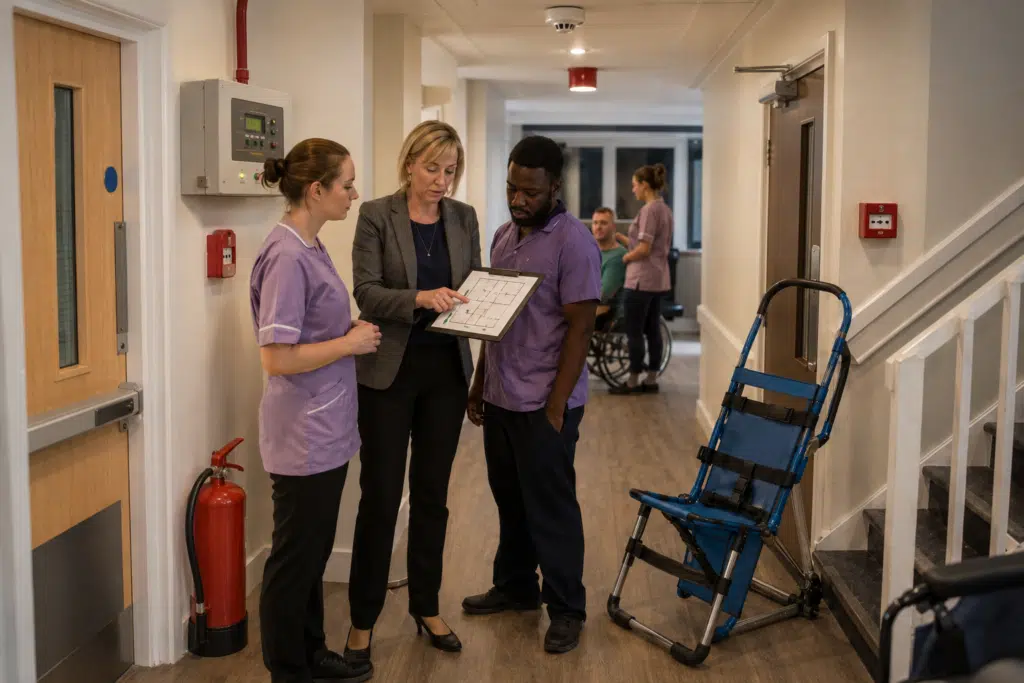
One home had an evacuation chair that could not physically navigate the corner in the staircase. The stairs had a turn, and the chair was too wide to get around it. The chair would have been useless in an actual evacuation. Another home had a sledge that was damaged and had clearly not been inspected. A third home had a written process that instructed staff to hoist a client into an evacuation chair using electrical hoisting equipment. There are two reasons this is not acceptable: you do not use electrical equipment during a fire, and a hoist transfer takes significant time that nobody has in an emergency. The equipment must match the building, and the process must reflect what can actually be done safely and quickly.
3. Fire drills were not being run correctly
One home had a process of warning a client with significant rigid routines twenty minutes before a drill so the client could complete their routine before participating. I understand entirely why that decision was made, and the staff genuinely believed they were supporting the client’s wellbeing. But a fire drill that gives advance notice to a resident so they can prepare is not a drill. It is a rehearsal for a set of conditions that will never exist in a real emergency. The purpose of a drill is to test whether your plan works in as close to real-world conditions as possible. If your plan cannot be tested without twenty minutes’ notice, your plan needs to change, not the drill.
4. PEEPs were identical across residents
Across several homes, the PEEPs for individual residents were the same document with a name inserted. Same equipment specified. Same procedures. Same named assistants in some cases, regardless of shift patterns. In a home supporting people with learning disabilities, residents can have profoundly different mobility, communication, and behavioural profiles. A PEEP that does not reflect the individual it covers is not a PEEP. It is a document that creates a false sense of compliance while providing no actual protection.
5. The laundry room tumble dryers were a significant unmanaged risk
Across the homes, filters on tumble dryers were not being cleaned after every use. In some homes, there was no documented process at all for filter maintenance or regular equipment checks. This matters because tumble dryers are one of the most significant fire risks in residential care settings. Lint builds up in filters and vents, restricts airflow, and causes overheating. Fire and rescue services attended an average of nearly two tumble dryer fires per day across England over a recent five-year period. In a care home, where the laundry cycle runs constantly, and machines are operated by multiple staff, the maintenance discipline has to be formal and documented.
What Happened Next
I did not deliver the training, identify the problems, and leave. That is not how I work, and it is not how Prima Cura operates.
On the day of each visit, beyond the training itself, I spent additional time doing walk-throughs of every home, identifying specific issues with equipment placement, evacuation routes, and procedural gaps. I wrote detailed reports for the organisation covering what I had found and what needed to change at each site.
Over the following couple of months, I worked with them to support the process of getting things right. That involved them purchasing new evacuation equipment that was actually suitable for the buildings they were operating in, rewriting their evacuation plans to reflect real-world procedures, updating all their PEEPs to make them individual rather than generic, and establishing proper processes for laundry room equipment checks. By the end of that process, all nine homes had been brought to a standard that I was satisfied with. Not satisfied in a box-ticked sense. Satisfied in the sense that if an alarm had sounded, those staff would have known what to do and had the right equipment to do it.
I did not charge for that additional work. I am telling you that not as a sales point, but because I want to be honest about why. Fire safety in a care setting is not an abstract compliance exercise. The people living in those homes are some of the most vulnerable people in the system. Getting it wrong has consequences that no certificate can undo.
The Laundry Room: The Risk That Gets Overlooked
Cooking is the leading single cause of fire in care homes, accounting for approximately 41% of incidents. But the laundry room is a persistent secondary risk that often receives far less attention, and in a residential care setting it runs constantly.
Tumble dryers are responsible for a significant proportion of fires involving white goods in England. The cause, in the vast majority of cases, is the same: lint builds up in the filter and the internal cavity because the filter is not cleaned after every use, and the machine is not serviced regularly. Restricted airflow causes the machine to overheat. In the worst cases, the accumulated lint ignites on contact with the heating element.
| Tumble dryer fire risk: what good practice looks like in a care home Clean the filter after every single use. Every load. Without exception. This should be on a documented checklist, not left to individual staff discretion Service machines regularly. A qualified engineer should carry out periodic internal cleaning and inspection, including clearing lint from the cabinet cavity and checking the heating element and venting Never run the dryer unattended overnight. In a care home, this is particularly important: if a fire starts while the night team’s attention is with residents, detection and response time increases significantly Check that venting is clear and unobstructed. Kinked or blocked vent pipes increase heat buildup inside the machine Document everything. Filter cleans, machine checks, servicing dates. If you cannot show the evidence, the process does not exist as far as CQC and fire inspectors are concerned Position matters. The laundry room’s location relative to escape routes and sleeping areas should be considered in the fire risk assessment. It should not be an afterthought |
PEEPs in a Care Setting: Why ‘Same for Everyone’ Is Never Acceptable
A Personal Emergency Evacuation Plan is, by definition, personal. The moment you apply the same document to multiple individuals, it stops being a PEEP and becomes a form.
In a residential care home for people with learning disabilities, the range of needs across residents can be extraordinary. One resident may be ambulant and able to move quickly with verbal prompting. Another may be a full-time wheelchair user with complex physical needs. A third may have no physical mobility issues but will become distressed and resist contact if an alarm sounds unexpectedly. Each of those individuals needs a plan that is written for them, with them, and tested with the people who will carry it out.
A compliant PEEP in a care setting must include:
- The individual’s specific mobility, communication, and behavioural profile. Not a general description. The specific picture for this resident on this shift
- Named or role-specific assistants for every shift pattern. If the named assistant is not on duty, the plan does not work. Cover must be built in
- The specific equipment that will be used and confirmation it is appropriate for the building. An evacuation chair that cannot get around a corner in your staircase is not fit for purpose regardless of what the certificate says
- A communication approach. For a resident with learning disabilities who follows rigid routines or who may be non-verbal, the plan must include how staff will communicate what is happening in a way the individual can understand and respond to
- A record of the resident’s involvement and, where capacity allows, their agreement. Under the Fire Safety (Residential Evacuation Plans) (England) Regulations 2025, consent and capacity now have explicit procedural requirements. Where a resident lacks capacity, the Mental Capacity Act 2005 framework applies
- A regular review date. Any change in the resident’s condition, location in the building, or the building’s layout requires the PEEP to be updated immediately
- Evidence that it has been tested. A PEEP that has never been rehearsed in a drill is a document. A PEEP that has been tested, reviewed, and adjusted is a plan
Choosing the Right Evacuation Equipment for Your Building
The single most important thing I want care managers and H&S leads to take from this section is this: evacuation equipment must be selected for the specific building it will be used in and the specific individuals it will assist. Purchasing an evacuation chair because it is the one you have always used, or because it is the cheapest, is not safe procurement.
| Equipment type | Suitable for | Not suitable for |
| Evacuation chair | Straight staircases with sufficient width; ambulant or partially ambulant individuals who can transfer into the chair | Stairs with corners, turns, or limited width; individuals who cannot be transferred safely or quickly; buildings where hoisting would be required to position the resident |
| Evacuation sledge / ski sheet | Individuals who cannot sit upright; narrow staircases or those with corners; faster descent on straight stairs with trained operators | Situations where a single operator is managing alone; individuals requiring additional positional support during descent |
| Evacuation sheet / ski pad | Moving non-ambulant individuals across level surfaces or down gentle slopes; use alongside other equipment | Primary equipment on stairs; use without additional support for descent |
| Carry-down / carry chair | Very small or lightweight individuals; short distances; trained two-person teams | Larger or heavier residents; long evacuation distances; single-person operation |
| Horizontal stretcher / evacuation mattress | Bedbound residents or those requiring horizontal transfer; specific high-dependency needs | Standard staircase evacuation without specialist training; standard staffing ratios |
Equipment selection must be based on a proper assessment of the building and the individuals within it, carried out by someone who has been trained to make that assessment. Manufacturer guidance alone is not sufficient.
Critical: never specify the use of electrical hoisting equipment as part of an evacuation procedure. This is not safe during a fire, and the time required makes it incompatible with an emergency evacuation.
CQC, Fire Safety, and What Inspectors Look For
The Care Quality Commission assesses fire safety under Regulation 12 (Safe Care and Treatment) of the Health and Social Care Act 2008 (Regulated Activities) Regulations 2014. Fire safety is not a peripheral concern in CQC inspections. It sits at the centre of how inspectors assess whether a service is safe.
During a CQC inspection, inspectors will typically review:
- Your current, reviewed fire risk assessment and whether it reflects the actual building and resident profile
- Staff training records: all staff must complete fire safety training, including bank and agency workers, as part of induction and annually thereafter
- Evidence of fire drills: frequency, records, times (at least one drill at night shift staffing levels per year), outcomes, and actions taken
- Individual PEEPs for every resident who requires evacuation assistance: that they exist, that they are individual, that they have been reviewed, and that they are achievable with actual staffing
- Evacuation equipment: that it is present, appropriate for the building and individual needs, maintained, and that staff are trained to use it
- Fire door checks and escape route records
- Documentation under Building Safety Act 2022, Section 156: all fire risk assessment findings must now be recorded regardless of premises size
Care homes received 192 enforcement notices in 2024/25, the second-highest total of any premises type in England. The most commonly cited articles of non-compliance involve emergency routes and exits, inadequate evacuation planning, and staff training failures. These are not technical or obscure failures. They are the fundamentals.
Fire Safety Training for Care Homes with Prima Cura
Prima Cura Training delivers fire marshal training, evacuation equipment training, and fire safety assessment support specifically for care settings across Greater Manchester and throughout England. This is not generic workplace training adapted for the sector. It is training built around the real complexity of residential care: the people living there, the buildings they live in, and the staff responsible for keeping them safe.
Every course is delivered by a trainer with over 25 years of direct health and social care experience. We do not just hand over a certificate. We work with your team to make sure they genuinely understand the procedures, can operate the equipment specific to your buildings, and can run a drill that is actually worth running.
- Fire Marshal Training: available for care home teams, including evacuation equipment training
- Health and Safety Training: broader H&S programmes for care settings
If you want to talk through what your homes need before you book, get in touch. Call us on 0333 999 8783 or email info@primacuratraining.co.uk.
For further reading, see our earlier post Your Fire Marshal Is Not a Tick-Box, which covers the legal framework, staff ratios, and fire drill standards for all business types, and Every Box Ticked, Except the One That Actually Mattered, on why equipment and processes need to be fit for purpose and regularly checked.
This article provides general information about fire safety law, regulations, and good practice in care settings in England as at June 2026. It does not constitute legal, regulatory, or professional advice and should not be relied upon as such. Legislation and CQC guidance are subject to change. Care providers should seek qualified advice specific to their premises, their registered service, and the individuals they support. All statistics are sourced from official government publications including MHCLG Fire Statistics 2024/25, MHCLG Fire Prevention and Protection Statistics 2024/25, and official government guidance documents.