Why We Now Teach Wound Packing on Every EFAW and FAW Course
Written by Stephanie Austin, Owner & Lead Trainer, Prima Cura Training
Last reviewed: October 2026 | Next review: October 2027
| Wound packing and catastrophic bleeding control have moved from a specialist add-on to standard content across UK First Aid at Work training. We’ve built hands-on wound packing practice into every Emergency First Aid at Work and First Aid at Work course we deliver, using training kit built specifically to make it count. |
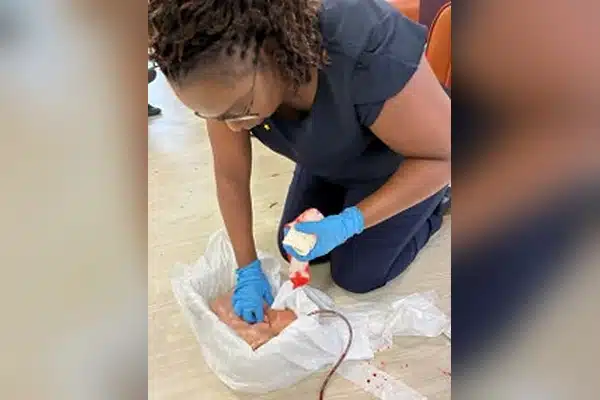
A few weeks ago I was on my knees in a nursing home living room area, scrubbing fake blood out of brand new laminate flooring, wondering exactly how a conversation over a beer had ended up here. The blood was meant to stay inside the training prop. It did not stay inside the training prop. Neither, if I’m honest, did quite a lot of my dignity.
It was messy, it was a bit chaotic, and it was one of the best training days I’ve delivered in a long time. Underneath the laminate-flooring disaster was something genuinely important: a group of care staff learning how to pack a catastrophic bleed properly, on a training device realistic enough to make the skill actually stick.
Where the Idea Actually Came From
It started with a moan over a pint about wound packing training kit. The equipment on the market tends to fall into two camps: eye-wateringly expensive, or not realistic enough to be worth the money. A friend of mine, the sort of person who can build almost anything if you describe it clearly enough, took that complaint and turned it into a project.
What came back a few weeks later was a wearable wound. Silicone, moulded, disturbingly convincing. Underneath it, tubing runs to a hand pump, so the wound genuinely bleeds while someone is trying to control it. I hadn’t seen anything on the market that came close, certainly not at a price a small training provider could justify.

What Actually Happened When We Used It
This month’s session was its first proper test, on a First Aid at Work course at a nursing home. The plan was to use the wearable version, strapped on, so learners could practise on a moving casualty rather than a static prop on a table.
That plan lasted about half an hour. Once we discovered that “washable” fake blood is a bold claim rather than an accurate one, we adapted fast, and the wearable wound went into what we’ve started calling the wound in a box: the same silicone wound, the same tubing and pump, sitting in a lined tray instead of strapped to an arm. Slightly less realistic as a scenario. Considerably kinder to the carpet.

The feedback from the group told me everything I needed to know.
They said it was genuinely fun to train with, and that the wound looked convincingly real.
A couple of them were visibly thrown by the part that actually matters: having to put a finger inside the wound to find the point of bleed. That reaction is exactly what we want. Packing a wound from a distance, without ever making contact with where the bleeding is actually coming from, does not control catastrophic bleeding. Finding the source does, and that only really sinks in once you’ve had to do it on something that pushes back a little.

Why Is Wound Packing Now Part of First Aid at Work Training?
This isn’t us adding a party trick to make training more interesting. It reflects a real, industry-wide shift in what UK first aid training is expected to cover.
In October 2024, the First Aid Quality Partnership issued a position statement on managing life-threatening bleeding, recommending that tourniquets, wound packing and haemostatic dressings be built into First Aid at Work training rather than treated as a specialist extra. The FAQP brings together Resuscitation Council UK, the Voluntary Aid Societies, and other bodies who set standards across UK first aid qualifications, so when they move, the rest of the sector tends to follow. Their updated 2026 statement makes the direction of travel clear: from around October 2025, catastrophic bleed control is shifting from “strongly recommended” to something first aid trainers are expected to deliver as standard, with training providers themselves expected to complete accredited CPD in life-threatening bleeding management.
In plain English: if your organisation’s first aid needs assessment shows a realistic chance of catastrophic bleeding, whoever delivers your training should now cover wound packing and tourniquet use as a matter of course, not as something you have to specifically ask for.
None of this sits apart from UK law. Every employer already has a legal duty under the Health and Safety (First-Aid) Regulations 1981 to provide first aid provision appropriate to the risks in their workplace, and the HSE’s Approved Code of Practice L74 sets out how that duty is met, starting with a proper first aid needs assessment. What’s changed is the answer that assessment is now more likely to produce. It all sits on the evidence base in the Resuscitation Council UK’s 2025 First Aid Guidelines, which are clear that appropriate tourniquet use and wound packing, applied correctly, improve survival where direct pressure alone isn’t enough.
Care settings are a good example of why this matters more widely than people assume. Catastrophic bleeding tends to get associated with construction sites and factories, and it does happen in both. But a serious fall onto glass or furniture, equipment failing, or a medical crisis that produces sudden heavy blood loss can happen anywhere people are cared for, including a nursing home corridor on an ordinary weekday. Being the closest trained person in that moment is what a first aider is actually for.
What Wound Packing Actually Involves
Direct pressure is still the starting point for any serious bleed, and it stays the right first response in the vast majority of cases. Wound packing and tourniquet use come in when direct pressure alone isn’t controlling blood loss quickly enough, which is exactly the situation where hesitation costs the most.
Packing a wound properly means applying firm, continuous pressure directly at the source of the bleeding, not simply pushing gauze into the opening and hoping for the best. That distinction sounds small on paper. It isn’t small in practice, and it’s exactly why a realistic training kit matters. You can’t teach someone to find a bleeding point by feel using a static mannequin with no resistance and no mess. You can teach it using something that behaves, even roughly, as a real wound does.
Our Emergency First Aid at Work with Life-Threatening Bleeding Control course goes furthest on this, with dedicated hands-on time on tourniquets, haemostatic dressings, simulated wound packing, and what to do when none of that equipment is to hand. But the underlying awareness, recognising catastrophic bleeding and knowing the escalation from pressure to packing to tourniquet, is now something we build into every EFAW and FAW course, because it’s what the current guidance, and our own experience in the room, tells us learners need.
Why We Built Our Own Kit Instead of Buying One
The commercial options I’d seen fell into two camps: kit that cost more than most small training providers spend on an entire course, or kit realistic enough to look fine in a photo but nowhere near convincing enough to hold up under a learner’s hands. Neither builds the kind of muscle memory and confidence a genuine catastrophic bleed demands.
What my friend built solves both problems. It’s realistic enough that learners hesitate the first time they touch it, which is exactly the reaction you want in training and precisely the one you don’t want for real. And it’s ours, so we can keep adapting it: wearable one week, wound in a box the next, depending on what the group and the venue can cope with. Given what happened to that flooring, adaptability turned out to matter rather a lot.
Frequently Asked Questions
What is wound packing in first aid?
Wound packing is the technique of firmly and continuously pressing dressing material directly against the source of a life-threatening bleed, inside the wound itself, to control blood loss when pressure over the wound alone isn’t enough. It’s used alongside tourniquets and haemostatic dressings as part of catastrophic bleeding control.
Is wound packing training now part of EFAW and FAW courses?
Following the First Aid Quality Partnership’s position statement, first issued in October 2024 and updated in 2026, catastrophic bleed control including wound packing is moving from a specialist add-on to standard content across UK First Aid at Work training. At Prima Cura, we now build hands-on wound packing awareness into every EFAW and FAW course we deliver.
Do I need standard EFAW or EFAW with Life-Threatening Bleeding Control?
That depends on your organisation’s first aid needs assessment. Standard EFAW suits lower-risk environments. EFAW with Life-Threatening Bleeding Control adds dedicated hands-on training in tourniquets, haemostatic dressings and simulated wound packing, and suits higher-risk settings or any employer who wants their first aiders specifically prepared for the most serious emergencies.
Is it safe for a workplace first aider to learn wound packing?
Yes, when it’s taught correctly and practised hands-on under supervision. The Resuscitation Council UK’s 2025 First Aid Guidelines (effective 2026) set out the evidence base for tourniquet and wound packing use in a first aid context, and the risk of harm from correct application is significantly lower than the risk of death from uncontrolled catastrophic bleeding
Can this training be completed online?
No. The HSE is clear that practical first aid competencies, including wound packing, must be physically assessed. Online-only training doesn’t meet the requirements of the Health and Safety (First-Aid) Regulations 1981 for this content.
Ready to Add Wound Packing to Your Team’s First Aid Training?
If your first aid needs assessment hasn’t been reviewed since this shift started, now’s a sensible time to look again, particularly if your team works somewhere a serious bleed is a realistic possibility. We’ll talk you through what’s changed and which course actually fits your risk profile, honestly, before you commit to anything.
- Emergency First Aid at Work (EFAW)
- Emergency First Aid at Work with Life-Threatening Bleeding Control
- First Aid at Work (3-Day)
Get in touch, and we’ll help you work out what your team actually needs.
This article reflects current UK first aid guidance, including the First Aid Quality Partnership’s Life-Threatening Bleeding Position Statement, the Resuscitation Council UK 2025 First Aid Guidelines (effective 2026), and the Health and Safety (First-Aid) Regulations 1981, as of the date of review. It is provided for general information only and does not constitute legal or clinical advice. Wound packing and tourniquet use are taught in a first aid context and should only be applied in a genuine emergency while awaiting professional medical help. Employers remain responsible for carrying out their own first aid needs assessment and ensuring their provision meets current legal requirements.