Emergency Services Day 2026: The Minutes That Belong to the Rest of Us
Written by Stephanie Austin, Owner & Lead Trainer, Prima Cura Training | Last reviewed: September 2026 | Next review: September 2027
Two years ago, one of my former learners sent a message to a business networking group that I still think about.
Kieren Robinson runs BeeSpoke Carpentry here in Manchester. He’s not a paramedic. Not a first responder by trade. Just a tradesman who’d done a first aid course with me a couple of months earlier and hoped he’d never need it.
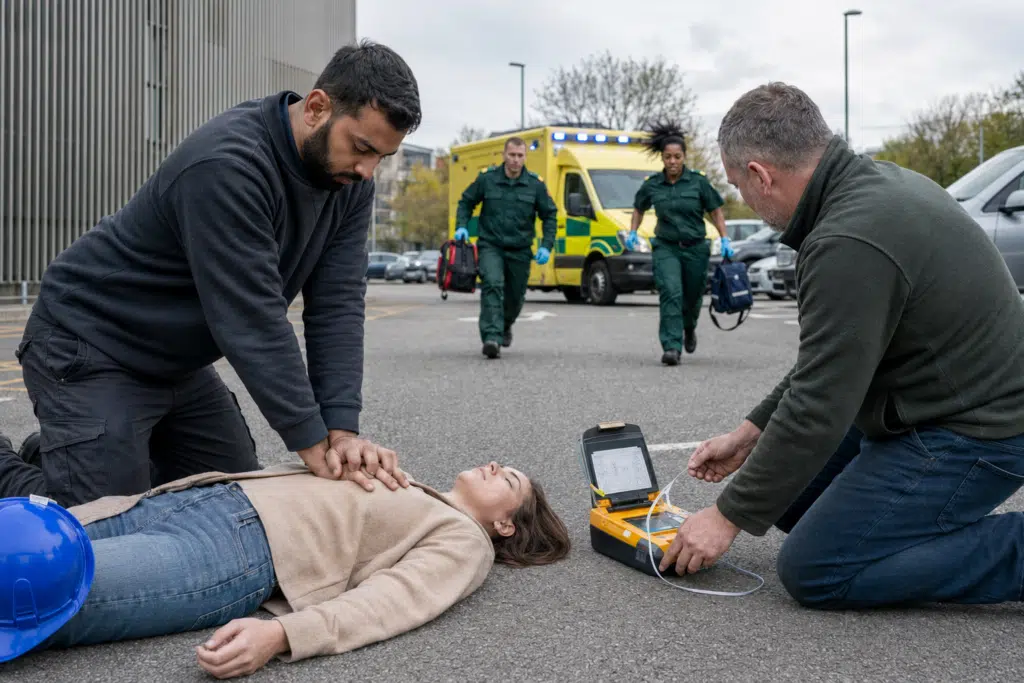
On a Tuesday in November 2023, he found a young woman unconscious in a car park. Her heart had stopped.

Kieren called 999. Then he did the two things that decide whether someone in cardiac arrest is still alive by the time a crew reaches them. He started CPR, and as soon as one was available, he used a defibrillator. She was put into the ambulance awake and talking.
That gap, the bit between someone collapsing and a crew arriving to take over, is what Emergency Services Day is actually about underneath the flags and the open days. It’s a thank you to the people who answer 999, and it’s earned every year. But it’s also a reminder that the outcome of most emergencies is decided before they ever arrive.
What Is Emergency Services Day, and Why the 9th of September?
Emergency Services Day, also known as 999 Day, falls on 9 September every year. It starts at 9 am to mark the ninth hour of the ninth day of the ninth month, echoing the UK’s 999 number, and opens with a two-minute silence to remember more than 7,500 members of the police, fire and ambulance services who have died in the line of duty.
It was founded in 2016 by Tom Scholes-Fogg, a serving police officer who noticed the UK had an Armed Forces Day but nothing equivalent for the NHS and emergency services, despite there being far more people serving in those roles. The day was formally backed by the government the following year, with support from the then Prime Minister Theresa May and members of the Royal Family, and it’s run every year since.
The day has three stated aims: to thank the emergency services workforce, to educate the public on using 999 responsibly and on basic lifesaving skills, and to highlight the career and volunteering opportunities across the sector, from Special Constables to NHS Community First Responders. You can find this year’s events at 999day.org.uk.
The Minutes Before They Arrive: What UK Ambulance Response Times Actually Look Like
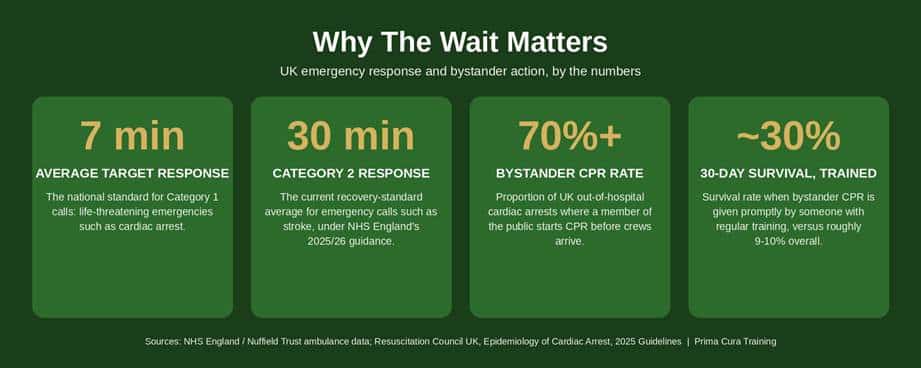
Ambulance calls in England are sorted into four categories by how serious they are. Category 1 covers life-threatening emergencies such as cardiac arrest, and the national standard is an average response of seven minutes. Category 2 covers serious but slightly less immediate emergencies such as stroke or chest pain. NHS England’s current recovery standard sets the average response for these at 30 minutes, a temporary adjustment from the original 18-minute target while services work through sustained demand.
Ambulance crews and control room staff work under relentless pressure, and response times have genuinely improved through 2025 and into 2026 in a lot of areas. That’s not really the point I want to make here. The point is that even when the system is working exactly as intended, there’s a window, sometimes a handful of minutes, sometimes longer, where the person having the emergency is entirely in the hands of whoever happens to be nearby.
For someone in cardiac arrest, that window decides the outcome. Every minute without CPR or defibrillation after a cardiac arrest reduces the chance of survival. A trained bystander doesn’t replace the ambulance service. They bridge the gap until it arrives.
What Kieren Actually Did, and Why the Order Mattered
When Kieren found the young woman, he didn’t freeze, and he didn’t wait for someone more qualified to turn up. He followed the sequence I teach on every Basic Life Support and AED course: check whether it’s safe to approach, check for a response, call 999 immediately if someone is unresponsive, and start chest compressions without delay if their breathing isn’t normal.
Under the Resuscitation Council UK’s 2025 guidelines, that call to 999 happens before you fully assess breathing, not after it. The call handler is trained to talk you through recognising a cardiac arrest and coaching you through compressions in real time. Compressions should be delivered at 100 to 120 per minute, roughly the tempo of Staying Alive, to a depth of 5 to 6 centimetres, with as few interruptions as possible. A defibrillator, if one’s nearby, should be attached and switched on the moment it arrives. It talks you through everything else.
None of that is complicated. It’s a sequence anyone can learn in a few hours. What Kieren’s message told me, more than anything, is that training holds up under pressure. His words were, “I’m shaking with adrenaline.” That’s what adrenaline does. It’s what makes people freeze if they’ve never practised what to do with it. He didn’t freeze, because the sequence was already in his hands before he needed it.
I told the fuller version of this story, and the science behind CPR and defibrillator use, in our CPR & AED Awareness Week series earlier this year.

Is First Aid Training a Legal Requirement for UK Employers?
Yes, in the sense that every employer has a duty to provide it. Under the Health and Safety (First-Aid) Regulations 1981, employers must provide adequate and appropriate first aid equipment, facilities and personnel, based on a proper assessment of the risks in their workplace. The HSE’s Approved Code of Practice, L74, sets out how that assessment should be carried out and what adequate and appropriate looks like for different types of workplace.
There isn’t a single course that fits every employer. A low-risk office might only need an Emergency First Aid at Work (EFAW) certificate holder on site. Higher-risk environments such as construction or manufacturing usually need the fuller three-day First Aid at Work (FAW) qualification. I’ve written about the difference in more detail if you want to work out which one applies to you.
How to Mark Emergency Services Day This Year
You don’t need to organise anything to take part. Pause at 9 am if you can. Thank a 999 worker if you know one, or if your paths cross this week. Share a story like Kieren’s, using #999Day, if you have one of your own. And if you’ve never actually learned what to do in the minutes before help arrives, this is as good a prompt as any to book it.
Common Questions About Emergency Services Day and First Aid
What is the UK’s target ambulance response time?
For Category 1 calls, life-threatening emergencies such as cardiac arrest, the national standard is an average response of 7 minutes. Category 2 calls, such as stroke, currently sit under a temporary recovery standard averaging 30 minutes.
Can anyone learn CPR and how to use a defibrillator?
Yes. Resuscitation Council UK guidance is explicit that CPR and AED use can be learned by almost anyone, regardless of medical background, and both are taught on a standard Basic Life Support and AED course in a matter of hours.
What should I do if someone collapses and isn’t breathing normally?
Call 999 immediately. Follow the call handler’s instructions, and start chest compressions without delay if the person isn’t breathing normally. Use a defibrillator as soon as one is available. It will guide you through the rest.
How can I get involved in Emergency Services Day?
You can mark the day by pausing for the two-minute silence at 9 am, thanking emergency services staff or volunteers you know, sharing a first aid or emergency services story using #999Day, or finding local open day events at 999day.org.uk.
Learn the Skills That Bridge the Gap
Kieren’s story isn’t rare because what he did was impossible. It’s rare because so few people ever get the training in the first place.
Our Basic Life Support & AED course covers exactly what he used that day: recognising a cardiac arrest, CPR, and defibrillator use, in one focused half-day session delivered at your workplace.
If you need fuller coverage for a higher-risk workplace, our Emergency First Aid at Work (EFAW) course builds on the same skills alongside wound care, choking and other workplace emergencies.
Get in touch if you’d like to talk through which course fits your team.
This article reflects UK guidance and legislation current at the time of writing, including the Resuscitation Council UK 2025 Guidelines and the Health and Safety (First-Aid) Regulations 1981. It’s shared for general information and awareness and does not replace formal first aid training, a workplace risk assessment, or professional medical advice. If you or someone near you is in a medical emergency, always call 999.


