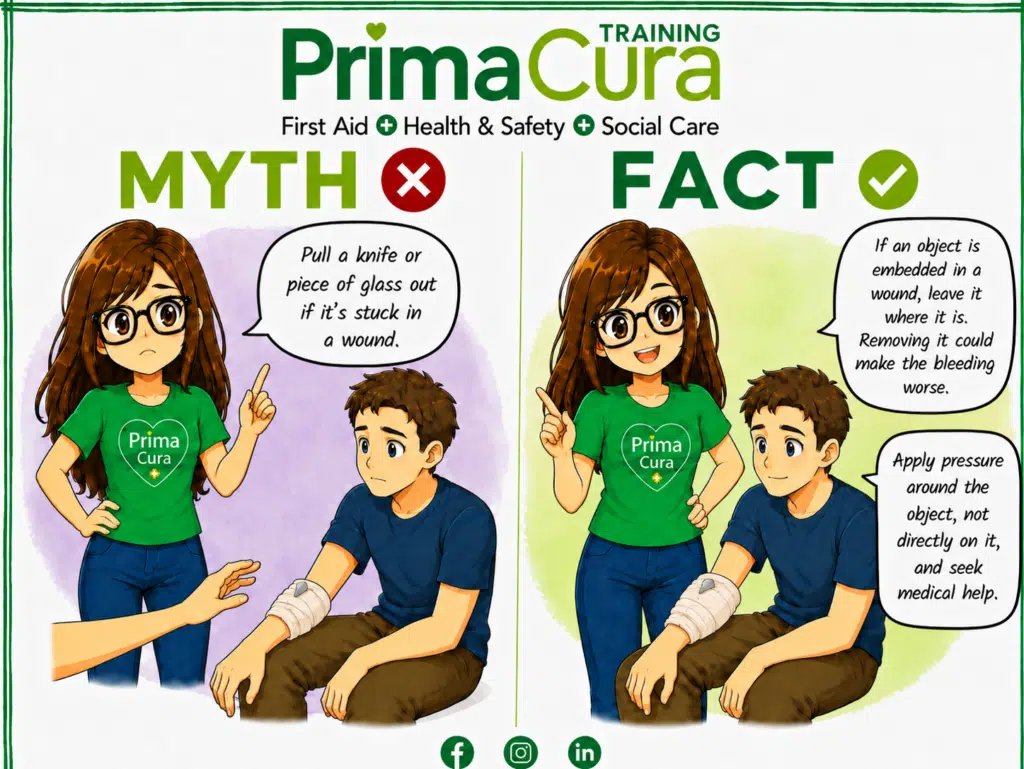
Myth Busting Monday: Should You Pull Glass Out of a Wound? Here’s What to Do Instead
Written by Stephanie Austin, Owner and Lead Trainer, Prima Cura Training | Last reviewed: September 2026 | Next review: September 2027
| MYTH | “Get it out. You can’t just leave it in there.” |
| FACT | Leave it exactly where it is. St John Ambulance and the British Red Cross both say the same thing: an object in a wound may be acting as a plug that is holding back the bleeding, and pulling it out can make the bleeding far worse. It cuts on the way in, and it will cut again on the way out, and you cannot see what it is resting against. Press firmly either side of the object rather than on it, pad around it, and get help. NHS guidance lists something stuck in a cut, such as a shard of glass, as a reason to go to A&E, and says not to take it out yourself. |
A glass goes on the kitchen floor. Somebody crouches to gather up the pieces, or walks through in socks ten minutes later assuming it has all been swept, and a shard goes into the ball of their foot.
The first thing almost everybody does is reach for it.
That is not stupidity. It is the opposite. The object is wrong; it does not belong there, and getting it out feels like the fix. Leaving it in feels like doing nothing, and doing nothing feels like failing the person in front of you.
It is also the single most dangerous reflex in wound first aid, and it takes about a second and a half to act on.
The box above is the short version. The rest of this post is why the instinct is wrong, what to do with your hands instead, and the part nobody ever explains: where the line actually sits, because obviously nobody is calling an ambulance over a splinter.
Where does this myth come from?
Partly the screen, where the hero grits their teeth, pulls the thing out of their own shoulder and carries on. It is such a familiar shot that most of us have absorbed it as the correct sequence of events without ever thinking about it.
Partly the language. We talk about cleaning a wound, and cleaning implies removing what is in it. If the object is dirty, and it usually is, the urge to get it out feels like the hygienic thing as well as the tidy one.
And partly because leaving it in looks like inaction. Standing over somebody with a piece of glass in their foot and deliberately not touching it feels wrong in a way that is hard to override unless somebody has told you why.
Why does leaving it in actually help?
Three reasons, and they stack.
The first is the plug. St John Ambulance put it plainly: do not pull it out, because it may be acting as a plug to reduce the bleeding. The British Red Cross say the same, adding that removing the object can make the bleeding much worse. Whatever is in there is occupying space that would otherwise be an open channel, and the moment you withdraw it, that channel is open.
The second is the damage. It cut on the way in, and it will cut on the way out. Going in, tissue moved out of its path. Coming out, you are dragging a sharp edge back through the same track at whatever angle you happen to pull, and things it merely nudged on the way in can be sliced on the way out.
The third is that you are working blind. You cannot see what the object is touching. Something resting against an artery, a tendon or a nerve is doing no further harm while it stays still. You also cannot tell how deep it goes, and glass is particularly deceitful here, because it snaps. The visible piece may be a small part of what is actually in there.
Which leaves an asymmetry worth holding onto. Leave something in that could safely have come out, and the cost is a trip to A&E and some mild embarrassment. Pull something out that should have stayed, and the cost can be a bleed you cannot control on a kitchen floor. Those two mistakes are not the same size.
Why an object in a wound is holding back the bleeding, and what happens the moment it comes out.
What should you do instead?
The technique is specific, and it is not the same as pressing on an ordinary cut. NHS guidance sets it out: do not press down on the object, and instead press either side of it firmly to push the edges of the wound together.
- Do not touch or move the object, and do not press on it
- Press either side of it firmly with your fingers, pushing the edges of the wound together, using a clean cloth or dressing if you have one
- Build padding either side of the object, high enough that you can bandage over the top without the bandage pressing down on it
- Bandage over the padding rather than over the object, firmly enough to hold pressure but not so tight that it cuts off circulation below
- If the wound is on a hand or arm, raise it above the level of the head. If it is on a lower limb, lie the person down and raise it above the level of the heart
- Call 999 for heavy bleeding, or if the object is large, deeply embedded or in the head, neck, chest or abdomen. Use the speakerphone so you can keep your hands on the wound
- Do not wash a wound that is bleeding heavily, because it can make it bleed more
- Keep them warm and watch for shock: pale, cold, clammy skin, dizziness, fast shallow breathing, or confusion
If it is serious, do not drive them to A&E yourself. NHS guidance is to ask somebody else to drive or to call 999 and ask for an ambulance, and there is a good reason for that: a person who is losing blood can deteriorate quickly, and you cannot treat them and steer at the same time.
So what can you take out?
This is the part that gets left out, and its absence is why the advice sometimes gets ignored altogether. If somebody is told never to remove anything, and then finds themselves holding a rose thorn in their thumb, they conclude the rule is nonsense and stop applying it to the things that matter.
So here is the line, as three questions rather than a list to memorise.
- Can you see the whole of it? If you can see the end, grip it, and tell how deep it goes, and it is sitting shallow in the skin, that is a splinter, and you can deal with it. If you cannot see where it ends, leave it
- Is it bleeding more than a small cut would? Meaningful bleeding means the object is deep enough to have reached something worth bleeding from. Leave it and press either side
- Is it glass, is it near the eye, or did it go in with force? Any of those three and it stays in, regardless of how small it looks. Glass snaps and hides, the eye is unforgiving, and anything driven in by machinery, a nail gun or a fall has gone deeper than it appears
For a splinter that passes all three, the method is to clean the skin around it, grip it as close to the skin as you can with tweezers, and draw it out at the same angle it went in so it does not snap. Clean the wound afterwards and cover it.
And when you are not sure, leave it in and get it looked at. Uncertainty is itself an answer here, because the two possible mistakes cost such different amounts.
Three questions that decide whether an object stays in or can safely come out.
What if it is in the eye?
Same principle, less margin for error.
St John Ambulance draw the distinction clearly in their eye injury guidance. Things resting on the surface of the eye, like grit, a loose eyelash or a contact lens, can usually be rinsed out. Sharp fragments such as metal or glass can cut or penetrate the eye and become embedded, and in that case the object must not be removed. Cover the eye, and get medical help quickly.
- Do not try to remove anything embedded in the eye, and do not let the person rub it
- Do not apply pressure to the eyeball
- Cover the injured eye with a clean eye pad or wound dressing
- Help them rest in a comfortable position with the eye closed, and keep the head still
- For a wound to the eye, an embedded object or a chemical splash, call 999 or go straight to A&E or an eye casualty department
Eye injuries are one of the few situations where people reliably underestimate the urgency, because an eye can be seriously damaged without looking dramatic and without hurting as much as you would expect.
Is it 999, A&E, or something you can sort out at home?
Roughly, it breaks down like this.
- 999: bleeding you cannot control, blood coming out in spurts, a large or deeply embedded object, anything in the head, neck, chest or abdomen, or somebody becoming pale, cold, drowsy or confused
- A&E: something stuck in the cut such as a shard of glass, a wound that will not stop bleeding with pressure, numbness or trouble moving anything beyond the wound, a large or gaping wound, or a deep puncture wound
- 111 or a pharmacy: a minor wound you have cleaned and covered that you are unsure about, or one that later looks red, swollen, hot or is oozing
- At home: a shallow splinter you can see and grip, or a minor cut or graze with nothing left in it, rinsed under running water and covered
Two things worth knowing before you go. NHS guidance notes that a wound with something in it may need an X-ray, which is exactly why glass gets taken seriously, and that you may also need an injection to protect against tetanus. Neither is a reason to delay, and both are reasons to let somebody look properly rather than deciding for yourself that it came out clean.
What about public bleed control kits?
You may have started noticing these in town centres, stations, shopping centres and venues, often mounted next to a defibrillator. They go by several names: Public Access Trauma kits, PAcT kits, bleed control kits, critical injury packs.
The British Red Cross describe them as designed so that anyone can use them, even without training, with clear instructions inside the pack. They typically hold gloves, dressings including some that help blood clot, tourniquets and instructions. If severe bleeding is not stopping and one is nearby, use it, and follow the 999 call handler’s instructions exactly.
They are there to support the basics rather than replace them. The first thing that stops a bleed is still a hand and firm pressure in the right place, which is the part you can already do.
Training that answers this before the emergency does
Bleeding control is the part of a first aid course where the change in people is most visible. It is one thing to read that you press either side of an object rather than on it. It is another to have done it, under time pressure, on a wound that is bleeding convincingly, with somebody telling you your padding is not high enough yet.
Our Emergency First Aid at Work course is the one-day qualification most workplaces need, and it covers wound and bleeding management properly. Higher-risk environments, and anywhere with glass, blades or machinery, usually need the three-day First Aid at Work qualification instead. If your concern is mainly children at home or in a setting, the 2-Day Paediatric and Early Years First Aid course covers the same ground for smaller bodies.
Give us a call on 0333 999 8783 or drop us a message and we will tell you honestly which one fits.
Earlier in this series: can you be sued for giving first aid, does CPR restart the heart, and is it safe to prop a baby’s bottle.
THE VERDICT: BUSTED
The urge to pull it out is the urge to help, which is why it is so hard to resist and so worth naming in advance. Leaving it in is not doing nothing. It is holding the wound together with the one thing already in the right place, until somebody who can see inside takes over.
This article is provided for general information and awareness only and reflects NHS guidance, St John Ambulance and British Red Cross first aid advice and Resuscitation Council UK Guidelines 2025 as they stood in September 2026. It does not constitute medical advice, and it is not a substitute for accredited, hands-on first aid training. Guidance can change, and how it applies depends on the specifics of an individual injury. If bleeding cannot be controlled, or you are unsure how serious a wound is, call 999.


