What Is a PEG, and Who Is Actually Allowed to Use One?
Written by Stephanie Austin, Owner & Lead Trainer, Prima Cura Training | Last reviewed: October 2026 | Next review: October 2027
The most common complaint I hear from people living with a PEG has nothing to do with the tube. It is speed. Staff go too fast on the flushes.
PEG feeding training for care workers must cover more than the practical task. Staff also need to understand delegation, accountability, assessed competence and when to escalate concerns.
A PEG, or percutaneous endoscopic gastrostomy, is a feeding tube that passes through the abdominal wall directly into the stomach, so that feed, fluid and medicines can be given to someone who cannot safely take enough by mouth. It is a feeding route, not a diagnosis. In England it is also a delegated healthcare activity, which means a registered healthcare professional has to decide it can be delegated at all, has to be satisfied that the care worker is competent, and stays accountable for that decision.
That is a serious amount of weight resting on a ten minute task. And in most of the rooms I walk into to deliver this course, at least half the staff have never seen a PEG before.
The Short Version
| Question | Short answer |
| What is a PEG? | A feeding tube passed through the abdominal wall into the stomach, used to give feed, fluid and medicines to someone who cannot safely take enough by mouth. |
| Is using one a delegated healthcare activity? | Yes. A registered healthcare professional decides it can be delegated for that individual and remains accountable for that decision. |
| Do care staff need training? | Yes, and training on its own is not enough. Competence has to be assessed against the task and recorded. |
| Who assesses competence? | The delegating healthcare professional, or an assessor the employer and the delegator have agreed between them. |
| Does the employer need to register with CQC for treatment of disease, disorder or injury? | Not where the activity is delegated by a district registered nurse who works for another provider. CQC names PEG feeding as an example. |
| Can a care worker say no? | Yes. Anyone who does not feel competent or confident should say so, and the employer should act on it. |
What Is a PEG, and What Is It Actually For?
A PEG is a feeding tube placed through the abdominal wall into the stomach using an endoscope. The name is just a description of the method: percutaneous means through the skin, endoscopic means placed using a camera, and gastrostomy means an opening into the stomach.
People have a PEG for all sorts of reasons. A stroke that has left someone unable to swallow safely. Motor neurone disease. Head and neck cancer. A learning disability with an unsafe swallow. What those reasons have in common is that eating and drinking by mouth has become unsafe or not enough, not that the person has stopped being a person with preferences, dignity and a say in their own care. If your team supports someone with swallowing difficulties, our Dysphagia Awareness and Stroke Awareness courses sit either side of this one.
A PEG is not a nasogastric tube. An NG tube goes in through the nose and down into the stomach, and it is a completely different risk picture. Placement and position checking on an NG tube is a registered nurse task, not a delegated care worker task, and it should never be treated as one.
The tube itself is held in place from the inside, by a retention disc or a water filled balloon sitting against the inner wall of the stomach. On the outside there is a fixation device holding it steady against the skin, a clamp, and one or more ports where a syringe or giving set connects. The opening through the abdominal wall is the stoma, and it needs checking every day for redness, soreness and leakage.
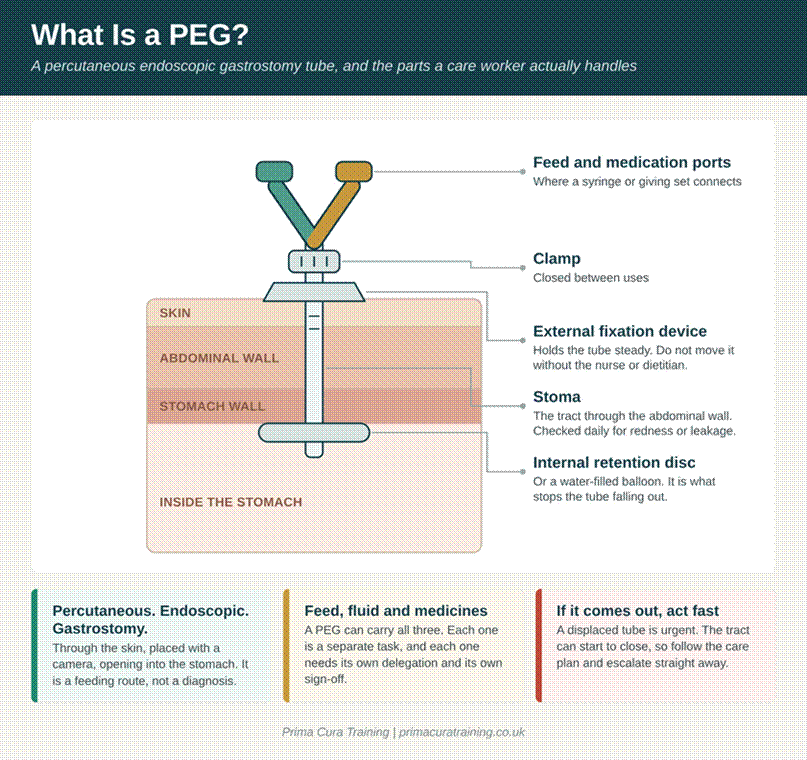
Seeing the actual kit is what makes it click for most people. Below is what gets passed around the room on day one.

Why Is PEG Care Classed as a Delegated Healthcare Activity?
Because it is a healthcare task being carried out by someone who is not a registered healthcare professional. That is the whole of the definition, and it is why PEG care sits in the same bracket as a delegated healthcare task like eye drops, catheter care or insulin administration.
In England the framework for this is the guiding principles for delegated healthcare activities, published by Skills for Care with the Department of Health and Social Care and NHS England. They were first published in May 2023 and revised in November 2024. They cover four areas: person centred care, governance, regulation and accountability, learning, development, skills and competency, and monitoring and review.
Read those alongside the NMC Code (2018) and the picture is clear. Section 11 of the Code requires a registered nurse to delegate only tasks that sit within the other person’s competence, to make sure the person is adequately supervised and supported, and to confirm that the outcome of the delegated task meets the required standard. The Royal College of Nursing sets the same expectations out in its accountability and delegation guidance.
In plain English: a nurse cannot hand PEG care to a care worker and walk away, and a provider cannot accept it on their staff’s behalf without doing something real about training, competence and records.

Who Is Accountable When a Care Worker Gives the Feed?
Three parties are accountable, for three different things, and they do not cancel each other out.
The registered healthcare professional is accountable for the decision to delegate. The guiding principles are direct about it: the professional “remains accountable for the appropriateness of the delegation and undertake appropriate actions to ensure safe delegation”.
The employer is accountable for the governance wrapped around it. The same guidance puts the social care provider as “responsible for the acceptance of the delegated healthcare activities by their workers and to have necessary governance arrangements”. That means the written agreement, the risk assessment, the competency records, the insurance position, the supervision and the review.
The care worker is accountable for their own practice. Carrying the task out exactly as agreed and as written in the care plan, recording it properly, and escalating anything that does not look right.
What nobody is accountable for is a gap. If a care worker is doing PEG flushes because a nurse showed her once, eighteen months ago, and nothing was ever written down, then no one took the decision, no one assessed the competence and no one recorded any of it. That is the arrangement that comes apart the moment something goes wrong, and it is usually the care worker standing in it.
Does a Care Provider Need to Register With CQC for Treatment of Disease, Disorder or Injury?
In most delegated arrangements, no. CQC’s scope of registration guidance names PEG feeding specifically as an example of where the regulated activity of treatment of disease, disorder or injury does not apply. The wording is:
“When a care worker or nursing associate cares for people receiving nutritional support through a PEG feed or provides care for pressure areas delegated by a district registered nurse (a listed healthcare professional) who works for another provider.”
So where the delegation comes from a district nurse employed somewhere else, the care provider does not need to add that regulated activity to their registration in order to support someone with a PEG.
It is worth being clear about what that does not mean. It does not remove the need for training. It does not remove the need for assessed competence. It does not touch Regulation 12 or Regulation 18. Registration and competence are two separate questions, and providers get caught out by assuming that clearing the first one settles the second.
And if your arrangement does not look like the example in CQC’s guidance, for instance where the delegating professional is employed by you, check it directly with CQC rather than reading across from somebody else’s set up.
If you have taken on someone with a PEG and you are working out what your staff actually need, that is a conversation worth having before the first shift rather than after it. Our PEG and PEJ (Enteral Feeding) Awareness course is delivered in house, built around your own care plans and escalation routes, and competency assessment can be included if you request it when you book.
What Does the Law Require the Employer to Do?
Two regulations do most of the work here.
Regulation 12 of the Health and Social Care Act 2008 (Regulated Activities) Regulations 2014 requires that care and treatment is provided in a safe way, and specifically that the provider ensures “persons providing care or treatment to service users have the qualifications, competence, skills and experience to do so safely”.
Regulation 18 requires “sufficient numbers of suitably qualified, competent, skilled and experienced persons”, and that staff receive “such appropriate support, training, professional development, supervision and appraisal as is necessary to enable them to carry out the duties they are employed to perform”.
Notice the word that appears in both. Competent. Not trained. Not inducted. Not aware. Competent.
An attendance certificate proves somebody was in the room. It does not prove they can carry out the task safely on the person in front of them, and it is not what either regulation asks for. I have written more about where that distinction bites at inspection in Regulation 18 and what it really means for training and competence.
The Thing I Correct Most Often: Slow Down on the Flush
If I could change one habit across every PEG course I have ever run, it would be this one.
Treat every flush as if the person is taking sips of water. Not a glass downed in one. Sips.
The method I teach is push and pause. A small amount, stop, look at the person’s face, listen to the tube, then the next small amount. It costs a couple of extra minutes and nothing else.
Why it matters is not complicated. A fast flush is uncomfortable. It can cause cramping, bloating and retching, and for some people it is genuinely distressing. Here is the part that gets missed: a lot of people with a PEG cannot tell you to slow down partway through, and some cannot tell you at all. So the discomfort gets written up as the person being unsettled that morning, rather than as the flush being given too fast. The cause and the record end up pointing in completely different directions, and nobody ever joins them back up.
This is exactly why I teach it on a clear training model. On a see through torso, staff watch and hear precisely what happens when they push. They see the fluid move. They hear it. And something shifts in the room at that point, because it stops being a procedure and starts being something that is happening to a person. That is what builds empathy, and it is also what builds genuine confidence, because they finally understand what is going on inside and why it matters.
Volumes and frequency come from the person’s own regimen, set by their dietitian and written into their care plan. Never from a blog, including this one. What I am talking about here is pace, and pace is yours to get right on every single flush.


What Should PEG Training Actually Cover?
NICE guideline CG32 recommends that people managing enteral tube feeding, and their carers, receive training from the multidisciplinary team on “the management of the tubes, delivery systems and the regimen”, including “the likely risks and methods for troubleshooting common problems”. Treat that as the floor rather than the ceiling.
A PEG course worth booking covers all of this:
- What a PEG is, how it sits in the body, and why this particular person has one.
- Consent and capacity, including what to do when someone cannot consent for themselves. Our Mental Capacity Act 2005 and DoLS course covers this properly.
- Infection prevention, hand hygiene and clean technique. See Infection Prevention and Control.
- Positioning before, during and after a feed, and why it matters for aspiration risk.
- Daily checking of the stoma site, and what redness, leakage, soreness or overgranulation should trigger.
- Flushing, including pace. See above.
- Medicines through the tube, which is its own subject and overlaps with Safe Medication Administration.
- Setting up and running a pump feed, on the pumps your service actually uses.
- Recognising complications, and knowing exactly who to escalate to and how fast.
- Record keeping, because if it is not written down it did not happen. See Reporting, Record Keeping and Information Governance in Care.
- Nutrition and hydration in the round, because a PEG is one route among several. See Nutrition and Hydration in Care Settings.
And all of it hands on. Every learner should physically do the task, not watch somebody else do it.

What that looks like in a real room
I ran a course recently for a company that provides respite holidays for adults with learning disabilities. They had a new guest coming who has a PEG, and they needed both training and competency assessment in place before he arrived. Most of the staff in that room had never seen a PEG, let alone cared for one.
Every single one of them got hands on. They flushed, they set up the pump, they handled the equipment and they asked the questions people only ask once they are holding the syringe themselves. The feedback afterwards was some of the strongest I have had, and the word that kept coming back was not interesting. It was confident. That word only turns up after people have done the thing with their own hands. It never turns up after a slideshow.

What Is the Difference Between Awareness Training and a Competency Assessment?
Awareness training tells people what a PEG is, what can go wrong, and when to escalate. It is the right thing for staff who will not be carrying out the task but who work alongside someone who has one. A competency assessment is something else entirely: a judgement, made by an assessor, that this named person can carry out this specific task safely to a standard, recorded and dated.
| Awareness training | Competency assessment |
| Everyone in the service who works around the person. | Only the staff who will actually carry out the delegated task. |
| Builds understanding and confidence to escalate. | Evidences that this named individual can do this named task safely. |
| Certificate of attendance and achievement. | A signed, dated record against specific criteria, held on the staff file. |
| Refreshed periodically as knowledge updates. | Reassessed when the person’s needs change, after an incident, after a long absence, and on a cycle the delegator agrees. |
| Supports Regulation 18. | Supports Regulation 12, and is what the delegating professional needs before they can delegate. |
There is a limit to this that I am strict about, and I would rather say it in public than have a provider discover it later. Where the delegated tasks have not been observed with the actual individual during their care, assessment is done on the training model, and medication administration is not signed off as competent. It is demonstrated and discussed. That is the honest position. Any competency framework that pretends a manikin can stand in for a person is doing the provider no favours at all, and it will not survive contact with a serious incident.
Where it can be done, assessing in real practice is far better. I support one personal health budget arrangement where I go back annually and assess the team while they are delivering medication and feed to the person themselves. That team’s processes are genuinely robust, and it shows, because I am watching the real task with the real person, in their own home, with their own equipment and their own care plan open in front of us. That is the strongest form of assessment there is, and it is available to a lot more providers than currently use it.
Competency assessment has to be requested when you book, because it changes how the session is designed and it cannot be bolted on afterwards. If you want your PEG training to finish with signed, dated competency records rather than a certificate of attendance, say so at the point of enquiry. Have a look at the course or just give us a ring on 0333 999 8783.
Can a Care Worker Refuse to Carry Out PEG Care?
Yes, and the national guidance says so plainly. The guiding principles state that “care workers have a responsibility to raise concerns with their line manager and inform the delegator if they do not feel competent or confident”.
Read that last bit again. Competent or confident. Someone can be technically trained and still not be ready, and both of those count. The RCN’s checklist for anyone being asked to accept delegated work reaches the same conclusion: if the conditions are not met, “say no, accepting it would not be appropriate and in the best interests of the service user”.
For managers, that is worth sitting with for a moment. When a member of your team tells you they are not confident carrying out a PEG feed, that is the system working exactly as designed. It is not somebody being awkward. The right answer is more supervision and another assessment, not a different name on the rota.
Frequently Asked Questions
Is PEG feeding training a legal requirement in the UK?
No single piece of legislation names PEG training specifically. Regulation 12 of the Health and Social Care Act 2008 (Regulated Activities) Regulations 2014 requires providers to ensure that people delivering care have the competence and skills to do so safely, and the delegating healthcare professional must be satisfied the care worker is competent before delegating. In practice that means no training and no assessed competence means no delegation.
How often should PEG competency be reassessed?
There is no fixed national interval. The guiding principles place monitoring and review with the delegating healthcare professional, who may arrange direct or indirect observation to reassess competence. Most providers I work with reassess annually as a baseline, and always after an incident, after a change in the person’s needs, or after a long absence from that person’s care.
Can a care worker be signed off as competent on a training manikin alone?
Mostly. Flushing technique and pump set-up can be demonstrated and assessed on a training model. Where the delegated task has not been observed with the actual individual during their care, medication administration is demonstrated and discussed, but not signed off as competent. Assessment in real practice, with the person and their own equipment, is always the stronger evidence.
What should staff do if a PEG tube comes out?
Treat it as urgent, follow the person’s care plan and escalate immediately. NHS patient guidance is clear that once a tube is out the stoma tract will start to heal and “may close completely within a few hours”, so it needs a clinical decision quickly rather than at the end of the shift. Care workers should never attempt to reinsert a PEG tube. An ENplug may be used if the individual has one and care staff are trained to fit it.
Does a PEG competency assessment transfer between employers?
Not automatically. Competence is assessed against a specific person, a specific care plan and a specific employer’s procedures and equipment. A new employer and a new delegating professional will want their own assurance, and they are right to. Previous training records are useful evidence, but they are not a substitute for a fresh delegation decision.
Getting Your Team Properly Trained
Prima Cura’s PEG and PEJ (Enteral Feeding) Awareness course is delivered in house, at your workplace or a venue of your choosing, and built around your own care plans, equipment and escalation procedures rather than a generic template. It is hands on throughout: trainer led demonstration, supervised practice on training models, scenario work and real case discussion. Competency assessment can be built into the session where you request it at the point of booking.
If you have just taken on someone with a PEG and you are not sure where to start, ring us on 0333 999 8783 or email info@primacuratraining.co.uk. We will talk it through honestly, including telling you if awareness training is all you actually need.
This article is general information for care providers, care workers and families in England. It is not clinical, legal or professional advice, and it is not a substitute for the person’s own care plan or the instructions of the healthcare professionals involved in their care. Feed volumes, flush volumes, medicines and frequency must always come from the person’s own prescribed regimen. It reflects legislation and guidance current at the time of writing in October 2026, and guidance changes. If you are unsure about a delegation arrangement in your service, speak to the delegating healthcare professional, your commissioner or CQC directly.