Myth Busting Monday: Can Someone Move Their Toes and Still Have a Spinal Injury?
Written by Stephanie Austin, Owner and Lead Trainer, Prima Cura Training | Last reviewed: October 2026 | Next review: October 2027
Yes. Somebody can wiggle their toes, squeeze your hand, sit up and walk across the room with a broken neck, because movement only tells you the spinal cord is carrying messages at that moment. It tells you nothing about whether the bones around it are still holding position.
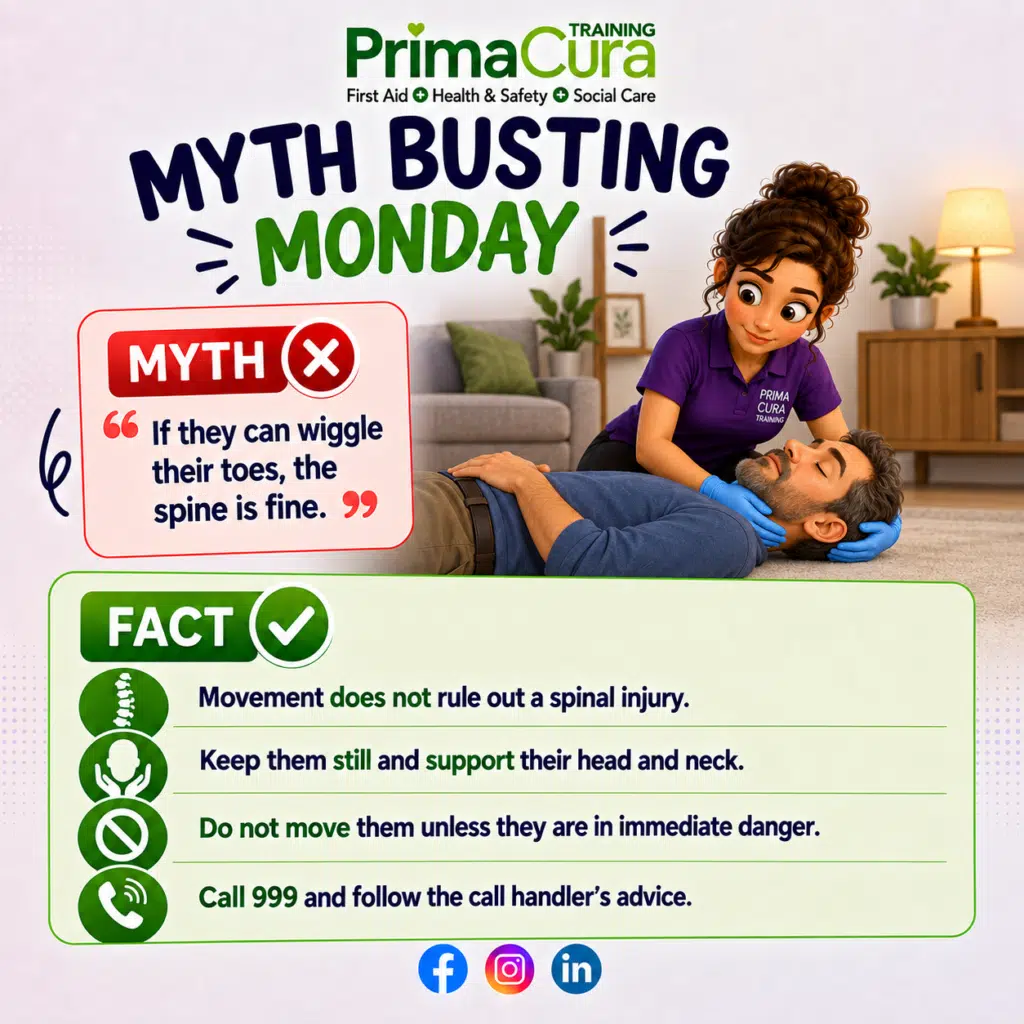
| MYTH | “If they can wiggle their toes, the spine is fine.” It sounds like a test, so people use it as one. |
| FACT | Movement does not rule out a spinal injury. The bones of the spine can be broken while the spinal cord is completely undamaged, so movement and sensation stay normal. An incomplete spinal cord injury can also leave some movement below the level of injury. Call 999, keep them still, and do not move them unless they are in immediate danger. |
Someone has gone down the last few stairs. They’re on the floor at the bottom, awake, talking, more embarrassed than anything, with a small circle of people around them.
Then somebody says it. “Can you wiggle your toes for me?”
They can. Everybody relaxes. Two people take an arm each and walk them over to a chair, and if harm is going to be done that day, that is the moment it happens.
It’s one of the most confidently repeated lines in first aid. It’s also wrong in a way that matters, because it gives people permission to do the one thing they shouldn’t.
Where did the toe wiggle test come from?
Television has a lot to answer for. So does the fact that it looks like a real test, and it half is.
A paramedic arriving at that scene genuinely will ask about movement and sensation. NICE guideline NG41 tells clinicians assessing someone at the scene to check whether the person has spinal pain, hand or foot weakness, and altered or absent sensation in the hands or feet. Movement is on the list.
But it’s one line on a checklist, not the checklist. And it only works in one direction.
If somebody can’t move their feet, that’s a serious finding and it changes everything. If they can, it rules nothing out. A test that gives you real information only when the answer is bad gets treated as an all clear when the answer is good, and that’s the exact point where this myth does its damage.
How can somebody break their neck and still move everything?
Two different ways. They’re worth separating, because they arrive at the same wrong conclusion by completely different routes.
The bones can be damaged while the cord is untouched. The spinal column is the stack of vertebrae, the discs between them and the ligaments holding the whole thing together. The spinal cord is the bundle of nerves threaded through the middle. They’re two different structures, and University Hospitals Sussex NHS Foundation Trust puts it plainly: “it is possible to have significant spinal injury without spinal cord injury.”
Break the column and leave the cord alone and everything still works. Full power, normal sensation, toes wiggling beautifully. If that injury is unstable, what’s missing is the structure keeping the broken bone away from the cord, and the thing most likely to close that gap is movement. Standing up. Being helped into a chair. Being rolled by two colleagues who are trying to help.
Or the cord can be damaged and still partly working. The South West Spinal Cord Injury Network describes an incomplete injury as one where “there is some movement and/or sensation below the level of injury, though still not normal function”. Some signals get past the damaged section and some don’t. So a person with a genuine spinal cord injury can move their feet, and the picture can change over the following hours as swelling develops.
Neither of these is rare or exotic. Both of them look, from a foot away, exactly like somebody who is fine.

What do the guidelines actually tell you to look for?
What happened to them. Not what they can do afterwards.
The 2025 Resuscitation Council UK first aid guidelines put it like this: “Suspect a cervical spine injury in a person who fell or dived from a height, was crushed by machinery or a heavy object or was involved in a road traffic or a sporting accident.”
There isn’t a word in that sentence about what the casualty can move. It’s entirely about mechanism.
NICE does the same thing for clinicians, listing the mechanisms that count as dangerous for the neck: a fall from more than one metre or five steps, an axial load to the head such as a dive, a high speed road traffic collision, a rollover, being thrown from a vehicle, and accidents involving motorised recreational vehicles, bicycles or horses. For the mid and lower back it’s a fall from more than three metres or an axial load to the base of the spine.
Read that first list again if you work in care, in a school or in a warehouse. “More than one metre” and “more than five steps” between them cover an enormous amount of what actually happens on an ordinary Tuesday.
Which signs actually matter?
These are the ones worth knowing, and any single one of them is enough to treat the situation as a spinal injury:
- Pain in the neck or back, or tenderness over the spine
- Weakness in the hands or feet
- Numbness, tingling or pins and needles, or a patch where sensation has changed or disappeared
- Loss of bladder or bowel control
- Difficulty breathing
- A head injury, reduced consciousness or confusion
- The head or neck held at an odd angle, or an obvious deformity
Now the awkward part. NICE also flags the things that stop a person reporting their own symptoms reliably: significant distracting injuries, drink or drugs, confusion and reduced consciousness. Someone with a badly broken wrist may not register that their neck hurts. Someone who has had a few may not register much at all.
So the rule reads in one direction only. Any of those signs is a reason to suspect a spinal injury. None of them is not a reason to rule one out.
What should you do instead?
Call 999, and lead with what happened. The mechanism is the single most useful thing you can give the call handler. “She fell down eight stairs” is worth more than “she says she’s fine”.
If they’re awake and alert, encourage them to keep their own head and neck still. This part has changed, so it’s worth reading twice. The 2025 guidance is to have a responsive casualty self-maintain their neck in a position that is comfortable and stable for them, rather than for you to take hold of their head. And never force an uncooperative person into any position, because that can make the injury worse.
If they’re unresponsive and lying on their back, kneel behind their head and hold their head and neck in a neutral in-line position using the head or trapezius squeeze.
If they’re unresponsive and lying face down, check the airway is open and hold the neck in a stable position. If you need to open the airway, get others to help you roll them as a single unit onto their back, keeping the neck in line with the body.
Don’t move them unless they’re in immediate danger. Fire, traffic, water, a collapsing structure. Those are the reasons. Being on a cold floor is not one.
Keep talking to them. Reassurance keeps a frightened person still far more reliably than a pair of hands does, and it buys you the information the ambulance crew will want.

Does the airway come before the spine?
Always, and the guidelines say so in as many words: “Airway opening, if required, always has priority over in-line immobilisation; using a jaw thrust manoeuvre should maintain a neutral position of the neck.”
A beautifully protected spine in somebody who isn’t breathing is no use to anyone.
If they’re not breathing normally, start CPR. Yes, with a suspected spinal injury. Cardiac arrest kills in minutes and a possible fracture doesn’t change that arithmetic. Hesitating over a neck injury while someone’s heart has stopped is the same mistake as hesitating over a lawsuit, which is where this series started back in Can You Be Sued for Giving First Aid?
Should you put them in the recovery position?
Not after trauma. The 2025 guidelines are direct about it: “In cases of agonal breathing or trauma, do NOT move the person into the recovery position.”
So an unresponsive casualty who is breathing normally after a fall from height or a road traffic collision isn’t rolled onto their side as a matter of routine. Hold the neck stable, keep the airway open, stay with them and watch the breathing continuously, and tell the call handler exactly what you have.
If the airway is genuinely at risk and moving them is the only way to protect it, move them. Breathing beats everything. But it’s a decision you make for a reason, not a default.
What if they get up and walk it off?
Walking is not evidence of a stable spine. It’s evidence that the cord is still working, which, as above, is a different question entirely.
On a rugby pitch, a building site or a care home corridor, the person who has just gone down very often wants to be fine and will get to their feet to prove it before anybody has assessed anything. Adrenaline is generous like that for about twenty minutes. If the mechanism fits, being upright doesn’t undo it. Sit them down, keep them still, and get them looked at properly.
Care settings carry an extra problem. After an unwitnessed fall you don’t know the mechanism, which means you can’t rule out the dangerous version of it. “We found her on the floor” has to be treated as a fall from an unknown height until somebody qualified says otherwise, and that includes resisting the very strong urge to get her up off the floor before the ambulance arrives.
At work there’s a paperwork tail to this as well. Under RIDDOR, all fractures other than to fingers, thumbs and toes are specified injuries and must be reported, as is loss of consciousness caused by a head injury. A spinal fracture at work is a reportable incident, so how the response was handled will be looked at after the fact.
How common is this, really?
The Spinal Injuries Association puts the figure at 4,700 people injured or diagnosed with a spinal cord injury in the UK every year. Not a number to frighten anybody with, but worth knowing, because “spinal injury” gets filed mentally alongside motorway pile-ups and diving accidents when plenty of it arrives through ordinary falls in ordinary buildings.
Frequently asked questions
What should you do if you think someone has a spinal injury?
Call 999 and tell the call handler what happened, not just what you can see. Keep the person still where they are, encourage them to keep their own head and neck still if they are awake and alert, and do not move them unless they are in immediate danger. Keep watching their breathing and follow the call handler’s instructions.
Should a first aider put a neck collar on someone?
No. The 2025 Resuscitation Council UK first aid guidelines state that responders with specialised training, such as lifeguards or mountain rescue, may consider the selective use of spinal motion restriction devices and collars under their existing protocols. That is not a lay first aider or a standard workplace first aid role.
Do you still do CPR if you think someone has a spinal injury?
Yes. If a person is unresponsive and not breathing normally, start CPR straight away. Resuscitation Council UK guidance is that airway opening always takes priority over in-line immobilisation, and cardiac arrest is fatal within minutes whether or not there is a spinal injury.
What are the signs of a spinal injury?
Spinal pain or tenderness, weakness in the hands or feet, altered or absent sensation such as numbness or pins and needles, loss of bladder or bowel control, difficulty breathing, and any head injury, confusion or reduced consciousness. Distracting injuries, alcohol and drugs can all mask these signs, so the mechanism of injury matters more than the symptoms.
Training that gets this right on the day
The reason this myth survives is that nobody ever corrects it. It gets repeated on courses that skim the subject, passed between colleagues, and reinforced every time somebody gets away with it.
Ten minutes of proper teaching fixes it for good, and the 2025 changes to what a first aider does with a responsive casualty’s neck are worth hearing from somebody who has actually read the guidelines rather than picked it up second hand.
Emergency First Aid at Work (EFAW) is the one most workplaces need for a designated first aider, and higher risk sites usually need the three day First Aid at Work qualification instead. Schools should look at Emergency First Aid for Schools, and anyone working with young children needs Emergency Paediatric First Aid or the two day Paediatric and Early Years First Aid for Ofsted compliance. For a small team who just want the practical basics, Basic First Aid covers it.
If you work in care, two others are worth putting next to your first aid training. Fall Prevention Awareness deals with stopping the fall in the first place, and Moving and Positioning of People covers what safe handling looks like and, just as usefully, when not to handle somebody at all.
Not sure what your organisation needs? Our Workplace First Aid UK Guide walks through needs assessments and qualification levels. Give us a call on 0333 999 8783 or drop us a message and we’ll help you work it out.
THE VERDICT: BUSTED
Wiggling toes tell you the cord is working right now. They tell you nothing about the bones holding it in place. Call 999, keep them still, and let somebody with an X-ray machine decide whether the spine is fine.
This article is provided for general information and awareness only and reflects Resuscitation Council UK, NICE and NHS guidance applying in England as at October 2026. It does not constitute medical advice, and it is not a substitute for accredited, hands-on first aid training. Guidance can change, and how it applies depends on the individual and the circumstances of the injury. Any suspected spinal injury needs urgent medical assessment. In an emergency, always call 999.