Care Certificate Standard 13: Health and Safety
Written by Stephanie Austin — Owner & Lead Trainer, Prima Cura Training
Last reviewed: June 2026 | Next review: June 2027
Health and safety rarely feels like the most engaging part of induction training.
It tends to sit in the background of care practice, surrounded by policies, procedures, risk assessments and documentation. Compared with topics like safeguarding or person-centred care, it can sometimes feel administrative rather than meaningful.
Yet anyone who has worked in health and social care for any length of time will recognise something important: when health and safety standards slip, the consequences rarely stay small.
This article is part of the wider Care Certificate Standards Explained series, in which each standard is explored in practical terms for care workers, supervisors, and assessors across health and social care settings.
Care Certificate Standard 13 exists because safe care does not happen by chance. It happens because workers understand risk, recognise hazards and follow agreed ways of working even when nobody is watching.
Within the 2025 Care Certificate framework, this standard reinforces a simple but vital message: health and safety is everyone’s responsibility.
It does not sit solely with managers. It does not belong only to supervisors or health and safety leads. Every worker contributes to the safety of the environment in which they work.
What Care Certificate Standard 13 Actually Requires
Care Certificate Standard 13 focuses on helping workers understand the principles that underpin safe practice within care environments.
Learners are expected to understand:
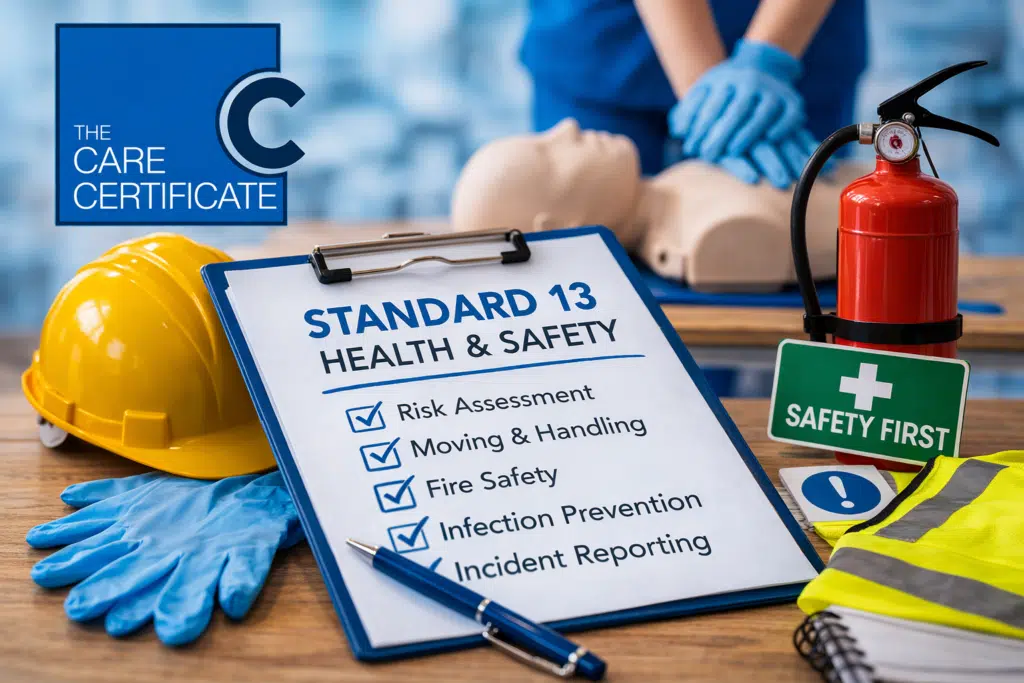
- Their responsibilities under the Health and Safety law
- The purpose and importance of risk assessment
- Safe moving and positioning practice
- Fire safety procedures and emergency response
- Safe use of equipment and work environments
- Infection prevention and control
- Accident and incident reporting
Health and safety sit quietly underneath almost everything that happens in care settings. It influences how people are supported physically. How equipment is used. How environments are maintained. How hazards are reported. How incidents are documented.
When health and safety systems are working well, they often become almost invisible. In many ways, that invisibility is a sign that safe practice has become embedded in everyday working routines.
The Legal and Regulatory Context
Health and safety within health and social care is supported by a number of key pieces of UK legislation.
These include:
- Health and Safety at Work etc. Act 1974
- Management of Health and Safety at Work Regulations
- Manual Handling Operations Regulations
- Regulatory Reform (Fire Safety) Order
- RIDDOR – Reporting of Injuries, Diseases and Dangerous Occurrences Regulations
Within regulated care services, these responsibilities sit alongside the Health and Social Care Act 2008 (Regulated Activities) Regulations.
For organisations inspected by the Care Quality Commission (CQC), failures in health and safety may raise regulatory concerns linked to:
In practical terms, this means that ignoring hazards, misusing equipment, or failing to report incidents properly may move beyond internal policy breaches and become regulatory compliance issues.
Care Certificate Standard 13 introduces these expectations early in induction so that accountability becomes part of everyday care practice.
Shared Responsibility: Not Just a Management Function
In some workplaces, there can be an assumption that health and safety belong mainly to management. Policies sit in folders. Risk assessments are written by supervisors. Audits are carried out periodically.
However, Standard 13 reinforces something important: workers themselves also carry direct responsibility for safe practice. This includes:
- Following agreed ways of working
- Using equipment correctly
- Wearing appropriate personal protective equipment
- Reporting hazards promptly
- Avoiding unsafe shortcuts
- Escalating concerns when something does not feel safe
Health and safety risks rarely start out looking dramatic. Most of the time, they show up as small things that seem easy to overlook at the time: a wet floor that hasn’t been cleaned up yet, a hoist being used without the usual checks, or someone carrying out a task they haven’t been properly trained to do. On their own, they might not seem like much, but situations like these are often where larger problems begin.
Standard 13 focuses on building awareness so workers recognise these situations early and respond appropriately.
Risk Assessment: Structured Thinking, Not Just Forms
Risk assessments are sometimes misunderstood as documents that simply need to be completed. In reality, they represent a structured way of thinking about safety. They encourage workers to consider questions such as:
- What could go wrong here?
- Who might be harmed?
- What measures are already in place to reduce risk?
- What additional precautions might be needed?
Good risk assessment practice involves recognising potential hazards before harm occurs.
When assessing Standard 13, the goal is not to see whether someone can recite template headings. Instead, it is about understanding whether they appreciate why risk assessment exists and how it influences everyday decisions.
Safe care is proactive rather than reactive.
Moving and Positioning: Where Shortcuts Cause Harm
Manual handling and people moving & positioning remain one of the most common causes of injury in health and social care. The pattern is often familiar. It rarely begins with a lack of knowledge.
More often, it begins with pressure, time constraints or the belief that something will “only take a moment”. Care Certificate Standard 13 expects workers to understand:
- Why moving and positioning plans must be followed
- The importance of using appropriate equipment
- When assistance should be requested
- The risks to both staff and individuals receiving care
Safe moving and handling protects everyone involved.
In many services, these principles are reinforced through training such as Moving and Handling Training delivered alongside Care Certificate learning.
Fire Safety and Emergency Awareness
Fire safety forms an important part of Standard 13 because emergency response requires clarity and confidence. Workers should understand:
- The location of alarms and extinguishers
- Evacuation routes and assembly points
- Their role during evacuation procedures
- The importance of keeping exits clear
- Why regular fire drills matter
During emergencies, people rarely perform well if procedures are unfamiliar. Training and rehearsal improve confidence and response.
Many organisations reinforce these principles through courses such as Fire Safety Training or Fire Marshal Training.
Infection Prevention and Control
Health and safety also includes protecting individuals from infection risks. Workers should understand:
- Effective hand hygiene
- Appropriate use of PPE
- Safe disposal of clinical waste
- Environmental cleaning procedures
- How infection spreads
Infection prevention links closely with other Care Certificate topics, including Care Certificate Standard 15 – Infection Prevention and Control and Care Certificate Standard 7 – Privacy and Dignity, where protecting individuals from avoidable harm forms part of safe care practice.
Accident and Incident Reporting
One of the most underestimated parts of Standard 13 is incident reporting. Workers should understand:
- Why accidents and near misses must be reported
- Recording factual and objective information
- Informing the appropriate person promptly
- Escalating serious incidents appropriately
Incident reporting is not about assigning blame. It is about learning and prevention. Services that fail to record near misses often repeat them.
Clear documentation also supports expectations linked to Good Governance regulations overseen by the Care Quality Commission.
What a Robust Standard 13 Assessment Should Include
A meaningful assessment for Care Certificate Standard 13 should explore more than theoretical knowledge. It should consider:
- Awareness of shared responsibility
- Scenario-based risk awareness
- Knowledge of escalation procedures
- Understanding of documentation processes
- Reflection on real workplace situations
For example, if a learner is asked: “What would you do if you noticed a colleague taking a health and safety shortcut?” You are listening for professional judgement, awareness and willingness to escalate concerns appropriately.
Observation also plays an important role. How someone uses equipment, checks surroundings, or documents incidents often reveals far more than written answers alone.
Where Services Sometimes Drift
Health and safety rarely collapse suddenly. More often, it erodes gradually when:
- Risk assessments are copied without review
- Equipment checks become rushed
- Incident reporting is delayed
- Shortcuts become normalised
- Near misses are not discussed
Over time, these small compromises accumulate. Care Certificate Standard 13 exists to prevent that slow erosion of safe practice.
Why Standard 13 Matters
When health and safety awareness is strong:
- Workplace injuries reduce
- Hazards are identified earlier
- Staff confidence increases
- Regulatory compliance improves
- Individuals receiving care remain protected
When awareness weakens, risk grows quietly. Care Certificate Standard 13 may not appear dramatic or complex, but it forms part of the foundation that safe care services depend on every day.
Frequently Asked Questions
Is Standard 13 just about following policies?
No. It focuses on understanding why safety procedures exist and applying them consistently in everyday practice.
Does Standard 13 require observation?
Yes. Observing safe working practice, hazard awareness, and documentation processes provides strong assessment evidence.
How does Standard 13 relate to regulation?
Health and safety failures can engage regulatory expectations linked to Safe Care and Treatment and Good Governance overseen by the Care Quality Commission.
Final Reflection on Standard 13
Care Certificate Standard 13 does not require complex theory. What it requires is awareness, consistency and accountability.
If you are reviewing your Care Certificate framework, it may be worth asking:
- Are staff confident in recognising risk?
- Do they escalate safety concerns appropriately?
- Are unsafe shortcuts challenged?
- Is the documentation clear and accurate?
Health and safety protect workers, protect individuals receiving care and supports safe, compliant services.
That is why it sits where it does within the Care Certificate framework.
This article is provided for educational guidance and workforce development purposes. It does not replace organisational health and safety policies, formal risk assessments or legal advice. Employers and training providers should ensure their procedures remain aligned with current UK legislation, regulatory expectations and guidance from bodies such as the Health and Safety Executive and the Care Quality Commission (CQC).