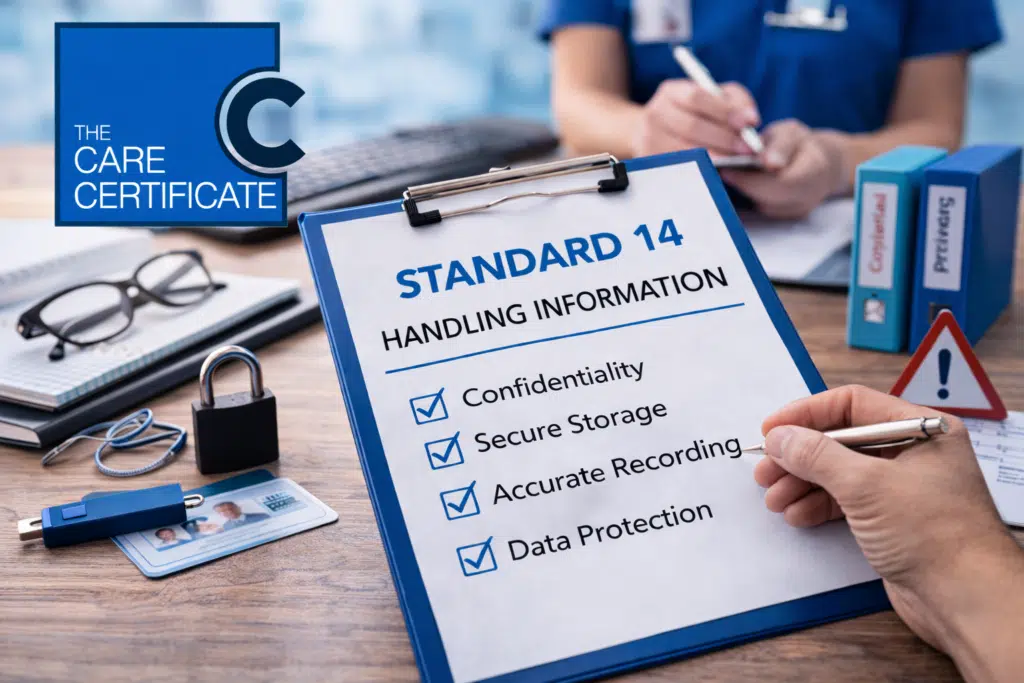
Care Certificate Standard 14: Handling Information
Written by Stephanie Austin — Owner & Lead Trainer, Prima Cura Training
Last reviewed: June 2026 | Next review: June 2027
Information in health and social care carries a degree of responsibility that is not always obvious at first glance.
Handled properly, it supports safe care, helps teams communicate clearly and protects the people receiving support. Handled poorly, even unintentionally, it can undermine trust very quickly and, in some cases, place individuals at risk.
Care Certificate Standard 14 ensures that new care workers understand how to handle information lawfully, securely, and with professional judgement. Within the 2025 Care Certificate framework, this standard reinforces that confidentiality, accurate record keeping and data protection are not optional extras. They are part of safe, accountable care.
And in a sector that increasingly relies on digital systems as well as traditional records, that responsibility continues to grow.
This article forms part of the wider Care Certificate Standards Explained series, where each standard is explored in practical terms for care workers, supervisors and assessors.
What Care Certificate Standard 14 Actually Requires
Care Certificate Standard 14 focuses on how information is handled in everyday care practice, rather than legal theory alone. Workers are expected to understand:
- The importance of confidentiality
- How to store and share information securely
- The difference between factual recording and opinion
- Core data protection principles
- When information can be shared
- When it must not be shared
- The importance of accurate, timely documentation
This is not about turning care workers into legal specialists.
It is about ensuring they understand enough to protect the people they support, themselves and the organisation they work for.
The Legal and Regulatory Framework
Handling information in health and social care is supported by a number of key legal and regulatory frameworks. These include:
- UK General Data Protection Regulation (UK GDPR)
- Data Protection Act 2018
- Health and Social Care Act 2008 (Regulated Activities) Regulations
- Regulation 17 – Good Governance
- Safeguarding responsibilities outlined within the Care Act 2014
For organisations regulated by the Care Quality Commission, how information is recorded, stored and shared may be reviewed during inspection activity.
Poor documentation, insecure handling of information or inappropriate disclosure can quickly become regulatory concerns rather than minor administrative issues.
Care Certificate Standard 14 introduces these expectations during induction so that professional standards are clear from the outset.
Confidentiality: More Than Avoiding Obvious Breaches
Most people understand that sharing personal information casually is inappropriate. However, confidentiality in care goes beyond avoiding obvious breaches such as gossip. It includes everyday behaviours such as:
- Avoiding discussions about individuals in public or shared spaces
- Logging out of electronic systems properly
- Keeping paper records secure
- Verifying identity before sharing information
- Avoiding unnecessary disclosure
- Ensuring screens are not visible to unauthorised individuals
Information belongs to the individual.
Care workers are responsible for handling that information appropriately, not for owning or controlling it.
Even well-meaning conversations can become confidentiality breaches if they are not handled carefully.
This also connects closely to the principles explored in Privacy and Dignity, where respecting personal boundaries and protecting sensitive information form a key part of safe, person-centred care.
Recording: Factual, Objective and Timely
Documentation is one of the clearest indicators of professional practice. A well-written record should be:
- Accurate
- Objective
- Clear
- Timely
- Relevant
One of the most important distinctions within Standard 14 is the difference between observation and opinion. For example:
“Mrs Patel appeared tearful and stated she felt anxious”
is very different from
“Mrs Patel is depressed.”
The first reflects observation and reported information. The second introduces interpretation.
Care Certificate Standard 14 expects workers to understand this difference, as it directly affects safeguarding, communication and governance.
Accurate documentation protects the individual, supports continuity of care and strengthens accountability. In practice, this is a skill that develops over time, particularly when staff are given the opportunity to explore real examples and common pitfalls. Many organisations support this through more focused learning, such as Reporting and Recording Training, which helps staff understand how to document information confidently and professionally.
Sharing Information: Balancing Confidentiality and Safety
One of the most common areas of uncertainty is knowing when information can, or should, be shared.
The general principle is that information should be shared on a need-to-know basis, in line with organisational policy and professional guidance.
However, there are situations where sharing information is necessary, particularly in relation to safeguarding. Confidentiality does not override safety.
If there is a risk of harm, information may need to be shared appropriately with safeguarding leads or relevant professionals, even where consent has not been obtained.
This is why Standard 14 links closely with Care Certificate Standard 10 – Safeguarding Adults and Care Certificate Standard 11 – Safeguarding Children, where understanding when to escalate concerns is central to safe practice.
Digital Security and Modern Practice
Handling information in health and social care now includes a strong digital element.
Workers are expected to understand:
- The importance of strong, confidential passwords
- Avoiding shared logins
- Not accessing records on unsecured personal devices
- Being cautious with emails and attachments
- Recognising potential phishing or cybersecurity risks
- Following organisational IT and data protection policies
Information security is no longer limited to locked filing cabinets. Digital systems bring new risks as well as new efficiencies. Care Certificate Standard 14 reflects this shift and reinforces that digital awareness is now part of safe, professional practice.
Incident Reporting and Governance
Handling information also connects directly to governance and accountability. Workers should understand:
- When a data breach or confidentiality concern must be reported
- The importance of prompt escalation
- Recording incidents clearly and factually
- Following organisational reporting procedures
Clear reporting supports expectations linked to Good Governance regulations and helps prevent repeated issues.
In many cases, it is not the initial mistake that creates the biggest risk, but the failure to recognise and report it appropriately.
What a Robust Standard 14 Assessment Should Include
A meaningful assessment for Care Certificate Standard 14 should move beyond simple definitions.
It should explore:
- Scenario-based discussions around confidentiality
- Understanding of secure storage
- Awareness of escalation pathways
- Ability to distinguish fact from opinion
- Knowledge of when safeguarding responsibilities override confidentiality
For example, if a learner is asked:
“What would you do if a family member asked for information you were unsure about sharing?”
You are listening for reference to policy, escalation and professional judgement, rather than guesswork.
Reviewing documentation and observing how information is handled in practice can also provide valuable assessment evidence.
Where Services Sometimes Drift
Handling information rarely fails in a single obvious moment. It tends to weaken gradually when:
- Records are completed late or rushed
- Language becomes informal or subjective
- Confidential conversations take place in shared spaces
- Passwords are shared casually
- Digital security practices become inconsistent
Over time, these small compromises can become normalised.
Care Certificate Standard 14 reinforces that consistency protects both individuals and organisations.
Why Standard 14 Matters
Trust in health and social care is closely linked to how information is handled. When individuals feel confident that their information is:
- Protected
- Recorded accurately
- Shared appropriately
- Stored securely
They are more likely to engage openly with care and support.
When confidentiality is breached or documentation is poor, that trust can be damaged quickly.
Care Certificate Standard 14 supports dignity, safety and governance at the same time.
Frequently Asked Questions
Is Care Certificate Standard 14 mainly about GDPR?
It includes awareness of UK GDPR and data protection principles, but the focus is on how information is handled in everyday care settings.
Does Standard 14 require observation?
Yes. Reviewing documentation and observing how information is handled in practice provides strong assessment evidence.
Can confidentiality ever be overridden?
In certain situations, particularly safeguarding concerns, information may need to be shared appropriately in line with organisational procedures.
Final Reflection on Standard 14
Care Certificate Standard 14 does not require complex legal knowledge. What it requires is clarity, consistency and professional judgement.
If you are reviewing your Care Certificate framework, it is worth asking:
Are records factual and completed promptly?
Do staff understand secure storage?
Are escalation pathways clear?
Is digital security reinforced consistently?
Handling information well protects individuals, protects staff and supports safe, accountable services.
This article is provided for educational and training purposes only and does not replace organisational data protection policies or legal advice. Providers should ensure their practices remain aligned with current legislation, including UK GDPR, the Data Protection Act 2018, and regulatory expectations overseen by the Care Quality Commission.