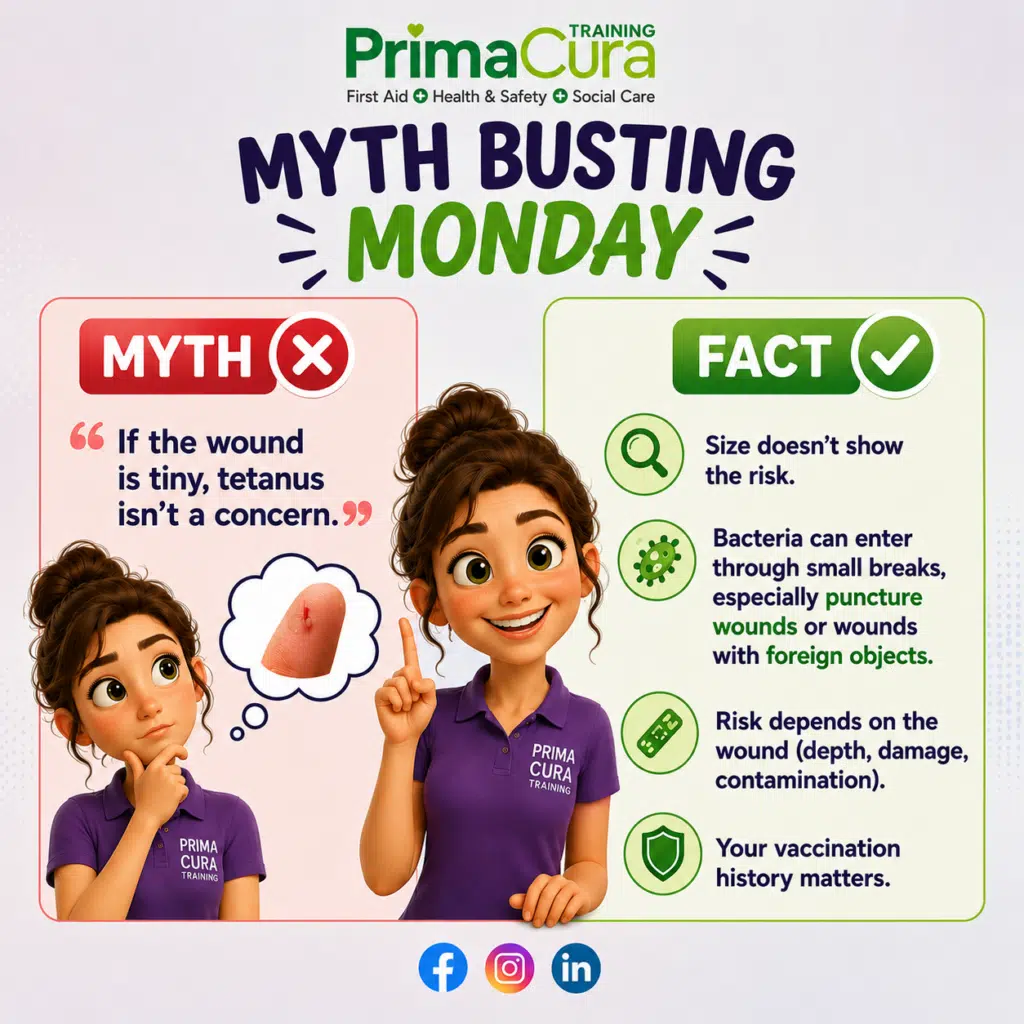
Myth Busting Monday: Is Tetanus Really a Risk From a Tiny Wound?
Written by Stephanie Austin, Owner and Lead Trainer, Prima Cura Training | Last reviewed: September 2026 | Next review: September 2027
| MYTH | “If the wound is tiny, tetanus isn’t a concern.” |
| FACT | Size doesn’t show the risk. Tetanus bacteria live in soil, dust and manure, and they can enter through small breaks in the skin. Puncture wounds and wounds containing foreign objects are the ones UKHSA specifically names as tetanus-prone, and both of those tend to look small on the surface. What matters is the depth, the damage and the contamination, not the length of the cut. Your vaccination history matters too, and in the UK that is a question about whether your course is complete rather than whether you have had one in the last ten years. |
Earlier this year my step-dad Bob got scratched by his cat.
It was nothing much to look at. The skin broke, and it bled a little, the sort of thing most of us would run under the tap, stick a plaster on and forget about by teatime.
Bob went to minor injuries and had it professionally cleaned, and while he was there he had his tetanus updated, because his cover was out of date. The staff told him he had been sensible to get both done.
Bob is one of our associate trainers. He teaches this for a living, which is exactly why he went. It is one thing to stand at the front of a room telling other people what a tetanus-prone wound looks like. It is another to apply it to your own thumb on a Tuesday afternoon when you feel a bit daft going.
Most myth-busting posts run on somebody getting it wrong. This one runs on somebody getting it right, quietly, over a scratch, and that is a better thing to copy.
The box above is the short version. The rest of this post is why size is the wrong thing to judge by, what actually raises the risk, and how tetanus protection works in the UK, which is not what most of the internet will tell you.
Where does this myth come from?
Mostly from a mental shortcut that works nearly everywhere else. Big injury, big problem. Small injury, small problem. It is a reasonable rule for bleeding, for pain, for broken bones, for almost everything a person meets in ordinary life. It just happens to fail here.
It is also propped up by how rare tetanus is in this country. Very few people have met anybody who has had it, so there is no story attached to it, no face, nothing to make it feel real. Rarity is a strange thing in health information, because it makes people careless in exactly the situations where the vaccination programme they are relying on is the only reason it stayed rare.
And there is the rusty nail. Almost everyone has absorbed the idea that tetanus comes from stepping on one, which quietly rules out every wound that did not involve a rusty nail. More on that shortly, because it is wrong in an interesting way.
Why is size the wrong question?
Because the bacteria that cause tetanus need conditions rather than space.
Clostridium tetani lives as spores in soil, dust and manure. Those spores are tough; they survive in the environment for years, and tetanus can never be eradicated because of it. But the spores only become a problem when they germinate, and to do that they need somewhere with very little oxygen.
Which is where the size logic falls apart. A wide, shallow, gaping cut is open to the air. A narrow puncture seals over at the surface within minutes and leaves a deep pocket underneath with almost no oxygen in it, carrying whatever was on the object that made it. That is close to ideal for these bacteria, and it is precisely the wound that looks like nothing.
So the small ones are not merely as risky as the big ones. In terms of the conditions that matter, a puncture can be worse than a gash.
The official definitions carry the same logic. UKHSA define a clean wound as one that is less than six hours old, non-penetrating, and with negligible tissue damage. Every word there is about depth, time and damage. Not one of them is about size.
Why a small puncture wound can be a better environment for tetanus bacteria than a large open cut.
What actually counts as a tetanus-prone wound?
UKHSA publish a list of tetanus-prone wounds for clinicians, and it is worth seeing because none of the entries mentions how big anything is.
- Puncture-type injuries picked up in a contaminated environment, where tetanus spores are likely, such as gardening injuries
- Wounds containing foreign bodies
- Compound fractures
- Wounds or burns with systemic sepsis
- Certain animal bites and scratches
A smaller group are classed as high-risk: any of the above plus heavy contamination with something likely to contain tetanus spores such as soil or manure, or extensive dead tissue, or a wound needing surgery that gets delayed beyond six hours.
Two of those entries are worth pausing on.
Wounds containing foreign bodies is the same category we covered last time, when the answer to a piece of glass in your foot was to leave it in and get it seen. This is the other half of that argument. It is not only about the bleeding: an object sitting in a wound is one of the things that makes it tetanus-prone. If you want the bleeding side of it, that is in the previous post.
Animal bites and scratches carry a caveat that most articles miss. UKHSA note that although smaller bites from domestic pets are usually puncture injuries, animal saliva should not contain tetanus spores unless the animal has been rooting in soil or lives on a farm. So an indoor cat and a cat that spends its afternoons in the flowerbeds are not quite the same proposition. Bob had no way of knowing that his cat had not been in the garden, and either way his own cover was out of date, which settled it.
Isn’t it the rust that causes tetanus?
No, and this one is worth dismantling properly because it does real harm.
Rust does not cause tetanus. The bacteria do, and NHS guidance is clear about where they come from: there is a risk of tetanus if soil or manure containing the bacteria gets into a wound, whether that is a bite, a burn or a scratch.
The reason rusty nails got the blame is circumstantial. Rusty things tend to be old things that have been lying outside, in exactly the soil where the spores are. The rust is a sign the object has been sitting in the environment, not the thing that hurts you. A clean, shiny nail that has been lying in a field will do the job perfectly well, and so will a rose thorn, a splinter off a fence post or a fork you were digging with.
The harm in the myth is the mental filing it does. Somebody scratches themselves in the garden on something that is not rusty and not a nail, concludes that tetanus is not on the table, and never asks the question. The wound that put them at risk was the one they dismissed.
How does tetanus protection actually work in the UK?
Here is where most of the internet will mislead you, because most of the internet is American.
You will very often read that you need a tetanus booster every ten years. That is the routine in some countries. It is not how the UK schedule works.
In the UK, the full course is five doses of a tetanus-containing vaccine, given across the childhood and teenage immunisation programme. Once that course is complete, it is considered to give long-term protection, and for most people that means lifelong. There is no routine ten-year top-up for people living in the UK.
Two important exceptions sit around that.
- If you are travelling somewhere that treatment for a tetanus-prone wound might not be readily available, a further dose is recommended if it has been at least ten years since your last one. This is about where you will be when you get injured, not about your protection wearing off at home
- Routine tetanus immunisation only began in the UK in 1961. Anyone born before then may never have had a full course, and UKHSA treat people born before 1961 the same way as those with uncertain vaccination history
That second point deserves more attention than it gets. A person in their late sixties or seventies doing the gardening is in the group most likely to be both unprotected and doing the exact activity that carries the risk.
So when do you actually need a jab?
This is a clinical judgement rather than a self-assessment, and that is the useful thing to understand rather than something to be frustrated by.
What a clinician is weighing up, using the UKHSA risk assessment, is two things at once: what kind of wound it is, and where you stand on vaccination. Roughly:
- If your priming course is complete and your last dose was within ten years, no treatment is needed for any wound type
- If your priming course is complete but the last dose was more than ten years ago, a clean wound needs nothing, while a tetanus-prone wound gets a reinforcing dose, and a high-risk one gets that plus an injection of tetanus immunoglobulin
- If your course was never completed, or your history is uncertain, or you were born before 1961, a reinforcing dose is given even for a clean wound, with immunoglobulin added for tetanus-prone and high-risk wounds
The practical version for the rest of us is much simpler. If a wound is a puncture, has something in it, happened in soil or muck, or came from an animal, and you are not certain your vaccinations were completed, that is a conversation to have with a professional rather than a decision to make over the kitchen sink.
Getting it checked and being told you are fine costs you an hour. The other way round costs considerably more.
How wound type and vaccination history combine to decide whether a tetanus jab is needed.
What Bob actually got right
Three things, and none of them were dramatic.
He treated a small wound as a question rather than an answer. He did not decide for himself that a scratch was too minor to matter, which is the exact judgement this myth encourages.
He got it cleaned properly. Thorough cleaning of a wound is the first thing UKHSA say about managing tetanus-prone injuries, before any discussion of vaccines or immunoglobulin at all. NHS guidance also notes that you may need an injection to protect against tetanus when a wound is assessed, which is another reason to let somebody look at it rather than deciding yourself that it came out clean.
And he did not assume his vaccination history was fine. Most people genuinely do not know. If you have never checked, your GP surgery holds it, and it is a reasonable thing to ask about before you are standing in a minor injuries unit trying to remember a jab you might have had as a teenager.
That is not heroism. It is somebody applying to himself the thing he would tell a room full of learners to do, on a day when it would have been easier not to bother.
Frequently asked questions
Do you need a tetanus jab for every cut?
No. A clean wound, meaning one that is less than six hours old, non-penetrating and with negligible tissue damage, does not need tetanus treatment if your vaccination course was completed. Treatment is considered for wounds that are tetanus-prone, and for anyone whose course was never completed or whose history is uncertain.
How often do you need a tetanus booster in the UK?
There is no routine ten-year booster in the UK. The full UK course is five doses of a tetanus-containing vaccine given through the childhood and teenage immunisation programme, and completing it is considered to give long-term protection. A further dose is recommended before travel to places where treatment for a tetanus-prone wound may not be readily available if it has been at least ten years since your last dose.
Is it the rust on a nail that causes tetanus?
No. Tetanus is caused by Clostridium tetani bacteria, which live as spores in soil, dust and manure. Rusty objects are associated with tetanus because they have usually been lying outdoors where those spores are, not because rust itself is harmful. A clean object that has been in soil carries the same risk, as do gardening injuries, thorns and splinters.
How do I check whether my tetanus vaccination is up to date?
Your GP surgery holds your vaccination record, and NHS guidance is to check with them if you are unsure whether you have been fully vaccinated. This is worth doing before you need it, particularly if you were born before 1961, when routine tetanus immunisation began in the UK, or if you spent part of your childhood outside the UK.
Training that answers this before the emergency does
Wound assessment is one of those parts of a first aid course that sounds unglamorous next to CPR and turns out to be the thing people use most. Knowing which wounds need somebody to look at them, and being able to say why to a colleague or a parent who thinks you are overreacting, is a genuinely useful skill.
Our Emergency First Aid at Work course is the one-day qualification most workplaces need. Higher-risk settings, and anywhere involving outdoor work, soil, animals or machinery, usually need the three-day First Aid at Work qualification. For nurseries, childminders and early years settings, the 2-Day Paediatric and Early Years First Aid course covers the same ground for children, who are reliably the people most likely to fall onto something in a flowerbed.
Give us a call on 0333 999 8783 or drop us a message and we will tell you honestly which one fits.
THE VERDICT: BUSTED
Tetanus does not care how impressive your injury looks. It cares whether the spores got in and whether they found somewhere with no oxygen to grow, and a scratch or a puncture will do that as readily as anything worse. Bob went to minor injuries over a cat scratch and felt slightly silly doing it. That is the correct amount of silly.
This article is provided for general information and awareness only and reflects NHS guidance and UK Health Security Agency guidance on the management of tetanus-prone wounds as they stood in September 2026. It does not constitute medical advice, and it is not a substitute for accredited, hands-on first aid training or for individual clinical assessment. Decisions about vaccination and wound treatment are made by a healthcare professional based on the specific wound and the individual’s vaccination history. If you are unsure about a wound, contact NHS 111 or your GP surgery, and in an emergency call 999.