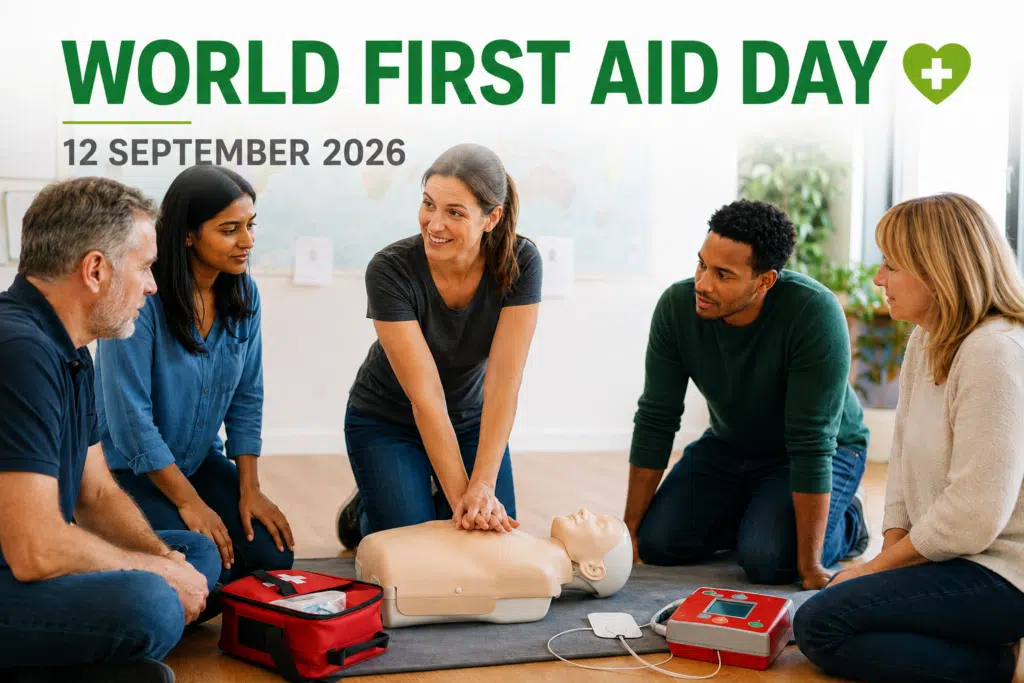
World First Aid Day 2026: They Do Use It, Far More Often Than You Think
Written by Stephanie Austin, Owner & Lead Trainer, Prima Cura Training | Last reviewed: September 2026 | Next review: September 2027
A carpenter called Kieren Robinson messaged his business networking group on a Tuesday in November 2023. A couple of months earlier he’d sat one of my courses. That afternoon he’d used it, in a car park, on a young woman who had stopped breathing. She walked out of the ambulance awake and talking. Thirteen people hit the heart emoji within minutes. I told that story properly in the CPR and AED Awareness Week post, and I still think about it.
Kieren is a carpenter. Not a paramedic, not a first responder. He got trained, he remembered it when it counted, and somebody’s daughter went home.
World First Aid Day 2026 falls on Saturday 12 September.
It is held on the second Saturday of September every year, and was created by the International Federation of Red Cross and Red Crescent Societies to get more ordinary people trained in first aid. The IFRC and its member societies trained more than 12.4 million people in first aid in 2022 alone.
I’ve been training people in first aid for over fifteen years, and working in health and social care for over twenty-five. So this is the day I think about all the ones who came back and told me.
The short version
- World First Aid Day 2026 is Saturday 12 September 2026, the second Saturday of the month.
- UK ambulance services attempt resuscitation on around 43,000 people a year, and around 9.5% of them survive to 30 days in England.
- CPR is the emergency most people picture, but it is not the one first aiders deal with most. Choking, bleeding, fainting, seizures, burns and falls come up far more often.
- Under the Health and Safety (First-Aid) Regulations 1981, employers must provide first aid that is adequate and appropriate for their actual workplace, which is decided by a first aid needs assessment, not by a headcount rule.
- A first aid certificate lasts three years. The HSE recommends annual refresher training in between.

When is World First Aid Day 2026 and what is it for?
World First Aid Day 2026 is Saturday 12 September 2026. It has been marked on the second Saturday of September for over two decades, and the point of it is simple: the person standing closest to an emergency is almost never a professional. It is a colleague, a shopper, a parent, a bloke fitting a kitchen.
Every ambulance service in the country is built on that assumption. The response starts before the crew arrives, or it doesn’t really start at all.
What do trained first aiders actually deal with?
This is the bit that surprises people who book training.
A few years back I delivered Emergency First Aid at Work to the staff working under the G4S contract for the NHS Test and Trace programme. Every member of staff on that contract, most of whom had never done a first aid course in their lives, was working at test sites across the country.
They used it. Not once or twice, but regularly.
Choking. Nosebleeds that wouldn’t stop. People fainting in queues in the heat, in car parks, in marquees. Falls. Diabetic emergencies. The ordinary, unglamorous end of first aid that never makes a training brochure but makes up the overwhelming majority of what actually happens.
And at one site in Greater Manchester, a team saved someone’s life. A person in mental health crisis had come off a low bridge onto a main road. The staff who reached them first had been on my course a few weeks earlier. They managed the scene, they kept that person alive, and they handed over to the ambulance service. I did not train them to do that. I trained them to do the basics properly, and the basics were enough.
I have lost count over the years. Not a formal tally, just a steady trickle of messages and emails and people catching my eye at the start of a refresher going “you’ll never guess what happened.” Care workers. Teachers. Security staff. Site managers. Almost none of it was cardiac arrest.
Why “it’s only useful if someone has a cardiac arrest” is the myth that costs the most
Cardiac arrest is the reason most people book. It deserves to be.
According to the Resuscitation Council UK 2025 Resuscitation Guidelines, NHS ambulance services attempt resuscitation on around 43,000 people in the UK each year. In England, bystanders start CPR in 72.6% of cases, but a defibrillator is used by a bystander in only 9.0%. Overall 30-day survival in England sits at 9.5%.
That gap between 72.6% and 9.0% is the single biggest thing training can shift, and it is why I bang on about defibrillators in every course I run. You do not need to be trained to use one. It talks you through it. I wrote about that in more detail in do you need training to use a defibrillator.
But here is what the cardiac arrest framing does to a workplace: it makes first aid feel like insurance against something rare. So the training gets treated as a box, the certificate goes in a drawer, and nobody thinks about it again for three years.
Meanwhile someone chokes in the staff canteen.
Research carried out by Censuswide for St John Ambulance in July 2024, surveying 1,000 UK adults, found that only around four in ten people would know what to do in a life-threatening emergency. Fifty-nine per cent said they didn’t know or weren’t sure how to deal with severe bleeding. Around a quarter had never learned any first aid at all.
Those are the people standing next to your staff when something happens.
What does the law actually ask employers to do?
There is no magic number of first aiders in UK law, and anyone who tells you there is has not read the regulations.
The Health and Safety (First-Aid) Regulations 1981 require employers to provide “adequate and appropriate” first aid equipment, facilities and personnel. What counts as adequate is decided by a first aid needs assessment, which the HSE says should take account of the nature of the work, the hazards and risks, the size and spread of the workforce, shift patterns, accident history, cover for absence, remoteness from emergency services, and whether members of the public are on site.
Two offices of forty people can legitimately need completely different provision. A print works and an accountancy practice are not the same risk.
The HSE also addresses mental health directly. Its guidance states that “following your employer’s first aid needs assessment, you might decide that it will be beneficial to have personnel trained to identify and understand symptoms and able to support someone who might be experiencing a mental health issue.”
It is not a legal duty to appoint mental health first aiders. It is a legitimate outcome of a properly done needs assessment, and given what that Greater Manchester team walked into, I would not treat it as an optional extra.
Full detail sits in the HSE’s approved code of practice, L74 First aid at work.
To the workplaces who train more people than they have to
I want to say this plainly on World First Aid Day, because these organisations rarely get any credit for it, and I am not going to name them, because they would hate that.
Some of my clients train every single member of staff, not the two the needs assessment technically calls for. Some train the cleaners and the receptionists and the weekend cover, not just the ones on the rota. Some small businesses pay for it out of money they genuinely cannot spare, because the owner decided it mattered. Some care providers refresh annually rather than every three years because they know skills fade.
None of them does it for the certificate. They do it because they’ve worked out that the person nearest an emergency is whoever happens to be nearest, and they’d rather that person knew what to do.
Every one of those decisions is why someone like Kieren was ready. The training is the visible bit. The decision to pay for it, and to send more people than the minimum, is the bit that actually saves the life.
Five things worth doing this World First Aid Day
- Check the date on your first aid needs assessment. If it predates your last restructure, new premises or a change in headcount, it is out of date, whatever the file says.
- Check your certificate expiry dates now, not in December. First aid at work and emergency first aid at work certificates last three years, and the HSE recommends an annual refresher in between to stop skills fading.
- Go and physically find your defibrillator. Check the pad expiry date, check the battery indicator, and check that it is registered on The Circuit, the national defibrillator network run by the British Heart Foundation with the ambulance services. An unregistered defib is invisible to the 999 call handler.
- Ask your first aiders what they have actually dealt with. Most minor incidents never get reported upward. You will find out more about your real risk profile in ten minutes of asking than in any generic risk template.
- Ask whether your provision covers mental health. If your needs assessment has never considered it, it is not a finished needs assessment.
Frequently asked questions
Is first aid training a legal requirement for employers in the UK?
Employers in the UK must provide adequate and appropriate first aid equipment, facilities and personnel under the Health and Safety (First-Aid) Regulations 1981. There is no fixed legal minimum number of trained first aiders. The level of provision is determined by a first aid needs assessment based on the workplace’s actual risks, size, working patterns and accident history.
Do you need training to use a defibrillator?
No. Anyone can use a public access defibrillator without training. The device gives spoken instructions and will not deliver a shock unless it detects a shockable rhythm. Training helps people act faster and with more confidence, which is why bystander defibrillator use in England remains under 10% despite widespread availability.
What should I do if I am not trained and someone collapses in front of me?
Call 999 immediately and put the phone on speaker. The call handler is trained to talk an untrained bystander through CPR step by step and will direct you to the nearest registered defibrillator. Doing something imperfectly is better than doing nothing, and section 4 of the Social Action, Responsibility and Heroism Act 2015 requires a court to have regard to whether the person “was acting heroically by intervening in an emergency to assist an individual in danger”. I covered the liability question in full in can you be sued for giving first aid.
Get your team trained
If World First Aid Day prompts one thing this year, make it the needs assessment. Once you know what your workplace actually needs, the training is the easy part.
Most workplaces start with Emergency First Aid at Work, the one-day course Kieren and the Test and Trace staff sat. Higher-risk sites, or anyone whose needs assessment points beyond one-day cover, want First Aid at Work, the three-day qualification. And if your assessment has flagged mental health, First Aid for Mental Health sits alongside physical first aid rather than replacing it.
We deliver across England, on your site or ours, and we build your own policies into the day so the training matches how your people actually work. If you want to talk it through before booking anything, call 0333 999 8783 or email info@primacuratraining.co.uk.
This article is general information about first aid and workplace first aid provision in England. It is not medical advice, legal advice, or a substitute for a first aid needs assessment carried out for your own workplace. Guidance and legislation referenced were current at the time of writing in September 2026 and may change. Statistics are attributed to their original sources. If someone is seriously ill or injured, call 999. For advice specific to your organisation’s duties, speak to a competent health and safety adviser.