Myth Busting Monday: Do You Need Training to Use a Defibrillator?
Written by Stephanie Austin, Owner and Lead Trainer, Prima Cura Training | Last reviewed: August 2026 | Next review: August 2027
Every course I run circles back to the same cabinet on the wall. Somebody always wants to know whether they’re allowed to open it without a certificate in their pocket. Sometimes it’s the same person who asked me about being sued back in week one of our myth-busting Mondays. The honest answer catches people out every time. You don’t need one.
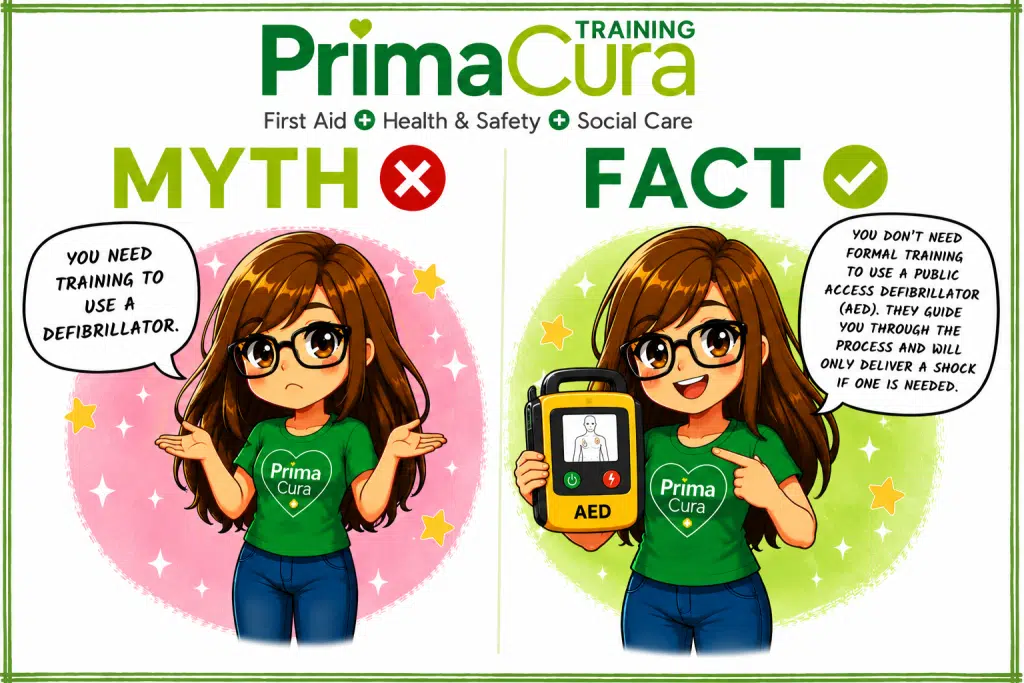
| MYTH | “You need training to use a defibrillator.” |
| FACT | A public access defibrillator talks you through every single step out loud. Open the case, switch it on, and a voice tells you exactly what to do next. Resuscitation Council UK is explicit that no training is required to use one, and untrained bystanders have used them to save lives. The only thing that shortens someone’s chances is standing at the cabinet deciding whether you’re allowed to. |
That answer unsettles people almost as much as the original fear did. It shouldn’t. A public access defibrillator is built for precisely this moment: somebody with no clinical background at all, standing over a person whose heart has stopped, working out what happens next. The machine carries that person through it, not the other way round.
Where does this myth come from?
Partly it’s the paperwork culture around first aid itself. CPR needs a course and a certificate, so people assume the box with the pads and wires must need one too, and a more serious one at that. Partly it’s television, again: paddles pressed to a bare chest while somebody shouts “clear”, a scene that looks like it belongs to a consultant, not a passer-by. And partly it’s simple unfamiliarity. Most people go their whole lives without ever opening one of these cabinets, so when the moment arrives, the closed lid looks like something only a trained person is allowed past.
None of that holds up. Resuscitation Council UK has said for years that AEDs are designed to be used by members of the public, and that operators with no formal training at all have used them successfully to save lives.
What actually happens when you open the case?
Open it, and the device switches itself on, or asks for a single press of a button. From that point, a voice does the talking. It tells you to bare the chest, where the two pads go, and then to stand clear while it reads the heart’s rhythm. The machine analyses that rhythm itself. If a shock is likely to help, it tells you to press the shock button, or in some models delivers the shock automatically. If a shock won’t help, it tells you to carry on with chest compressions instead, and it won’t let a shock go anywhere near the person.
Resuscitation Council UK’s guidance on defibrillators describes these devices as safe to use and suitable for members of the public with little or no training, which is precisely why a member of staff who has never seen one before can be handed one and still use it correctly.
Why build a life-saving machine that needs no training?
Because that’s the entire point. It’s called public access defibrillation: putting AEDs in shops, gyms, train stations and village halls specifically so the person nearest the emergency, who is very rarely a paramedic, can act before one arrives. Every minute that passes without CPR and defibrillation cuts someone’s chance of survival, and fewer than 1 in 10 people survive an out-of-hospital cardiac arrest in the UK. Waiting for somebody more qualified to turn up is often the single most expensive delay in the whole emergency, and it’s a delay this machine was specifically designed to remove.
Does training make any difference at all, then?
Yes, just not the difference the myth suggests. Training doesn’t unlock permission to use the machine. It buys you speed and confidence. The Health and Safety Executive’s own first aid guidance, which sits alongside the workplace regulations covered in week one, agrees that AEDs are safe to use and can be used by untrained bystanders, while also recommending that where a first aid needs assessment identifies a genuine need for a defibrillator, staff should be trained in its use. That guidance sits in the HSE Approved Code of Practice L74, updated in 2024 to include AED-specific advice.
That’s a recommendation about confidence, not a legal precondition to touch the device. A designated workplace first aider who has practised with a training AED will find the pads faster and pause less. Somebody who has never seen one before will still be talked through it successfully by the voice prompts. Both of them can save the same life. Training simply narrows the gap between collapse and shock. It doesn’t create the gap in the first place.
What if the defibrillator you need is locked away, or you can’t find one?
Call 999 first, always, before you go looking. The call handler can check whether a defibrillator near you is registered on The Circuit, the national network that maps devices for the ambulance service, and give you any access code the cabinet needs. Over 110,000 defibrillators are currently registered on The Circuit, run jointly by Resuscitation Council UK, the British Heart Foundation and the ambulance services.
If the nearest cabinet isn’t registered, or the code won’t work, don’t burn minutes hunting for a keyholder. Start CPR, keep the call handler on the line, and let compressions carry the person until the defibrillator, or the ambulance, gets to you.
Frequently asked questions
Can a defibrillator shock someone who doesn’t need it?
No. The device analyses the heart’s rhythm before it will allow a shock, and it will not deliver one if the rhythm doesn’t call for it. This is one of the features that makes it safe for an untrained bystander to use.
Do workplaces have to train staff to use a defibrillator?
There’s no blanket legal requirement to provide or train staff on a defibrillator. Where an employer’s first aid needs assessment identifies a genuine need for one, Health and Safety Executive guidance recommends training, but an untrained employee is still expected to use one rather than wait.
Training that answers this before the emergency does
Knowing you’re allowed to use the defibrillator is only half of it. Opening the cabinet, peeling the backing off the pads, and pressing them onto a chest for the first time feels different in your hands than it does on paper. That’s exactly why we build hands-on AED practice into every course rather than talking about it from the front of the room.
Our Basic Life Support and AED course is built around exactly that: real hands-on practice with a training defibrillator until the voice prompts feel familiar instead of intimidating. If your workplace needs a designated first aider from scratch, our Emergency First Aid at Work (EFAW) course is usually the right starting point, and higher-risk environments should look at the three-day First Aid at Work qualification instead.
If you missed the earlier posts in this series, Post 1 covers whether you can be sued for stepping in to help, and Post 2 explains what CPR actually does to the body.
THE VERDICT: BUSTED
Nobody needs a certificate to open that cabinet. The machine was built to carry an untrained bystander through the whole thing, prompt by prompt, and the only real risk is standing there deciding whether you’re allowed to start.
Next Monday: the myth that an AED could shock a healthy heart and kill someone.
This article is provided for general information and awareness only and reflects Resuscitation Council UK guidance and Health and Safety Executive guidance current as at July 2026. It does not constitute medical advice, and it is not a substitute for accredited, hands-on first aid training. Guidance can change, and how it applies depends on the specifics of an individual situation. In a medical emergency, always call 999.