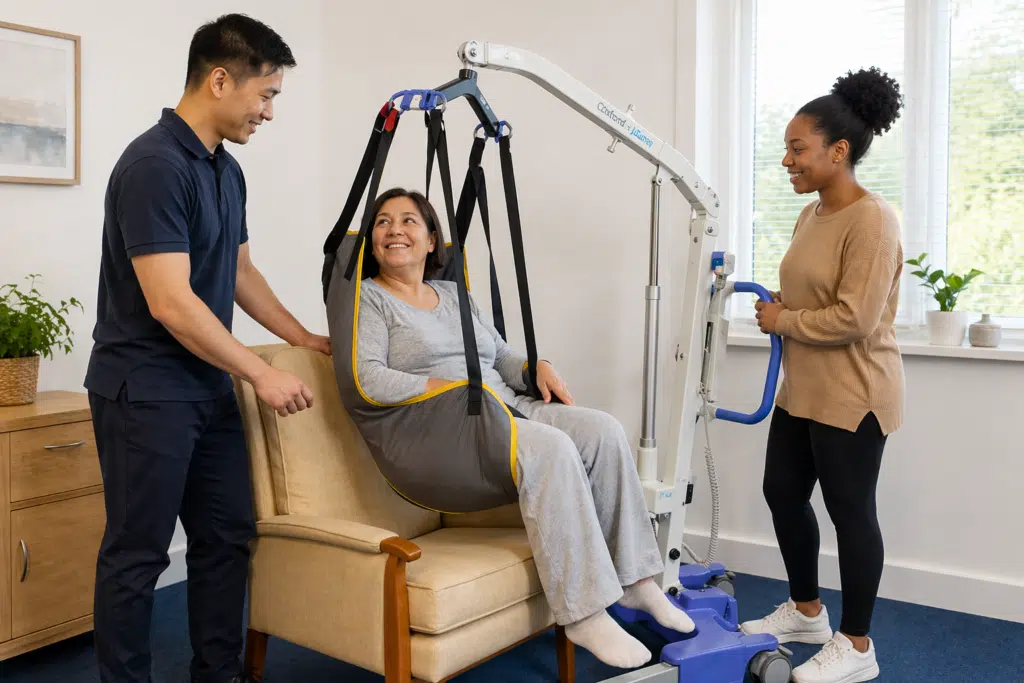
A New Patient Safety Alert on Hoists and Slings Just Landed: Here’s What Your Service Needs to Do
Written by Stephanie Austin, Owner & Lead Trainer, Prima Cura Training | Last updated: September 2026
A new National Patient Safety Alert landed on 16 September 2026, and if your service uses a hoist or a sling in any capacity, it applies to you. NatPSA/2026/005/MHRA gives every acute and community healthcare organisation, care home, nursing home, domiciliary care service and equipment provider until 16 September 2027 to close five specific safety gaps, and it doesn’t leave much room for interpretation.
Between 1 January 2015 and 31 December 2025, the MHRA received 22 reports of a fatal outcome during a patient transfer involving a hoist or sling. That’s an average of two deaths a year, and it isn’t confined to one manufacturer, one type of hoist, or one type of setting. These incidents happened in acute hospitals, care homes, and people’s own homes.
Why This Alert Has Been Issued Now
The alert isn’t describing a new problem. It says outright that the contributing factors it identifies are consistent with the themes raised in Medical Device Alert MDA/2014/054 and Patient Safety Alert NHS/PSA/W/2015/010, and that existing guidance “has not been reliably and systematically implemented.” In other words, the advice has been out there for over a decade. This alert is a harder line under it, with a national deadline and an expectation of documented evidence, not just awareness.
You can read the full alert, NatPSA/2026/005/MHRA, on GOV.UK. It’s addressed to everyone responsible for the use, purchase or maintenance of patient hoists, and implementation should sit with an executive leader or, in organisations without an executive board, an equivalent senior accountable person such as a registered manager.
What’s Actually Causing These Falls?
The alert names eight recurring causes behind fatal and serious patient falls from hoists and slings, drawn from incident reports and wider surveillance data since 2015.

Four of those eight causes are training and competency issues rather than equipment faults on their own: missed pre-use checks, incompatible hoist and sling combinations, the wrong size or type of sling, and insufficient staff training and competence assessment. Those are the areas your service has the most direct control over, and where I most often find the gap when I’m reviewing a client’s existing moving and handling provision.
The Five Actions You Need to Complete by 16 September 2027
The alert sets out five actions. None of them are new concepts if you already run a moving and handling programme properly, but the alert wants them documented, current, and consistently applied, not just understood in principle.

In plain English: Action 2 (compatibility) means you can’t assume any sling fits any hoist. If you’re using a sling from a different manufacturer to your hoist, someone qualified needs to have checked and documented that the combination is safe, and that check needs repeating whenever the equipment or the person’s condition changes.
In plain English: Action 3 (the equipment record) means a spreadsheet or register covering every hoist and sling you use, including anything provided into someone’s own home, with service dates, LOLER examination dates, and when each item is due for replacement. If that register doesn’t exist yet, it’s the most practical place to start.
How Often Does LOLER Require Hoists to Be Examined?
Under the Lifting Operations and Lifting Equipment Regulations 1998 (LOLER), hoists and slings need a thorough examination by a competent person at intervals not exceeding six months. This alert is explicit that a pre-use check carried out by a member of staff is not a substitute for that statutory examination. Any hoist or sling with an overdue examination or an unresolved defect must be taken out of service immediately and clearly marked as not to be used.
Who’s Responsible for Making This Happen?
The alert states that implementation should be coordinated by an executive leader, or an equivalent senior accountable person, such as a registered manager, in organisations without an executive board. In practice, for most of the care homes, domiciliary care providers and supported living services I work with, that responsibility lands with the registered manager. It’s worth naming that explicitly in your own service rather than assuming someone else already owns it.
Why Training Keeps Coming Up in This Alert
Action 5 asks for role-appropriate training with regular updates, and it isn’t a box-ticking requirement sitting apart from the rest of the alert. Insufficient staff training and competence assessment is named directly as one of the eight recurring causes behind these incidents. Under CQC Regulation 12: Safe Care and Treatment, inspectors already ask whether moving and handling training was delivered by someone qualified to deliver it, and whether it reflects current guidance. This alert gives that question a harder edge, and a training record that can’t answer it is a gap worth closing before an inspector finds it.
It’s also worth reading the CQC’s own learning from safety incidents page on falls from improper use of equipment, which sets out a real prosecution case involving equipment that staff weren’t trained to use safely.
Quick Answers
What is NatPSA/2026/005/MHRA?
NatPSA/2026/005/MHRA is a National Patient Safety Alert published by the MHRA on 16 September 2026, with stakeholder engagement from NHS England, the Devolved Administrations, the Care Quality Commission and Care England. It covers all types of patient hoists and slings and sets out five actions that acute and community healthcare organisations, care homes, nursing homes, domiciliary care services and equipment providers must complete by 16 September 2027.
Does this alert apply outside the NHS?
Yes. The alert names care homes, nursing homes, and care services supporting people in their own homes directly, alongside acute and community healthcare organisations and equipment providers. It is not limited to NHS-funded settings.
How often must hoists and slings be examined under LOLER?
At intervals not exceeding six months, carried out by a competent person, under the Lifting Operations and Lifting Equipment Regulations 1998. A pre-use check by staff does not replace this statutory examination.
What should I do if I find a damaged sling or a hoist fault?
Take the equipment out of service immediately, mark it clearly as not to be used, and report it through your organisation’s usual route. Serious incidents involving a medical device should also be reported to the MHRA’s Yellow Card Scheme.
Where can I find the full alert and supporting information?
The full alert is published on GOV.UK, along with a separate supporting information page covering incidents and case examples in more detail.
Summary
None of the five actions in this alert are complicated on their own. Pre-use checks, compatibility records, an equipment register, LOLER compliance, and trained staff are things most services already have some version of. What the alert is really asking for is proof that all five are happening consistently, and that’s usually where the gap sits.
If you want your team’s hoist and sling training checked against this alert, our Moving & Positioning (People) course covers pre-use checks, sling selection, hoist inspection, and the prohibited lifts CQC inspectors ask about, using your own equipment wherever possible. For teams whose role involves moving objects rather than people, our Manual Handling (Objects) course covers that separately. If you’re not sure which your team needs, get in touch and we’ll help you work it out before you commit.
Related reading: Moving and Positioning: Why CPD Matters.
This article reflects National Patient Safety Alert NatPSA/2026/005/MHRA as published on 16 September 2026, and is provided for general information only. It is not a substitute for reading the full alert or for your own organisation’s risk assessments, moving and handling care plans, and equipment-specific manufacturer instructions. Legislation and official guidance can change, so always check the current position before acting.